The Ultimate CBEST Math Formula Cheat Sheet
TL;DR: No formula sheet. No calculator. That’s the CBEST Math section in two sentences — and if you’re a prospective California teacher, it’s between you and your credential. This page lists every formula you should walk in already knowing cold, from area and perimeter to averages and percent change. Get these locked in beforehand and the test stops being a memory game and starts being what it should be: a chance to show you can think.
Key takeaways:
- CBEST Math has 50 multiple-choice questions.
- All three CBEST sections share a 4-hour time limit.
- No calculator allowed; no formula sheet provided.
- Passing scaled score is 41 per section, with a minimum total of 123 across all three sections.
- Math content is roughly grade 8 level: arithmetic, basic algebra, basic geometry, and data interpretation.
Decimals
Is a fraction written in a special form? For example, instead of writing \(\frac{1}{2}\) you can write \(0.5\).
Mixed Numbers
A number is composed of a whole number and a fraction. Example: \(2 \frac{2}{ 3}\) Converting between improper fractions and mixed numbers: \(a \frac{c}{b}=a+\frac{c}{b}= \frac{ab+ c}{b}\)
Factoring Numbers
Factor a number means breaking it up into numbers that can be multiplied together to get the original number. Example:\(12=2×2×3\)
Integers
\( \{…,-3,-2,-1,0,1,2,3,…\} \)
Includes: zero, counting numbers, and the negative of the counting numbers
Real Numbers
All numbers that are on a number line. Integers plus fractions, decimals, and irrationals, etc.) (\(\sqrt{2},\sqrt{3},π\), etc.)
Order of Operations
PEMDAS
(parentheses/ exponents/ multiply/ divide/ add/ subtract)
Absolute Value
Refers to the distance of a number from, the distances are positive as the absolute value of a number cannot be negative. \(|-22|=22\)
or \(|x| =\begin{cases}x \ for \ x≥0 \\x \ for \ x < 0\end{cases} \)
\(|x|<n⇒-n<x<n\)
\(|x|>n⇒x<-n or x>n\)
Ratios
A ratio is a comparison of two numbers by division.
Example: \(3: 5\), or \(\frac{3}{5}\)
Percentages
Use the following formula to find part, whole, or percent
part \(=\frac{percent}{100}×whole\)
Proportional Ratios
A proportion means that two ratios are equal. It can be written in two ways:
\(\frac{a}{b}=\frac{c}{d}\), \(a: b = c: d \)
Percent of Change
\(\frac{New \ Value \ – \ Old \ Value}{Old Value}×100\%\)
Expressions and Variables
A variable is a letter that represents unspecified numbers. One may use a variable in the same manner as all other numbers: Addition: \(2+a\): \(2\) plus a
Subtraction: \(y-3\) : \(y\) minus \(3\)
Division: \(\frac{4}{x}\) : 4 divided by x
Multiplication: \(5a\) : \(5\) times a
Distributive Property
\(a(b+c)=ab+ac\)
Equations
The values of the two mathematical expressions are equal.
\(ax+b=c\)
Distance from A to B:
\(\sqrt{(x_{1}-x_{2})^2+(y_{1}-y_{2})^2 }\)
Parallel and Perpendicular lines:
Have equal slopes. Perpendicular lines (i.e., those that make a \(90^° \) angle where they intersect) have negative reciprocal slopes: \(m_{1}\).\(m_{2}=-1\).
Parallel Lines (l \(\parallel\) m)
Mid-point of the segment AB:
M (\(\frac{x_{1}+x_{2}}{2}, \frac{y_{1}+y_{2}}{2}\))
Slope of the line:
\(\frac{y_{2}- y_{1}}{x_{2} – x_{1} }=\frac{rise}{run}\)
Point-slope form:
Given the slope m and a point \((x_{1},y_{1})\) on the line, the equation of the line is
\((y-y_{1})=m \ (x-x_{1})\).
Slope-intercept form:
given the slope m and the y-intercept b, then the equation of the line is:
\(y=mx+b\).
Factoring:
“FOIL”
\((x+a)(x+b)\)
\(=x^2+(b+a)x +ab\) “Difference of Squares”
\(a^2-b^2= (a+b)(a-b)\)
\(a^2+2ab+b^2=(a+b)(a+b) \)
\(a^2-2ab+b^2=(a-b)(a-b)\) “Reverse FOIL”
\(x^2+(b+a)x+ab=\) \((x+a)(x+b)\)
You can use Reverse FOIL to factor a polynomial by thinking about two numbers a and b which add to the number in front of the x, and which multiply to give the constant. For example, to factor \(x^2+5x+6\), the numbers add to 5 and multiply to 6, i.e.: \(a=2\) and \(b=3\), so that \(x^2+5x+6=(x+2)(x+3)\). To solve a quadratic such as \(x^2+bx+c=0\), first factor the left side to get \((x+a)(x+b)=0\), then set each part in parentheses equal to zero. For example, \(x^2+4x+3= (x+3)(x+1)=0\) so that \(x=-3\) or \(x=-1\).
To solve two linear equations in x and y: use the first equation to substitute for a variable in the second. E.g., suppose \(x+y=3\) and \(4x-y=2\). The first equation gives y=3-x, so the second equation becomes \(4x-(3-x)=2 ⇒ 5x-3=2\) \(⇒ x=1,y=2\).
Exponents:
Refers to the number of times a number is multiplied by itself.
\(8 = 2 × 2 × 2 = 2^3\)
Scientific Notation:
It is a way of expressing numbers that are too big or too small to be conveniently written in decimal form.
In scientific notation all numbers are written in this form: \(m \times 10^n\)
Decimal notation:
5
\(-25,000\)
0.5
2,122.456
Scientific notation:
\(5×10^0\)
\(-2.5×10^4\)
\(5×10^{-1}\)
\(2,122456×10^3\)
Square:
The number we get after multiplying an integer (not a fraction) by itself. Example: \(2×2=4,2^2=4\)
Square Roots:
A square root of \(x\) is a number r whose square is \(x: r^2=x\)
\(r\) is a square root of \(x\)
Pythagorean Theorem:
For any right triangle with legs \(a\) and \(b\) and hypotenuse \(c\): \(a^2+b^2=c^2\)
Solving for the hypotenuse: \(c=\sqrt{a^2+b^2}\)
Solving for a leg: \(a=\sqrt{c^2-b^2}\)
Common Pythagorean triples: \(3,4,5\); \(5,12,13\); \(8,15,17\); \(7,24,25\)
Triangles
Area: \(A=\frac{1}{2}bh\) where \(b\) is the base and \(h\) is the height.
Perimeter: \(P=a+b+c\) (sum of all three sides).
Pythagorean Theorem (right triangles): \(a^2+b^2=c^2\) where \(c\) is the hypotenuse.
Sum of interior angles: \(180°\)
All triangles:
Area \(=\frac{1}{2}\) b. h
Angles on the inside of any triangle add up to \(180^\circ\).
The length of one side of any triangle is always less than the sum and more than the difference between the lengths of the other two sides.
An exterior angle of any triangle is equal to the sum of the two remote interior angles. Other important triangles:
Equilateral:
These triangles have three equal sides, and all three angles are \(60^\circ\).
Isosceles:
An isosceles triangle has two equal sides. The “base” angles (the ones opposite the two sides) are equal (see the \(45^\circ\) triangle above).
Circles

Area \(=πr^2\)
Circumference \(=2πr\)
Full circle \(=360^\circ\)
Rectangles
(Square if l=w)
Area=lw
Parallelogram
(Rhombus if l=w)
Area=lh
Regular polygons are n-sided figures with all sides equal and all angles equal.
The sum of the inside angles of an n-sided regular polygon is
\((n-2).180^\circ\).
Area of a trapezoid:
\(A =\frac{1}{2} h (b_{1}+b_{2})\)
Surface Area and Volume of a Rectangular/right prism:
\(SA=ph+2B\)
\(V=Bh\)
Surface Area and Volume of a Cylinder:
\(SA =2πrh+2πr^2\)
\(V =πr^2 h \)
Surface Area and Volume of a Cone
\(SA =πrs+πr^2\)
\(V=\frac{1}{3} \ πr^2 \ h\)
Surface Area and Volume of a Sphere
\(SA =4πr^2\)
\(V =\frac{4}{3} \ πr^3\)
(p \(=\) perimeter of base B; \(π ~ 3.14 \))

Simple interest:
\(I=prt\)
(I = interest, p = principal, r = rate, t = time)
mean:
mean: \(\frac{sum \ of \ the \ data}{of \ data \ entires}\)
mode:
value in the list that appears most often
range:
largest value \(-\) smallest value
Median
The middle value in the list (which must be sorted)
Example: median of
\( \{3,10,9,27,50\} = 10\)
Example: median of
\( \{3,9,10,27\}=\frac{(9+10)}{2}=9.5 \)
Average
\( \frac{sum \ of \ terms}{number \ of \ terms}\)
Average speed
\(\frac{total \ distance}{total \ time}\)
Probability
\(\frac{number \ of \ desired \ outcomes}{number \ of \ total \ outcomes}\)
The probability of two different events A and B both happening is:
P(A and B)=p(A).p(B)
as long as the events are independent (not mutually exclusive).
Powers, Exponents, Roots
\(x^a.x^b=x^{a+b}\)
\(\frac{x^a}{x^b} = x^{a-b}\)
\(\frac{1}{x^b }= x^{-b}\)
\((x^a)^b=x^{a.b}\)
\((xy)^a= x^a.y^a\)
\(x^0=1\)
\(\sqrt{xy}=\sqrt{x}.\sqrt{y}\)
\((-1)^n=-1\), if n is odd.
\((-1)^n=+1\), if n is even.
If \(0<x<1\), then
\(0<x^3<x^2<x<\sqrt{x}<\sqrt{3x}<1\).
Simple Interest
The charge for borrowing money or the return for lending it.
Interest = principal \(×\) rate \(×\) time
OR
\(I=prt\)
Powers/ Exponents
\(x^a×x^b=x^{a+b}\)
\(\frac{x^a}{x^b}=x^{a-b}\)
\((x^a)^b=x^{ab}\)
\(x^0=1\)
\(x^{-a}=\frac{1}{x^a}\)
\(x^{\frac{1}{n}}=\sqrt[n]{x}\)
Positive Exponents
An exponent is simply shorthand for multiplying that number of identical factors. So \(4^3\) is the same as (4)(4)(4), three identical factors of 4. And \(x^3\) is just three factors of \(x\), \((x)(x)(x)\).
Negative Exponents
A negative exponent means to divide by that number of factors instead of multiplying.
So \(4^{-3}\) is the same as \( \frac{1}{4^3}\) and
\(x^{-3}=\frac{1}{x^3}\)
Factorials
Factorial- the product of a number and all counting numbers below it.
8 factorial \(=8!=\)
\(8×7×6×5×4×3×2×1=40,320\)
5 factorial \(=5!=\)
\(5×4×3×2×1=120\)
2 factorial \(=2!=2× 1=2\)
Multiplying Two Powers of the SAME Base
When the bases are the same, you find the new power by just adding the exponents
\(x^a.x^b=x^{a+b }\)
Powers of Powers
For the power of power: you multiply the exponents.
\((x^a)^b=x^{(ab)}\)
Dividing Powers
\(\frac{x^a}{x^b} =x^a x^{-b}= x^{a-b}\)
The Zero Exponent
Anything to the 0 power is 1.
\(x^0= 1\)
More from Effortless Math for CBEST Test …
Do you wonder why I should take the CBEST test?
The article What Does the CBEST Test Qualify You For? gives you the answer you need.
Are you disappointed with the success of your CBEST test?
We provide you with the strategies you need to succeed: How to Pass the CBEST Test: A Step-By-Step Guide
Do you want the CBEST math content to stay in your mind perfectly?
So you need to practice! The FREE CBEST Math Practice Test is a great resource for practice.
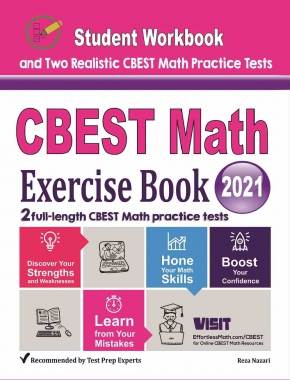
The Perfect Prep Books for the CBEST Math Test
Have any questions about the CBEST Test?
Write your questions about the CBEST or any other topics below and we’ll reply!
Recommended EffortlessMath Books
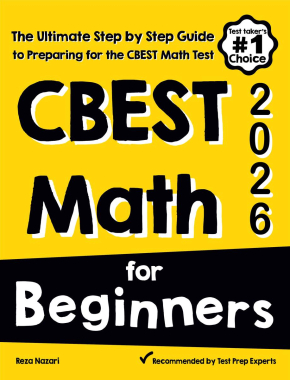
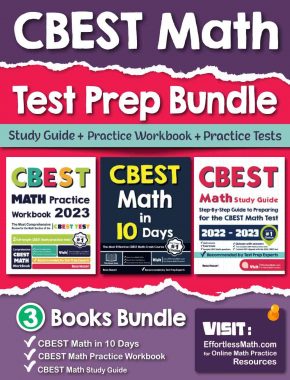
For a structured workbook covering every CBEST math topic, see the CBEST Math for Beginners. For full credential-exam prep with timed practice, the CBEST Math Test Prep Bundle bundles the workbook with practice tests.
Frequently Asked Questions
How many math questions are on the CBEST?
50 multiple-choice questions on the math section. The reading and writing sections add another 50 questions and 2 essays respectively. You have 4 hours total to complete all three sections in whichever order you prefer.
Can I use a calculator on the CBEST?
No. No calculators are permitted on any portion of the CBEST. Practice mental math, especially with fractions, decimals, and percentages, well before test day.
Is there a formula sheet on the CBEST?
No. The CBEST does not provide a formula reference. You’ll need to know area, perimeter, volume, the Pythagorean theorem, simple algebra, and basic stats formulas (mean, median, mode, range) from memory.
What’s a passing CBEST math score?
41 scaled score per section. You can pass overall with a section score as low as 37 if your total across all three sections is at least 123 and no section is below 37. Most candidates aim for 41+ in each section to play it safe.
What math topics are on the CBEST?
Three content areas: Estimation, Measurement, and Statistical Principles (about 30%); Computation and Problem Solving (about 35%); and Numerical and Graphic Relationships (about 35%). Topics include arithmetic with fractions and decimals, percent and ratio, basic algebra, simple geometry, mean/median/mode, and reading charts and tables.
How long does the math section take?
There’s no specific math-only time limit — you have 4 hours for the entire test and can split your time across reading, writing, and math however you choose. Most test-takers spend 60 to 90 minutes on math.
Can I retake the CBEST math section alone?
Yes. Once you pass a section, you don’t need to retake it. If you only need to pass math, you can sit for just that section. There’s no waiting period between attempts on computer-based CBEST.
How hard is the CBEST math test?
Content-wise, the CBEST math is around eighth-grade level — basic arithmetic, simple algebra, easy geometry, and reading graphs. The challenge for many candidates is doing it without a calculator and applying topics most adults haven’t touched in 10+ years.
How long should I study for the CBEST math?
Most candidates need 3 to 6 weeks of study at 30 to 45 minutes a day if math is rusty. If you’re already comfortable with arithmetic and basic algebra, 1 to 2 weeks of practice tests and targeted review is usually enough.
Is the CBEST math harder than the GRE or SAT?
Much easier in content. The CBEST stays at grade 8 level; the GRE and SAT push into Algebra II and beyond. The CBEST’s twist is the no-calculator rule and a long 4-hour sitting that requires stamina across reading, writing, and math.
Related EffortlessMath Lessons
If a topic on this page feels rusty, these short lessons go deeper:

Related to This Article
More math articles
- The Best Grade 7 ELA Practice Tests for Alaska Students
- FREE TABE Math Practice Test
- What Produces Social Change?
- 5th Grade ISASP Math Worksheets: FREE & Printable
- Multiple-Meaning Words
- Top 5 Best Math YouTube Channels for High School Students
- Chapter 36: Public Opinion
- Cooley’s Looking-Glass Self
- Citizenship, Immigration, Family, and Rights in the Early Twenty-First Century
- Information subsidies and venue shopping






What people say about "The Ultimate CBEST Math Formula Cheat Sheet - Effortless Math"?
No one replied yet.