Liberal, Conservative and Moderate Ideologies: Key Differences
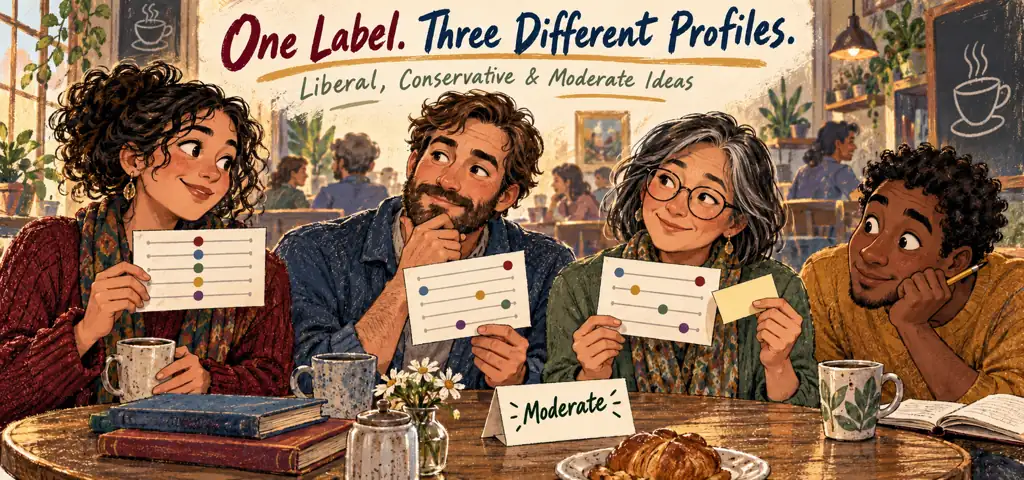
Liberal, conservative and moderate ideologies describe broad political orientations, not complete sets of opinions. For AP U.S. Government and Politics, distinguish a person’s chosen label, party attachment and positions on specific issues. Similar labels can conceal different priorities and degrees of commitment.
Broad Liberal and Conservative Tendencies
In contemporary American politics, liberalism generally places greater emphasis on public action to advance economic security and equality, while conservatism generally places greater emphasis on markets, limited government, and traditional order. These are broad tendencies within changing coalitions, not answers fixed for every issue and era.
Three Different Meanings of Moderate
A moderate label can describe at least three different patterns: consistently centrist positions, a combination of strong views associated with different sides, or an identity chosen to signal distance from ideological labels. The underlying issue distribution tells us which pattern is present.
Build a Profile from Labels, Positions and Intensity
A useful profile records self-identification, party attachment, positions across several domains, and the strength of each view. It does not assume that a centrist answer is weak, that a mixed profile is confused, or that every partisan shares the coalition’s full ideological program.
Compare Three Voters Who Choose the Same Label
In a hypothetical example, picture three voters who all select “moderate” on a survey. Jonah chooses the middle response on nearly every policy. Priya strongly favors public health insurance and strongly opposes restrictions on gun ownership. Luis holds mostly conservative positions but dislikes ideological labels. The shared label places them in the same self-identification category, but their issue positions differ. Luis’s mostly conservative positions do not become centrist simply because he chooses the word moderate.
Use Issue Evidence Alongside the Label
OpenStax’s explanation of ideology notes that a person can hold liberal positions on some issues and conservative positions on others. Economic views, social views and views about government power need not line up identically. A single midpoint on a diagram cannot show every combination or how strongly each position is held.
Pew Research Center’s 2026 political typology illustrates a different way to examine that complexity. Published in June 2026, it uses responses to 30 values-and-attitudes questions from a November 2025 survey to form nine statistical groups. It goes beyond party attachment or vote choice. Those groups are the study’s analytical classification, not nine permanent categories into which every future voter must fit.
For the three hypothetical voters, keep separate columns for self-label, issue positions and strength of opinion. Jonah’s repeated middle positions, Priya’s combination of strong positions and Luis’s preferred label are different kinds of evidence. Do not infer that all moderates are undecided, that a mixed profile is inconsistent or that a party label reveals every belief. Read the actual question wording and responses before drawing a conclusion.
Identify What Each Profile Actually Shows
Classify the evidence in the Jonah, Priya and Luis examples: who has consistently centrist issue positions, who combines strong positions associated with different sides, and who chooses a label that differs from most of his stated positions? Does their common label establish equal intensity or identical views?
Check your reasoning
Jonah supplies the consistently centrist profile; Priya supplies the mixed profile; Luis supplies the contrast between self-label and mostly conservative positions. Their common moderate label does not establish identical views or equal intensity. A stronger analysis records the positions and the strength of each view alongside the identity the person chooses.
Video Lesson: Political Ideology
CrashCourse gives a focused explanation of this topic in Political Ideology: Crash Course Government and Politics #35.
If the player does not load, watch this lesson directly on YouTube.
To apply these distinctions to policy arguments, compare ideological priorities in social-policy design.
Continue Studying Ideology and Policy Choices

Related to This Article
More math articles
- What Is the Best GED Math Study Guide?
- FREE 6th Grade Georgia Milestones Assessment System Math Practice Test
- The Best Grade 5 ELA Practice Tests for Georgia Students
- Average Value of a Curve
- How to Find Discriminant of Quadratic Equation?
- 5th Grade Georgia Milestones Assessment System Math Worksheets: FREE & Printable
- The Best Grade 4 ELA Practice Tests for Minnesota Students
- Cyclins and CDKs: How They Control the Cell Cycle
- Ideological conflict
- FREE 5th Grade Georgia Milestones Assessment System Math Practice Test



What people say about "Liberal, Conservative and Moderate Ideologies: Key Differences"?
No one replied yet.