4th Grade Math Worksheets for Illinois (IAR): 43 Free Printable PDFs

TL;DR: Free printable Grade 4 math worksheets for Illinois – answers included – covering multi-digit multiplication, long division, fractions, decimals, measurement, and geometry aligned with the Illinois Learning Standards tested by the IAR (Illinois Assessment of Readiness).
Key takeaways:
- Illinois IAR (Illinois Assessment of Readiness) replaced PARCC for grades 3-8.
- Worksheets cover every grade-4 strand: operations, base ten, fractions, measurement, geometry.
- All pages are free PDFs with full answer keys included.
- Aligned with the Illinois Learning Standards for Mathematics (Illinois’s adoption of Common Core).
- Short, daily practice (15-20 minutes) builds the fluency IAR expects.
Fourth grade is the year math stops being a list of separate facts and starts being a system. A student who once practiced times tables now multiplies three-digit numbers; a student who once divided into neat answers now divides and has to make sense of a remainder. Fractions become quantities to compare and add, not just shaded shapes. Decimals arrive. Angles get measured. The work is bigger, and, more importantly, the pieces start connecting.
That connectedness is what makes the year foundational. Understanding multiplicative comparison is what makes multi-step word problems solvable. Knowing factors and multiples is what makes the later fraction work click. A fourth grader in Chicago or Rockford who builds place value carefully in the fall is quietly preparing for the decimals that show up in spring. Skip a step and the gap does not stay small for long, which is exactly why a steady practice habit matters in this grade.
These 43 worksheets are made for building that habit. From Aurora to Naperville, each one takes a single skill and gives a child the space to actually practice it.
What’s on this page
This page holds 43 single-skill PDFs, each aligned to the Illinois Mathematics Standards at Grade 4. Each file does one job only. A worksheet on factors and multiples covers factors and multiples; a worksheet on adding fractions with like denominators will not wander into geometry. That focus is the point. It turns each PDF into a clear, honest signal of what a child has mastered and what still needs work.
Every file follows the same shape, so a student is never thrown off by the format. Each PDF opens with a one-page Quick Review: the skill explained plainly, with one example worked all the way through. Then come 20 practice problems, ordered to climb gently from easy to hard. Four word problems follow, putting the skill into a context a fourth grader can picture. The last page is a student-facing answer key, short, friendly explanations a student can read on their own and learn from.
Place Value & Multi-Digit Numbers
- Understanding Place Value Relationships, [4.NBT.A.1] each place is ten times the one to its right
- Reading and Writing Multi-Digit Numbers, [4.NBT.A.2] standard form, word form, and expanded form
- Comparing and Ordering Multi-Digit Numbers, [4.NBT.A.2] use place value and the symbols >, <, and =
- Rounding Multi-Digit Numbers, [4.NBT.A.3] round to any place from tens to hundred-thousands
Multi-Digit Arithmetic
- Adding Multi-Digit Whole Numbers, [4.NBT.B.4] the standard addition algorithm, with regrouping
- Subtracting Multi-Digit Whole Numbers, [4.NBT.B.4] the standard subtraction algorithm, including across zeros
- Multiplying by a One-Digit Number, [4.NBT.B.5] multiply up to four digits by a single digit
- Multiplying Two Two-Digit Numbers, [4.NBT.B.5] the area model and the standard algorithm side by side
- Dividing with Remainders, [4.NBT.B.6] divide and name the leftover as a remainder
- Finding Factors and Multiples, [4.OA.B.4] list every factor of a number and its first multiples
- Prime and Composite Numbers, [4.OA.B.4] exactly two factors means prime; more means composite
Operations & Problem Solving
- Multiplicative Comparisons, [4.OA.A.1] read ‘4 times as many’ as a multiplication statement
- Multiplicative Comparison Word Problems, [4.OA.A.2] solve ‘times as many’ stories with multiplication or division
- Multi-Step Word Problems, [4.OA.A.3] two or more operations in one real-world problem
- Interpreting Remainders, [4.OA.A.3] decide what the leftover means, round up, drop it, or use it
- Number and Shape Patterns, [4.OA.C.5] follow a rule and find the next terms in a pattern
Fractions
- Equivalent Fractions, [4.NF.A.1] the same amount written with different numbers
- Comparing Fractions, [4.NF.A.2] compare fractions with unlike denominators using benchmarks
- Adding Fractions with Like Denominators, [4.NF.B.3a] add the numerators, keep the denominator
- Subtracting Fractions with Like Denominators, [4.NF.B.3a] subtract the numerators, keep the denominator
- Decomposing Fractions, [4.NF.B.3b] break a fraction into a sum of unit fractions
- Adding and Subtracting Mixed Numbers, [4.NF.B.3c] work with the whole and fraction parts, including regrouping
- Multiplying a Fraction by a Whole Number, [4.NF.B.4b] repeated addition of a fraction, written as multiplication
- Fraction Word Problems, [4.NF.B.3d] real-world stories that call for adding or subtracting fractions
Decimals
- Fractions with Denominators 10 and 100, [4.NF.C.5] rename tenths as hundredths and add the two
- Decimal Notation for Fractions, [4.NF.C.6] write tenths and hundredths as decimals, and back
- Comparing Decimals to Hundredths, [4.NF.C.7] line up the place values and compare with >, <, =
- Adding Decimal Fractions, [4.NF.C.5] add decimals to the hundredths place
Measurement & Data
- Converting Measurement Units, [4.MD.A.1] change from a larger unit to a smaller one
- Measurement Word Problems, [4.MD.A.2] length, weight, volume, and time in real situations
- Area of Rectangles, [4.MD.A.3] length times width, the space inside a rectangle
- Perimeter of Rectangles, [4.MD.A.3] the distance all the way around a rectangle
- Area and Perimeter Word Problems, [4.MD.A.3] decide whether a problem needs area or perimeter
- Line Plots with Fractions, [4.MD.B.4] read and use a line plot of fraction measurements
Angles
- Angles as Fractions of a Circle, [4.MD.C.5] a full turn is 360 degrees, find a fraction of it
- Measuring Angles with a Protractor, [4.MD.C.6] name angles acute, right, or obtuse by their measure
- Drawing Angles with Given Measures, [4.MD.C.6] know what a given degree measure should look like
- Adding and Subtracting Angles, [4.MD.C.7] an angle split into parts, find the missing part
Geometry
- Points, Lines, Rays, and Angles, [4.G.A.1] the building blocks of geometry and how to tell them apart
- Parallel and Perpendicular Lines, [4.G.A.1] lines that never meet, and lines that cross at a square corner
- Classifying Triangles, [4.G.A.2] sort triangles by their angles and their sides
- Classifying Quadrilaterals, [4.G.A.2] name four-sided shapes by their sides and angles
- Lines of Symmetry, [4.G.A.3] find the lines that fold a shape onto itself
How to use these worksheets at home
Short sessions beat long ones. A fourth grader brings a finite amount of focus to the table, and fifteen unhurried minutes spends it well. Make one PDF one sitting, begin it, finish it, and stop. The feeling of having completed something is a real part of why a child agrees to do it again tomorrow.
Group skills into pairs. Two related worksheets done close together let the second one rest on the first. “Adding Multi-Digit Whole Numbers” followed by “Subtracting Multi-Digit Whole Numbers” is a clean pairing. “Equivalent Fractions” right before “Comparing Fractions” works beautifully, since finding a common form is most of comparing. “Area of Rectangles” next to “Perimeter of Rectangles” helps sort out the two ideas kids most often confuse.
Illinois families have packed evenings, and the school year stretches long, practice has to fit into ordinary nights. Print one PDF the night before so it is ready when there is a window. Keep the answer key aside until the work is finished, then let your child check their own page. That last quiet step, reading why a right answer is right, is where the worksheet does its real teaching.
It is also worth saving the four word problems at the end of each PDF for a moment when your child is fresh rather than worn down. Word problems ask for an extra layer of thinking, first understanding the situation, then choosing the math, and a tired fourth grader will often guess instead of reason. Read the problem together, ask what it is really asking, and let your child explain their plan before they solve. That habit of pausing to think is one of the most useful things this whole year can teach.
A note about IAR at Grade 4
Illinois students take the Illinois Assessment of Readiness, Mathematics, known as the IAR, in the spring. It is built on the Illinois Mathematics Standards, which are Common Core-aligned. Because these worksheets are drawn from the same standards, the skills your child practices here are the skills the IAR is measuring.
At Grade 4, the IAR asks students to do more than recall procedures. It asks them to multiply and divide multi-digit numbers, reason carefully about fractions and decimals, solve multi-step word problems, and explain their thinking about measurement and geometry. Since each PDF here targets a single Illinois standard, you can treat the spring window as a checklist, work through the skills, note which come easily, and aim your practice time only where your child still needs it.
A short closing
Fourth-grade math is a real climb, but it is a steady one, a child gets up it one skill, one short session at a time. Bookmark this page, print a single PDF tonight, and let your student start somewhere small. Illinois kids do hard things well when the next step is clear, and a worksheet waiting on the table is about as clear as a next step gets.
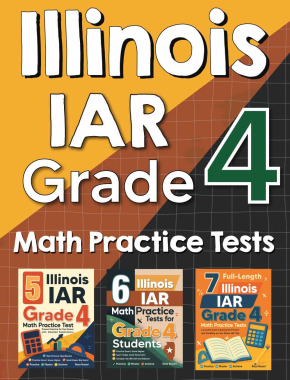
Best Bundle to Ace the Illinois IAR Grade 4 Math Test
Want the fastest path through Illinois IAR Grade 4 math? This bundle pulls it together, four full practice-test books with complete, step-by-step answer keys, instant PDF download.
Recommended EffortlessMath Books
For a workbook that pairs neatly with these printable practice pages, Mastering Grade 4 Math walks your child through every fourth-grade topic with clear examples and lots of try-it-yourself problems. For extra word-problem practice (the part many fourth graders find hardest), see Mastering Grade 4 Math Word Problems.
Frequently Asked Questions
Where can I find free 4th grade math worksheets for Illinois?
The 43 worksheets here are free printable PDFs for Illinois fourth graders, each built around one skill from the Illinois Learning Standards, with an answer key included. Pick the topic your child finds hardest, such as long division or equivalent fractions, and do one page in a 15 to 20 minute session a few days a week.
Are there IAR practice tests for 4th grade?
Yes. Illinois offers free online practice tests for its state assessment, so students can try the question types and on-screen tools before spring testing. Ask your child’s teacher or check the Illinois State Board of Education assessment page for the current grade 4 practice test. Then use the single-skill worksheets here to work on any topic the practice test shows is weak.
What is on the 4th grade math test in Illinois?
The grade 4 test follows the Illinois Learning Standards, which match the Common Core. It covers operations and algebraic thinking, place value and multi-digit arithmetic, fractions and decimals, and measurement, data and geometry. Many questions are word problems that ask students to explain or show their reasoning, so practice talking through each step out loud.
What kind of questions are on a 4th grade math test?
Expect multi-digit multiplication and division, fraction comparisons and sums, decimal notation, angle measures and multi-step word problems. Two quick examples: 1,236 ÷ 4 = 309, which you can check because 4 × 309 = 1,236, and 3/8 + 2/8 = 5/8. Many questions also ask whether an answer is reasonable, so estimation is worth practicing.
What math do 4th graders learn?
Fourth graders learn multiplicative comparison, such as seeing 21 as 3 times as many as 7, multiply up to four digits by one digit and two digits by two digits, and divide with remainders. They also find equivalent fractions, add and subtract like fractions, write decimals to hundredths, and measure angles. Factors and multiples set up the fraction work.
Related EffortlessMath Lessons
If a topic on this page feels rusty, these short lessons go deeper:
- How to multiply multi-digit numbers
- How to divide multi-digit numbers
- How to add and subtract fractions with like denominators
- How to find equivalent fractions
- How to solve multi-step word problems

Related to This Article
More math articles
- Hoover, the RFC, and the Bonus Army
- Factoring Trinomials Worksheet with Answers
- Massachusetts MCAS Grade 6 Math Free Worksheets: Printable PDF Practice with Student-Friendly Keys
- Multiple-Meaning Words
- How to Solve One-Step Inequalities? (+FREE Worksheet!)
- Top 10 7th Grade MEAP Math Practice Questions
- Math learning support for visual learners through browser tools
- Top 10 7th Grade STAAR Math Practice Questions
- 6th Grade PSSA Math Worksheets: FREE & Printable
- Can You Train Your Brain to Think Like a Mathematician?










What people say about "4th Grade Math Worksheets: Illinois IAR (43 Free PDFs)"?
No one replied yet.