The Best Algebra 1 Book for California Students
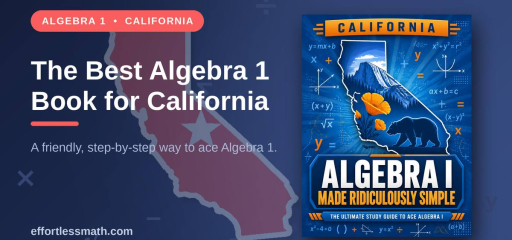
TL;DR: California built its math standards on the Common Core, and Algebra 1 sits at the hinge of the whole high-school sequence. A clear, patient book matters more than test prep – here’s the one we recommend.
Key takeaways:
- California Algebra 1 follows the Common Core State Standards.
- Most students take it in 8th or 9th grade.
- Algebra 1 underlies Geometry, Algebra 2, the SAT, the 11th-grade CAASPP, and college placement tests.
- Struggling students almost always need slower explanation, not more talent.
- Algebra I for Beginners is the book we recommend for California students.
Algebra 1 has a way of splitting a school year into “before” and “after.” Before, math was mostly numbers. After, there are letters, and rules, and a quiet feeling that everyone else got a memo you missed. If your child is heading into Algebra 1 here in California, or already sitting in it and starting to dread the homework, you have probably watched that shift happen at your own kitchen table.
So let’s start with the most important thing, said plainly: struggling in Algebra 1 almost never means a student “isn’t a math person.” Far more often it means the explanations came too fast, or the textbook quietly assumed a teacher would fill in the gaps. Slow the explanations down and most of the struggle simply melts away. That, in the end, is what picking the right book is really about.
Why this one course carries so much weight
California built its math standards on the Common Core, and Algebra 1 sits right at the hinge of the whole high school sequence. Most students take it in eighth or ninth grade, and nearly everything that follows leans on it: Geometry, Algebra 2, the math on the SAT, the eleventh-grade CAASPP test, and college placement exams years down the road.
That is a lot of weight on one course. It is also why a shaky Algebra 1 year tends to echo. A student who never quite got comfortable solving equations does not just lose a few points in Algebra 1. They carry that gap into every class stacked on top of it. Getting this year right the first time is one of the kindest things a California student can do for their future self.
The book we would actually hand a California student
If a family asked us for one book to carry a California student through Algebra 1 with their confidence intact, it would be California Algebra I Made Ridiculously Simple.
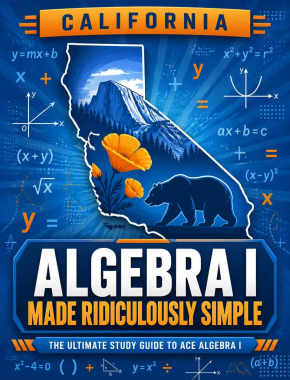
The title is a promise, and the book keeps it. Every topic is introduced in plain English first, with no jargon dropped on you out of nowhere. Then it is shown step by step with a worked example. Then it is handed to you to try, with answer keys so you can check yourself right away instead of practicing a mistake ten times. It was written for a student sitting alone at a desk, not for a teacher standing at a whiteboard. That one design choice is what makes it work so well for homeschoolers, for kids catching up over the summer, and for students whose class is simply moving faster than they are.
It follows the path California classrooms actually use
The chapters move in the same Common Core order your child’s teacher follows: expressions and the rules for handling them, then equations and inequalities, then linear functions and graphing, then systems, exponents, polynomials, factoring, and finally quadratics. Nothing arrives before the skills it depends on. So by the time a student reaches the topics with scary reputations, like factoring and quadratics, they are not facing five new ideas at once. They are facing one new idea resting on four they already own. That feeling of “oh, I recognize most of this” is exactly what confident math students have and struggling ones do not, and this book builds it on purpose.
How to actually get through it
A book only helps when there is a simple plan wrapped around it. Here is one that works for most students:
- Short and often beats long and rare. Three or four 30-minute sessions in a week will out-teach one exhausting weekend cram every single time.
- Do every practice problem with a pencil in hand. Reading math and doing math are two different activities, and only one of them sticks.
- Check answers as you go, not at the very end. Catching a small slip early keeps it from hardening into a habit.
- Do not move past a section until it feels genuinely easy. In algebra, a weak spot never stays quiet. It comes back bigger.
At that pace, most students work through the book comfortably in a semester. If you would like to see how this same step-by-step approach plays out across the whole subject, our guide to the best Algebra 1 book for self-study is a good companion read.
Questions California families ask
When do students take Algebra 1 in California?
Most California students take Algebra 1 in eighth or ninth grade, depending on their school and their middle school math track. Whichever year it lands, it is the foundation course for everything in high school math that comes after.
Is Algebra 1 required to graduate in California?
Yes. California students must complete the equivalent of Algebra 1 as part of their high school math credits, and those same skills feed directly into the eleventh-grade CAASPP math test. It is genuinely not a course to coast through.
Can my child use this book without a tutor?
That is exactly who it was written for. The explanations stand on their own and the answer keys give instant feedback, so a motivated student can work through most of it independently. It also makes a calm, low-pressure companion if you do have a tutor or a parent helping out.
What if my child is already behind in class?
Start with the early chapters even if they look too easy. That is usually where the real gap is quietly hiding. A week or two spent rebuilding the basics tends to fix problems that looked far bigger than they actually were.
The bottom line
Algebra 1 is a turning point, and in California it sets the tone for every math class that follows. With a book that explains things clearly and patiently, it stops being the course students dread and becomes the one where math finally clicks. California Algebra I Made Ridiculously Simple was built to be that book, and a good year here will quietly pay your child back for years.
Recommended EffortlessMath Books
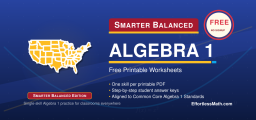
The book we recommend for California Algebra 1 students is Algebra I for Beginners, which walks through every Common Core Algebra 1 topic in plain language with full worked examples. For SAT-style timed practice in 10th or 11th grade, follow it with SAT Math for Beginners (resource currently unavailable).
Frequently Asked Questions
What is the best Algebra 1 book for California students?
For California students, we recommend Algebra I for Beginners. It covers the Common Core Algebra 1 topics California uses, including linear and exponential functions, systems of equations, polynomials, factoring, quadratics and basic statistics. Each lesson slows down with plain explanations and fully worked examples, which is often exactly what an eighth or ninth grader needs when class moves too fast.
What is the best Algebra 1 book for self study?
Pick a book designed for a student working alone, with every step written out and answer keys to check work. Algebra I for Beginners is organized by topic, so a California student can start with a quick diagnostic, find the gaps, and go straight to those chapters instead of redoing the whole year. Reworking every missed problem is what makes self study stick.
What is the best Algebra 1 workbook?
A good Algebra 1 workbook gives steady, topic-by-topic practice with answers. Use it alongside class: read the lesson, work the example, then do a short set of problems three to five times a week. For California’s Common Core course, make sure it includes exponential functions and simple statistics, not just linear equations and quadratics.
What should a good Algebra 1 curriculum include?
A solid Algebra 1 curriculum moves from linear equations and inequalities to functions, systems, exponents and polynomials, factoring and quadratics, with some statistics. That is the Common Core sequence most California schools follow, and it sets up Geometry, Algebra 2 and the 11th-grade CAASPP. Families supplementing at home can use Algebra I for Beginners as the core text at about one topic a week.
What is the best calculator for Algebra 1?
A basic scientific calculator handles most Algebra 1 work, and a graphing calculator helps when your child studies functions and their graphs. Many students also use a free online graphing tool for homework. Check what the teacher allows on tests, and make sure ideas like −3² = −9 versus (−3)² = 9 are understood by hand first, since a calculator only does what you type.
Related EffortlessMath Lessons
If a topic on this page feels rusty, these short lessons go deeper:

Related to This Article
More math articles
- New Hampshire Algebra 1 Free Worksheets: Printable Standards-Aligned Algebra 1 Practice with Answers
- Best Tablet Floor Stands For Online Teaching
- How to Apply Trigonometry: Practical Uses and Insights into Engineering and Astronomy
- Grade 8 Grammar and Revision Skills: Sentence Variety, Precision, and Editing Habits
- Embark on Your Mathematical Odyssey: “PERT Math for Beginners” Companion Guide
- How to Select Procedures for Determining Limits?
- How to Solve Exponential Equations
- ACT Math Test-Taking Strategies
- The Ultimate TASC Math Formula Cheat Sheet
- Judicial activism






What people say about "The Best Algebra 1 Book for California Students"?
No one replied yet.