Grade 6 Math: Prime and Composite Numbers
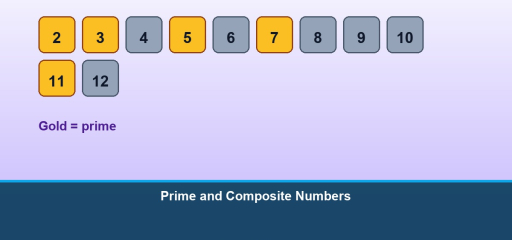
Grade 6 focus: A prime number is a whole number greater than \(1\) whose only positive factors are \(1\) and itself. A composite number is a whole number greater than \(1\) that has more than two positive factors. The number \(1\) is neither prime nor composite.
Video lesson: Watch this Math with Mr. J introduction to prime and composite numbers.
Quick examples
- Prime: \(2, 3, 5, 7, 11, 13, \ldots\)
- Composite: \(4, 6, 8, 9, 10, 12, \ldots\)
How to test “prime or composite?”
- Check divisibility by small primes (\(2, 3, 5, 7, \ldots\)) up to \(\sqrt{n}\).
- If you find a factor other than \(1\) and \(n\), then \(n\) is composite.
- If no such factor exists, \(n\) is prime.
Connection to factor trees
Prime factorization breaks a composite number into a product of primes. That skill supports GCF, LCM, and simplifying fractions.
Common mistakes
- Treating \(1\) as prime.
- Assuming all odd numbers are prime (\(9\) and \(15\) are not).
- Stopping after one failed divisibility test—always be systematic.
Fluency check
Classify \(29\) and \(39\). (\(29\) is prime; \(39 = 3 \times 13\) is composite.)

Related to This Article
More math articles
- What is a Good PSAT Score?
- 5th Grade NYSE Math Practice Test Questions
- Overview of the AFOQT Mathematics Test
- The Ultimate Trigonometry Course (+FREE Worksheets)
- How to Ace the PSAT Math Test?
- TASC Math Formulas
- Find the Key: “AFOQT Math for Beginners” Complete Answer Book
- Overview of the ACT Mathematics Test
- Role of Algebra 2 in College Readiness
- Connecting Limits at Infinity and Horizontal Asymptotes




What people say about "Grade 6 Math: Prime and Composite Numbers - Effortless Math: We Help Students Learn to LOVE Mathematics"?
No one replied yet.