ACT Math Practice Test Questions

College Entrance Tests
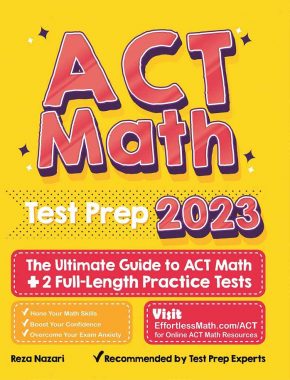
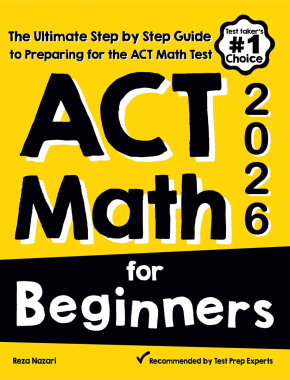
The Best Books to Ace the ACT Math Test
ACT Math Practice Test Solutions
ACT Mathematics contains 60 questions spanning algebra, geometry, trigonometry, and pre-calculus. Questions progress in difficulty over 60 minutes.
Sample Problem 1: Basic Algebra
Problem: If 2x + 5 = 13, what is x?
Solution: 2x = 8, x = 4. Early problems should take 30-40 seconds each.
Sample Problem 2: Geometry
Problem: Triangle angles 45°, 60°, and x°. What is x?
Solution: 45 + 60 + x = 180, x = 75°. Memorize special triangle properties (45-45-90, 30-60-90).
Sample Problem 3: Coordinate Geometry
Problem: Slope through (2,3) and (5,9)?
Solution: m = (9-3)/(5-2) = 6/3 = 2. Know: parallel lines same slope, perpendicular slopes are negative reciprocals.
Sample Problem 4: Systems
Problem: 2x + y = 8 and x – y = 1. Solve for x.
Solution: Add equations: 3x = 9, x = 3. Check: 2(3)+2=8 and 3-2=1.
Sample Problem 5: Word Problem Percent
Problem: 20% discount on $50 item. Sale price?
Solution: Discount = 0.20 × $50 = $10. Sale = $40. Or: 0.80 × $50 = $40.
Sample Problem 6: Trigonometry
Problem: Right triangle, sin(θ) = 3/5. What is cos(θ)?
Solution: (3/5)² + cos²(θ) = 1. cos²(θ) = 16/25, cos(θ) = 4/5.
Time Management
Early (1-20): 30-40s each. Middle (21-40): 1-1.5min. Late (41-60): 1.5-2min. Don’t exceed 2min per question. Use calculator strategically. Review ACT Math Course and formula cheat sheet weekly.
ACT Math Practice Test: Sample Problems with Complete Solutions
The ACT Mathematics Test contains 60 questions spanning algebra, geometry, trigonometry, and pre-calculus. Questions progress in difficulty, with easier problems at the beginning and more challenging ones toward the end. All questions are multiple-choice with five options (A through E). You have 60 minutes total, which works out to one minute per question on average, though easier questions should take significantly less time. Understanding the difficulty progression helps you manage your time effectively and allocate more time to challenging problems. Each content area requires different strategies and approaches to solve problems efficiently.
Sample ACT Math Problem 1: Basic Algebra (Early in Test)
Problem: If 2x plus 5 equals 13, what is the value of x?
Solution: Subtract 5 from both sides: 2x equals 8. Divide both sides by 2: x equals 4. Verification: 2(4) plus 5 equals 8 plus 5 equals 13. Correct!
ACT Strategy: Early problems are straightforward tests of basic algebra. Don’t overthink these. Use “gimme” questions to build confidence and secure easy points. Solve quickly to save time for harder questions later in the test. The first 20 questions should take about 30-40 seconds each if you’re on pace.
Sample ACT Math Problem 2: Geometry (Mid-Test Difficulty)
Problem: A triangle has angles measuring 45 degrees, 60 degrees, and x degrees. What is x?
Solution: The sum of angles in a triangle is 180 degrees. So 45 plus 60 plus x equals 180, which gives x equals 75 degrees. Verification: 45 plus 60 plus 75 equals 180. Correct!
ACT Note: The ACT expects you to know key geometric facts (angle sum in triangles, properties of special triangles like 45-45-90 and 30-60-90). Memorize these relationships before test day to save time during the exam and increase accuracy on geometry questions.
Sample ACT Math Problem 3: Coordinate Geometry
Problem: What is the slope of the line passing through points (2, 3) and (5, 9)?
Solution: Use the slope formula: m equals (y2 minus y1) / (x2 minus x1) equals (9 minus 3) / (5 minus 2) equals 6 / 3 equals 2. The slope is 2, meaning for every 1 unit right, the line goes up 2 units.
ACT Application: The ACT often asks about slope in the context of equations, parallel lines (which have the same slope), or perpendicular lines (whose slopes are negative reciprocals). Know these relationships thoroughly to answer related questions quickly.
Sample ACT Math Problem 4: Systems of Equations
Problem: If 2x plus y equals 8 and x minus y equals 1, what is the value of x?
Solution: Add the two equations to eliminate y: (2x plus y) plus (x minus y) equals 8 plus 1, which gives 3x equals 9, so x equals 3. Check: 2(3) plus y equals 8 gives y equals 2. Verify in second equation: 3 minus 2 equals 1. Correct!
ACT Skill: Elimination and substitution are essential techniques for solving systems. Practice both methods. The ACT often makes one method significantly easier than the other for a given problem. Flexible problem-solving is valued.
Sample ACT Math Problem 5: Word Problem with Percent
Problem: A store offers a 20 percent discount on a 50 dollar item. What is the sale price?
Solution: Discount amount: 0.20 times 50 dollars equals 10 dollars. Sale price: 50 dollars minus 10 dollars equals 40 dollars. Alternatively, the customer pays 80 percent of the original price: 0.80 times 50 dollars equals 40 dollars. Both approaches give the same answer: 40 dollars.
ACT Word Problem Tip: Always identify what you’re solving for before calculating. Translate “a 20 percent discount” into “multiply by 0.20” or equivalently “multiply the original price by 0.80.” Be careful not to calculate the discount amount when the question asks for the sale price.
Sample ACT Math Problem 6: Trigonometry (Later in Test)
Problem: In a right triangle, if sine of theta equals 3/5, what is cosine of theta?
Solution: Use the Pythagorean identity: sine squared of theta plus cosine squared of theta equals 1. So (3/5) squared plus cosine squared of theta equals 1, which gives 9/25 plus cosine squared of theta equals 1. Thus cosine squared of theta equals 16/25, and cosine of theta equals 4/5 (taking the positive value for acute angles in a right triangle).
ACT Trig Note: The ACT tests sine, cosine, tangent, and the Pythagorean identity extensively. Familiarize yourself with the unit circle and special angles (30 degrees, 45 degrees, 60 degrees). These appear repeatedly on the test, and knowing them cold saves significant time.
ACT Math Time Management
You have 60 minutes for 60 questions. Early questions (1-20) are easier and should take 30-40 seconds each on average, allowing about 10-13 minutes total for this section. Middle questions (21-40) are moderate difficulty and should take 1-1.5 minutes each, requiring about 20-30 minutes. Late questions (41-60) are harder and may take 1.5-2 minutes each, requiring about 25-30 minutes. Don’t spend more than 2 minutes on any single question; if stuck, make an educated guess and move forward. Sometimes returning with fresh eyes helps; other times, moving on is the right strategy. The calculator is allowed on the ACT Math Test. Use it strategically for complex arithmetic, but don’t rely on it for every calculation. Mental math and estimation are faster on simple operations. Practice solving problems with and without your calculator to develop both skills.
Common ACT Math Mistake Patterns
Mistake 1: Misreading the question. Re-read to ensure you’re solving for what’s asked, not something else. Many students calculate correctly but answer the wrong question.
Mistake 2: Arithmetic errors. Double-check your arithmetic on simple operations. An algebra error can carry forward to ruin an entire solution.
Mistake 3: Forgetting to check answers. For multiple-choice, substitute your answer back into the original equation. If it works, you’re correct. If not, recalculate or try another approach.
Mistake 4: Choosing the first answer that looks right. Read all five options. Sometimes a later option is simpler, more elegant, or more correct than your first choice. Review the ultimate ACT Math Course and ACT Math formula cheat sheet weekly to keep formulas and strategies fresh in your mind.

Related to This Article
More math articles
- How to Solve Composition of Functions? (+FREE Worksheet!)
- How Political Events Shape Ideology
- The Best Grade 8 ELA Practice Tests for Wisconsin Students
- Free Grade 4 English Worksheets for Oregon Students
- A 96% RTP Slot Over a Million Spins: The Distribution, Not the Average
- The Best Teacher Desks in 2026
- Top 10 4th Grade MEAP Math Practice Questions
- The Best Grade 3 ELA Practice Tests for South Dakota Students
- 6th Grade FSA Math FREE Sample Practice Questions
- The Ultimate Precalculus Course (+FREE Worksheets & Tests)








What people say about "ACT Math Practice Test Questions - Effortless Math"?
No one replied yet.