


LEARN · PRACTICE · EXPLORE
Georgia Grade 3 Math
Free Georgia Grade 3 math practice: short lessons, skill quizzes and printable worksheets for every standard, plus full-length practice tests with step-by-step solutions.
Focused lessons · Useful practice · Clear next steps
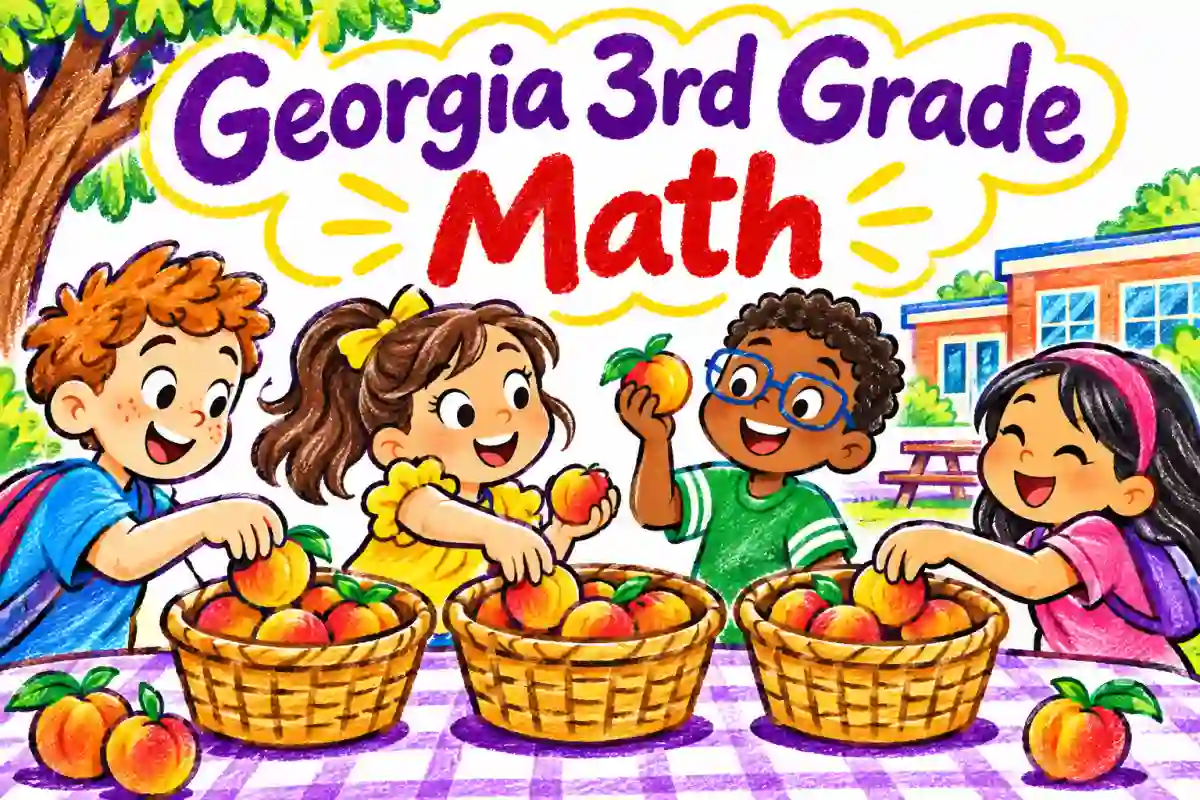
What do Georgia 3rd graders learn in math?
In 3rd grade, Georgia math centers on multiplication and division within 100, fractions on a number line, area and perimeter, and rounding. Students take the Georgia Milestones grade 3 math test in the spring. This page explains each Georgia grade 3 math standard and pairs it with short lessons, skill quizzes, printable worksheets and a full-length practice test.
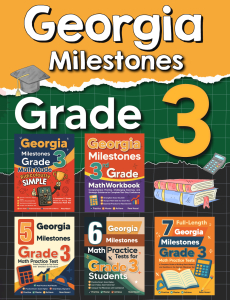
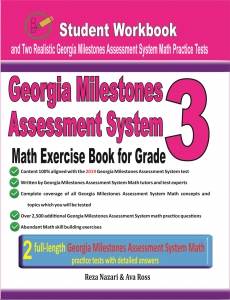
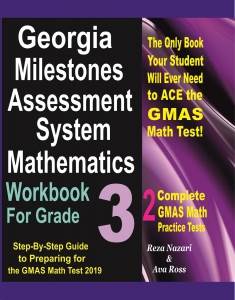
Printable Georgia grade 3 math books:
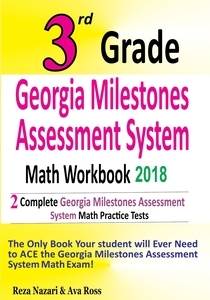
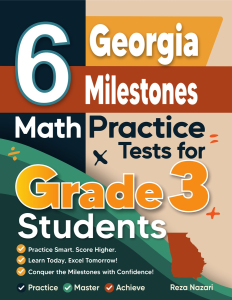
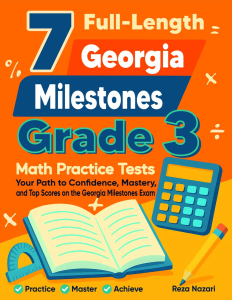
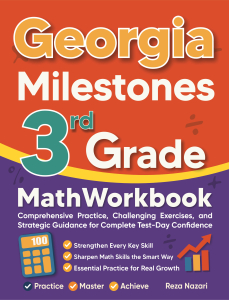
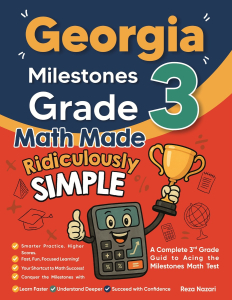
Georgia Milestones Grade 3 Math: Test Facts and Scores
Georgia 3rd graders take the Georgia Milestones End-of-Grade (EOG) test in mathematics each spring. A scale score of 525 or higher is Proficient Learner.
| Test | Georgia Milestones End-of-Grade, Grade 3 Mathematics |
|---|---|
| When | Spring, on dates your district sets inside the state window |
| Format | Online, with paper forms for students who need them |
| Achievement levels | Beginning, Developing, Proficient and Distinguished Learner |
Grade 3 math scale score ranges
| Achievement level | Scale score |
|---|---|
| Beginning Learner | 290 to 474 |
| Developing Learner | 475 to 524 |
| Proficient Learner | 525 to 574 |
| Distinguished Learner | 575 to 705 |
Practice on this page: Practice testsSkill quizzesGeorgia standardsTopics and lessons
Facts from the Georgia Department of Education, checked November 23, 2026: GaDOE: Georgia Milestones Interpretive Guide for Score Reports (scale score ranges, 2025–2026); GaDOE: Georgia Milestones Questions and Answers for Parents (2026–2027); GaDOE: Georgia Milestones Assessment System.
All 29 Georgia Grade 3 Math Expectations
Every Grade 3 standard in Georgia’s K-12 Mathematics Standards (in use since 2023–2024), with the expectations under each. Open a standard to see its expectations. The Georgia Milestones Grade 3 math test measures these standards.
3.NR.1 (Numerical Reasoning): Use place value reasoning to represent, read, write, and compare numerical values up to 10,000 and round whole numbers up to 1,000 (3)
| 3.NR.1.1 | Read and write multi-digit whole numbers up to 10,000 to the thousands using base-ten numerals and expanded form. |
|---|---|
| 3.NR.1.2 | Use place value reasoning to compare multi-digit numbers up to 10,000, using >, =, and < symbols to record the results of comparisons. |
| 3.NR.1.3 | Use place value understanding to round whole numbers within up to 1000 to the nearest 10 or 100. |
3.PAR.2 (Patterning and Algebraic Reasoning): Use part-whole strategies to represent and solve real-life problems involving addition and subtraction with whole numbers up to 10,000 (2)
| 3.PAR.2.1 | Fluently add and subtract within 1000 to solve problems. |
|---|---|
| 3.PAR.2.2 | Apply part-whole strategies, properties of operations and place value understanding, to solve problems involving addition and subtraction within 10,000. Represent these problems using equations with a letter standing for the unknown quantity. Justify solutions. |
3.PAR.3 (Patterning and Algebraic Reasoning): Use part-whole strategies to solve real-life, mathematical problems involving multiplication and division with whole numbers within 100 (7)
| 3.PAR.3.1 | Describe, extend, and create numeric patterns related to multiplication. Make predictions related to the patterns. |
|---|---|
| 3.PAR.3.2 | Represent single digit multiplication and division facts using a variety of strategies. Explain the relationship between multiplication and division. |
| 3.PAR.3.3 | Apply properties of operations (i.e., commutative property, associative property, distributive property) to multiply and divide within 100. |
| 3.PAR.3.4 | Use the meaning of the equal sign to determine whether expressions involving addition, subtraction, and multiplication are equivalent. |
| 3.PAR.3.5 | Use place value reasoning and properties of operations to multiply one-digit whole numbers by multiples of 10, in the range 10-90. |
| 3.PAR.3.6 | Solve practical, relevant problems involving multiplication and division within 100 using part-whole strategies, visual representations, and/or concrete models. |
| 3.PAR.3.7 | Use multiplication and division to solve problems involving whole numbers to 100. Represent these problems using equations with a letter standing for the unknown quantity. Justify solutions. |
3.NR.4 (Numerical Reasoning): Represent fractions with denominators of 2, 3, 4, 6 and 8 in multiple ways within a framework using visual models (4)
| 3.NR.4.1 | Describe a unit fraction and explain how multiple copies of a unit fraction form a non-unit fraction. Use parts of a whole, parts of a set, points on a number line, distances on a number line and area models. |
|---|---|
| 3.NR.4.2 | Compare two unit fractions by flexibly using a variety of tools and strategies. |
| 3.NR.4.3 | Represent fractions, including fractions greater than one, in multiple ways. |
| 3.NR.4.4 | Recognize and generate simple equivalent fractions. |
3.MDR.5 (Measurement and Data Reasoning): Solve real-life, mathematical problems involving length, liquid volume, mass, and time and analyze graphical displays of data to answer relevant questions (5)
| 3.MDR.5.1 | Ask questions and answer them based on gathered information, observations, and appropriate graphical displays to solve problems relevant to everyday life. |
|---|---|
| 3.MDR.5.2 | Tell and write time to the nearest minute and estimate time to the nearest fifteen minutes (quarter hour) from the analysis of an analog clock. |
| 3.MDR.5.3 | Solve meaningful problems involving elapsed time, including intervals of time to the hour, half hour, and quarter hour where the times presented are only on the hour, half hour, or quarter hour within a.m. or p.m. only. |
| 3.MDR.5.4 | Use rulers to measure lengths in halves and fourths (quarters) of an inch and a whole inch. |
| 3.MDR.5.5 | Estimate and measure liquid volumes, lengths and masses of objects using customary units. Solve problems involving mass, length, and volume given in the same unit, and reason about the relative sizes of measurement units within the customary system. |
3.GSR.6 (Geometric and Spatial Reasoning): Identify the attributes of polygons, including parallel segments, perpendicular segments, right angles, and symmetry (3)
| 3.GSR.6.1 | Identify perpendicular line segments, parallel line segments, and right angles, identify these in polygons, and solve problems involving parallel line segments, perpendicular line segments, and right angles. |
|---|---|
| 3.GSR.6.2 | Classify, compare, and contrast polygons, with a focus on quadrilaterals, based on properties. Analyze specific 3-dimensional figures to identify and describe quadrilaterals as faces of these figures. |
| 3.GSR.6.3 | Identify lines of symmetry in polygons. |
3.GSR.7 (Geometric and Spatial Reasoning): Identify area as a measurable attribute of rectangles and determine the area of a rectangle presented in real-life, mathematical problems (3)
| 3.GSR.7.1 | Investigate area by covering the space of rectangles presented in realistic situations using multiple copies of the same unit, with no gaps or overlaps, and determine the total area (total number of units that covered the space). |
|---|---|
| 3.GSR.7.2 | Determine the area of rectangles (or shapes composed of rectangles) presented in relevant problems by tiling and counting. |
| 3.GSR.7.3 | Discover and explain how area can be found by multiplying the dimensions of a rectangle. |
3.GSR.8 (Geometric and Spatial Reasoning): Determine the perimeter of a polygon presented in real-life, mathematical problems (2)
| 3.GSR.8.1 | Determine the perimeter of a polygon and explain that the perimeter represents the distance around a polygon. Solve problems involving perimeters of polygons. |
|---|---|
| 3.GSR.8.2 | Investigate and describe how rectangles with the same perimeter can have different areas or how rectangles with the same area can have different perimeters. |
Codes and wording from GaDOE’s official standards repository (standards with their expectations). Checked November 23, 2026: GaDOE: Georgia’s K-12 Mathematics Standards (Standards Satchel); GaDOE: Mathematics.
Standards source: Learning and Standards, Georgia Department of Education.
Start with Grade 3 Math Practice
Use this general Grade 3 math practice test to check your skills, then review the missed topics below. It is independent practice, not an official state assessment or a replica of its timing, scoring, or question types.
Open the Grade 3 practice test Explore Grade 3 lessons and worksheetsGeorgia Grade 3 Math Resource Snapshot
Use the topic directory below for grade-level skills and linked standards. The general practice test is an independent learning tool, not an official state test. Timing and calculator rules depend on your school or testing program.
Georgia Grade 3: match practice to what your class is learning
Use Georgia curriculum source to see what your class is working on right now, then pick the matching standard below. Read it together, ask your child to explain it in their own words, and open the lesson or worksheet for that skill in the topic list. The codes are planning references; the teacher's pacing guide decides the order.
- 3.NR.1.1
- Read and write multi-digit whole numbers up to 10,000 using base-ten numerals and expanded form
- 3.PAR.2.1
- Fluently add and subtract within 1,000 to solve problems
- 3.MDR.5.1
- Ask questions and answer them based on gathered information, observations, and appropriate graphical displays to solve problems relevant to everyday life
- 3.GSR.6.1
- Identify perpendicular line segments, parallel line segments, and right angles, identify these in polygons, and solve problems involving parallel line segments, perpendicular line segments, and right angles
Choose practice from the explanation
Ask the student to explain one of the ideas above with a drawing, model, table, or short calculation. If the explanation is unclear, open the related lesson before assigning a mixed test. If the idea is understood but the calculation is unreliable, choose a focused worksheet and review the strategy afterward.
Keep the classroom target, the resource used, and the next step together in a study note. A topic quiz can guide review; its score is not an official state performance level. Revisit the skill in a new context after a few days.
Grade 3 review and spring testing
Work through the Effortless Math introductory multiplication examples. The topic directory has lessons and worksheets for the full grade, including broader review and enrichment.
Schools in Georgia give the mathematics End-of-Grade assessment in the spring. Get the testing dates for your child’s school from the district calendar. Confirm your school’s dates. The published Georgia handbook lists no standard calculator for Grades 3–5 mathematics. State assessment information
For focused book practice, use the Grade 3 study guide and workbook listed with the grade resources.
Georgia Grade 3 Math Topics
Student-friendly Grade 3 math skills, with a focused lesson, practice resources where available, and a topic quiz. Displayed codes are broad reference groups, not a certified state crosswalk.
Standards source: Learning and Standards, Georgia Department of Education.
Place Value & Number Sense
Addition & Subtraction
Multiplication
Division
Problem Solving & Patterns
Fractions
Measurement, Time & Data
Best Georgia Milestones Grade 3 Math Books
Each book has a job: start from scratch, drill weak skills, or build pacing with full tests. All of them pair with the free tools on this page.
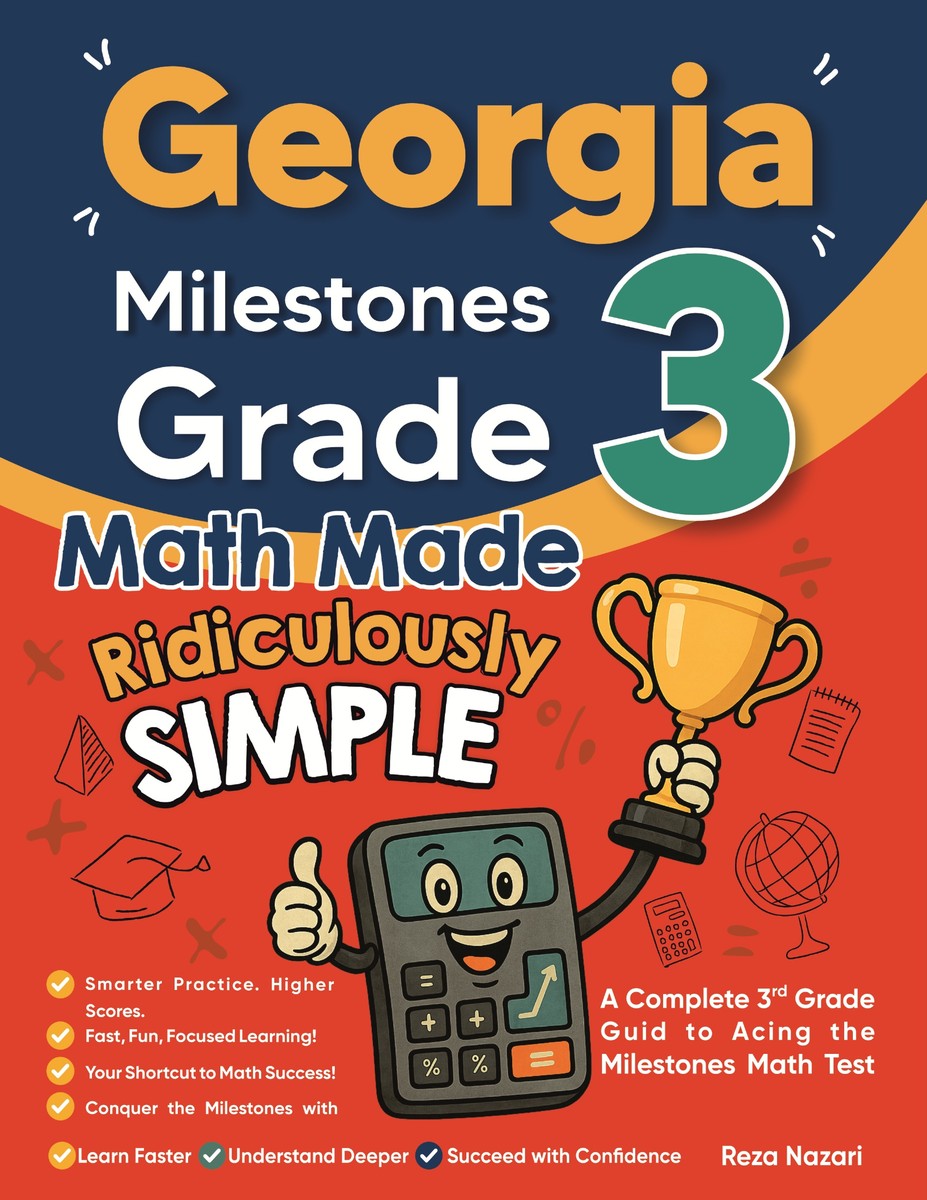
Georgia Milestones Grade 3 Math Made Ridiculously Simple
A step-by-step Milestones Grade 3 math book that rebuilds every tested skill clearly and in order, built to match the Georgia standards.
- Best starting point for the Milestones math test
- Pairs with Georgia flashcards and worksheets
- Use it before full timed practice tests
- Organized for students who need examples before drills
Step-by-step lessons
Short explanations show the move before the student practices it.
✍Worked examples
Examples translate Milestones-style wording into clear math steps.
Targeted practice
Rebuild one skill at a time instead of jumping around.
Test-day bridge
After each topic, connect to formulas, flashcards, and practice questions.
How to use it
- Read one lesson and copy the worked example.
- Do a short worksheet set on the same topic.
- Review the matching flashcards or formulas.
- Try a mixed quiz and mark every miss.
Pair it with free tools
Choose the right Georgia Grade 3 math book
Georgia Milestones Grade 3 Math Made Ridiculously Simple
Start here for Georgia Grade 3 math, step by step.
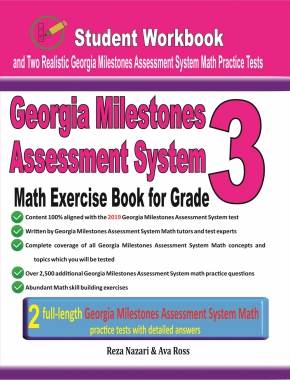
Georgia Milestones Math Exercise Book for Grade 3: Student Workbook and Two Realistic GMAS Math Tests
Practice by topic when a student needs more reps.
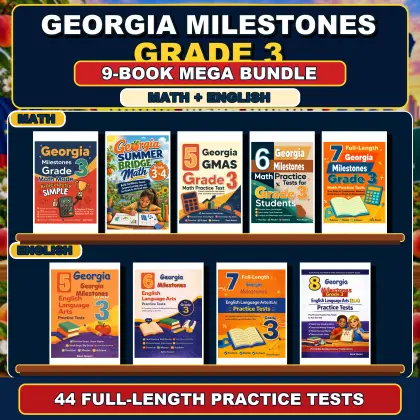
Georgia Milestones Grade 3 Math & ELA Mega Bundle
9 books and 44 full-length practice tests in one TPT bundle.
Georgia Milestones Grade 3 Math FAQ
What is the Milestones Grade 3 math test?
The Milestones (Georgia Milestones Assessment System) is Georgia’s Grade 3 mathematics assessment. The linked activities are independent Grade 3 practice. Their question count, timer, scoring, and item types may differ from the official assessment. Use the directions inside each activity.
Can I use a calculator?
Calculator rules depend on the grade, assessment, test segment, and approved accommodations. Follow the current assessment guidance and ask your school which rules apply. A tool available in independent practice does not establish permission on the official test.
How long is each practice test?
Read the timer and question count shown in the practice activity you open. These are practice settings, not a statement of the official assessment’s duration or scoring.
Is it free?
The linked general practice and topic resources are available separately from optional books. Check each activity’s directions and access requirements. The study guide and bundle are optional next steps.
Grade 3 Math in Other States
Explore Grade 3 math standards, practice tests, and worksheets for every state.
- Alabama
- Alaska
- Arizona
- Arkansas
- California
- Colorado
- Connecticut
- Delaware
- Florida
- Hawaii
- Idaho
- Illinois
- Indiana
- Iowa
- Kansas
- Kentucky
- Louisiana
- Maine
- Maryland
- Massachusetts
- Michigan
- Minnesota
- Mississippi
- Missouri
- Montana
- Nebraska
- Nevada
- New Hampshire
- New Jersey
- New Mexico
- New York
- North Carolina
- North Dakota
- Ohio
- Oklahoma
- Oregon
- Pennsylvania
- Rhode Island
- South Carolina
- South Dakota
- Tennessee
- Texas
- Utah
- Vermont
- Virginia
- Washington
- West Virginia
- Wisconsin
- Wyoming
- District of Columbia
Make This Your Georgia Milestones Starting Point
Take a timed practice test, find your weakest topic, and study it with the linked lessons, worksheets, and the Milestones study guide.
Start a practice testGeorgia Grade 3 Math: 10-Question Challenge
Ten fresh questions on the skills Georgia 3rd graders work on most. Pick an answer, check it, and read the explanation either way.
The 5 is in the thousands place, so its value is 5 × 1,000 = 5,000.
Look at the tens digit, which is 7. Since 7 is 5 or more, round up. 377 rounds to 400.
The numerators are the same. When the same amount is split into fewer parts, each part is larger, so \(\frac{1}{4}\) is greater than \(\frac{1}{6}\).
Multiply the numerator and denominator by 2: \(\frac{1}{4}\) = \(\frac{2}{8}\).
Choose another state
Grade 3 Math in Every State
Select a state on the map to open its Grade 3 Math page. You are viewing Georgia.
All states A–Z
A USEFUL NEXT STEP
Georgia Grade 3 Math: study questions
How should I choose a Grade 3 math study target?
Choose a current classroom target, find the matching learning reference, and use a lesson or available practice resource to check understanding. State documents control local wording and placement; shared reference codes are not a certified crosswalk.
Are these activities official state assessments?
These are independently published learning resources. A practice score does not predict or replace an official state score. Use the directions in each activity and consult your school for official testing and accommodation rules.
Resources from Effortless Math · Editorial standards