LEARN · PRACTICE · EXPLORE
Vermont Grade 3 Math
Solve a two-step equal-group problem, write an equation for the unknown, and check the answer in context, using a selected Vermont Grade 3 reference.
Focused lessons · Useful practice · Clear next steps
Standards source: Vermont mathematics standards.
Start with Grade 3 Math Practice
Use this general Grade 3 math practice test to check your skills, then review the missed topics below. It is independent practice, not an official state assessment or a replica of its timing, scoring, or question types.
Open the Grade 3 practice test Explore Grade 3 lessons and worksheetsClassroom practice and state assessment
The Vermont Agency of Education Academic Proficiency overview lists general VTCAP English and mathematics assessment in Grades 3–9. Grade 3 is included in that mathematics range. Follow the school’s current directions and accommodations. Independently published practice follows its own timing, tools, question count, and scoring; its result does not establish a state performance level. This original activity is not an official state assessment question. Read official assessment guidance.
Track Units through a Two-Step Problem
Solve a two-step equal-group problem, write an equation for the unknown, and check the answer in context, using a selected Vermont Grade 3 reference.
Rows first, then rows used
A fictional class has 24 square tiles. It arranges them in rows of 4 tiles, then uses 2 complete rows for a display. How many complete rows remain? Write an equation using r for the remaining number of rows. Explain why subtracting 2 from 24 first would answer a different question.
Follow the reasoning
Dividing 24 tiles by 4 tiles per row gives 6 rows. Using 2 of those rows leaves 6 − 2 = 4 rows. An equation is r = 24 ÷ 4 − 2, so r = 4. Subtracting 2 from 24 would remove two tiles, while the problem removes two entire rows, or eight tiles. A second check uses that tile count: 24 − 8 = 16 tiles, and 16 ÷ 4 = 4 rows. The answer is reasonable because fewer than the original six rows remain, and the used and remaining rows together account for all 24 tiles.
Check the explanation
The division here produces a whole number of complete rows. The number 2 names rows, not tiles. Label the quantities before choosing the order of operations; a familiar calculation is useful only when it represents the question.
Try the next step
Change the starting total to 28 tiles, keep four tiles per row, and use three complete rows. Explain r = 28 ÷ 4 − 3 = 4 rows. Check by subtracting the twelve used tiles before dividing the remaining sixteen.
Vermont reference for this worked activity
The Vermont mathematics standards directory identifies Common Core State Standards adoption in 2010. The linked publisher PDF is the June 2010 CCSS mathematics edition; the upload directory date does not establish a new adoption. The agency also lists Vermont Early Learning Standards through Grade 3. Read the complete requirements and the school’s current curriculum sequence. The reference below selects one worked focus.
| Selected reference | Activity focus | Complete requirement |
|---|---|---|
| 3.OA.8 | Solve two-step whole-number problems and assess reasonableness | Read the state-linked PDF page 23 |
This selected reference identifies the activity focus. The complete standard and grade curriculum include additional work. These labels do not certify alignment of every independent lesson, worksheet, or quiz in the broader directory.
Choose a next task from the student’s explanation
Use a different set of numbers to check whether the student can explain the same relationship. If the explanation is unclear, return to the model; if the reasoning is sound but a calculation is wrong, work through a shorter calculation and check it against the model. Use the related learning resources alongside the teacher’s assigned goals.
The Vermont Agency of Education Academic Proficiency overview lists general VTCAP English and mathematics assessment in Grades 3–9. Grade 3 is included in that mathematics range. Follow the school’s current directions and accommodations. Independently published practice follows its own timing, tools, question count, and scoring; its result does not establish a state performance level. This original activity is not an official state assessment question. Read Vermont assessment guidance.
State sources and the selected complete PDF page checked October 6, 2026. Confirm later guidance and local assignments before planning assessment preparation.
Vermont Grade 3 Math Topics
Choose a related lesson, printable resource, or quiz. This broader directory may include review and enrichment. Compare the task with the school’s learning goals; use the separately linked state reference for the worked activity above.
Official source: Vermont mathematics standards and guidance.
Place Value & Number Sense
Addition & Subtraction
Multiplication
Division
Problem Solving & Patterns
Fractions
Measurement, Time & Data
Vermont Grade 3 Math Books and Resources
Compare each resource’s contents, edition, and worked explanations with the student’s current assignment before choosing a book.
Choose the right Vermont Grade 3 math book
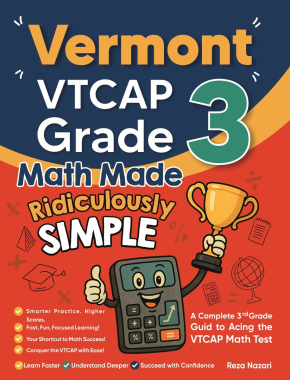
Vermont VTCAP Grade 3 Math Made Ridiculously Simple
Start here for Vermont Grade 3 math, step by step.
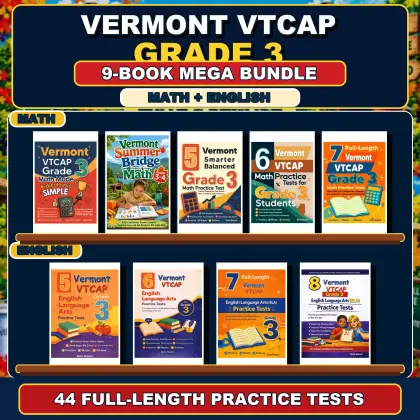
Vermont VTCAP Grade 3 Math & ELA Mega Bundle
Check the collection’s current contents and editions before choosing resources for classroom review or independent practice.
Grade 3 math: useful planning questions
Why keep units visible in a two-step problem?
Units show what each number counts. Subtracting two rows from a count of tiles mixes different quantities unless the rows are first converted to tiles.
How does Grade 3 mathematics connect with state assessment?
The Vermont Agency of Education Academic Proficiency overview lists general VTCAP English and mathematics assessment in Grades 3–9. Grade 3 is included in that mathematics range. Follow the school’s current directions and accommodations. Independently published practice follows its own timing, tools, question count, and scoring; its result does not establish a state performance level. This original activity is not an official state assessment question.
Grade 3 Math in Other States
Explore Grade 3 math standards, practice tests, and worksheets for every state.
- Alabama
- Alaska
- Arizona
- Arkansas
- California
- Colorado
- Connecticut
- Delaware
- Florida
- Georgia
- Hawaii
- Idaho
- Illinois
- Indiana
- Iowa
- Kansas
- Kentucky
- Louisiana
- Maine
- Maryland
- Massachusetts
- Michigan
- Minnesota
- Mississippi
- Missouri
- Montana
- Nebraska
- Nevada
- New Hampshire
- New Jersey
- New Mexico
- New York
- North Carolina
- North Dakota
- Ohio
- Oklahoma
- Oregon
- Pennsylvania
- Rhode Island
- South Carolina
- South Dakota
- Tennessee
- Texas
- Utah
- Virginia
- Washington
- West Virginia
- Wisconsin
- Wyoming
- District of Columbia
Choose the Next Topic to Review
Review a practice response alongside classroom work. Choose a related lesson or printable task, explain the method, and check a new example with the teacher.
Start a practice testA USEFUL NEXT STEP
Vermont Grade 3 Math: study questions
Why keep units visible in a two-step problem?
Units show what each number counts. Subtracting two rows from a count of tiles mixes different quantities unless the rows are first converted to tiles.
How does Grade 3 mathematics connect with state assessment?
The Vermont Agency of Education Academic Proficiency overview lists general VTCAP English and mathematics assessment in Grades 3–9. Grade 3 is included in that mathematics range. Follow the school’s current directions and accommodations. Independently published practice follows its own timing, tools, question count, and scoring; its result does not establish a state performance level. This original activity is not an official state assessment question.
Official source ↗Resources from Effortless Math · Editorial standards