LEARN · PRACTICE · EXPLORE
North Carolina Grade 3 Math
Solve a same-hour time problem in North Carolina Grade 3 math with a clear timeline, worked checks, lessons, worksheets, quizzes, and state references.
Focused lessons · Useful practice · Clear next steps
Add Time Within One Hour
Keep elapsed minutes separate from the clock’s hour. This activity follows North Carolina’s Grade 3 same-hour time-interval expectation.
Try this original activity
A class begins a reading task at 2:10 p.m. It reads for 15 minutes and then discusses for 9 minutes. At what time does the discussion finish? How many minutes remain before 2:50 p.m.? Explain both intervals on the timeline.
Work through the reasoning
Fifteen minutes after 2:10 is 2:25. Nine more minutes brings the time to 2:34. The total elapsed time is 15 + 9 = 24 minutes, so 2:10 plus 24 minutes also gives 2:34. From 2:34 to 2:50 there are 16 minutes. Check the full span: 24 elapsed minutes plus 16 remaining minutes equals the 40 minutes from 2:10 to 2:50. The hour remains two throughout. The clock label identifies when an event happens, while an interval such as 24 minutes measures how long it lasts. Both are needed to explain the answer.
Check the common mistake
Do not add 15 to the hour label. A result of 2:24 confuses the elapsed total with the minutes after two. This task stays within the same hour, as the selected North Carolina requirement specifies; it does not extend the example across an hour boundary. The times are invented classroom information.
Try a related case
Start at 2:12 with a 13-minute reading period and an 8-minute discussion. Reading ends at 2:25 and discussion at 2:33, leaving 17 minutes until 2:50. Explain why the 21-minute elapsed interval differs from the final clock’s 33-minute label.
Selected North Carolina mathematics references for this activity
The current North Carolina adopted content standards directory links North Carolina’s mathematics standards. The selected references below were checked in the 2017 state-linked standards document, revised for accessibility in May 2026. They identify this activity’s focus, rather than a complete course. Read the full requirements, mathematical practices, examples, and progression alongside the school’s curriculum.
| Selected reference | Activity focus | State-linked document |
|---|---|---|
| NC.3.MD.1 | Add and subtract same-hour time intervals | Read the state-linked PDF, page 15 |
Sources checked October 6, 2026. Read complete requirements, clarifications, limitations, and mathematical practices alongside the school’s sequence. This selected activity is an entry point for instruction.
Connect the explanation with practice
Use the lesson, worksheet, and quiz directory to choose a related skill. The existing resource links remain available; open each activity’s directions to understand its timer, tools, question count, and scoring.
NCDPI’s March 2026 EOG assessment brief describes mathematics tests in Grades 3–8, including Grade 3. Use current school instructions for the assigned assessment pathway and accommodations. This scope reference does not establish every 2026–2027 administration detail. Independently published practice may use its own timer, tools, question count, and scoring; these are not official administration specifications or a prediction of a state performance level. Read the March 2026 EOG assessment brief.
Read North Carolina adopted content standards for later guidance. Keep one example of the student’s reasoning with the practice result. Choose a smaller model, a related question, or a new context according to the difficulty revealed in the worked activity.
Standards source: North Carolina adopted content standards.
Start with Grade 3 Math Practice
Use this general Grade 3 math practice test to check your skills, then review the missed topics below. It is independent practice, not an official state assessment or a replica of its timing, scoring, or question types.
Open the Grade 3 practice test Explore Grade 3 lessons and worksheetsClassroom practice and state assessment information
NCDPI’s March 2026 EOG assessment brief describes mathematics tests in Grades 3–8, including Grade 3. Use current school instructions for the assigned assessment pathway and accommodations. This scope reference does not establish every 2026–2027 administration detail. Independently published practice may use its own timer, tools, question count, and scoring; these are not official administration specifications or a prediction of a state performance level. Read the March 2026 EOG assessment brief for official guidance.
Use the worked activity and lesson directory to choose a skill. Confirm the directions of an independent practice resource before assigning it.
North Carolina Grade 3 Math Topics
Choose a lesson, printable worksheet collection, or topic quiz. This broader library includes review and enrichment. Use the school’s current sequence and the complete state standards when choosing skills; these rows are not a certified full-course crosswalk.
Curriculum guidance: North Carolina adopted content standards.
Place Value & Number Sense
Addition & Subtraction
Multiplication
Division
Problem Solving & Patterns
Fractions
Measurement, Time & Data
North Carolina Grade 3 Math Books and Resources
Each book has a job: start from scratch, drill weak skills, or build pacing with full tests. All of them pair with the free tools on this page.
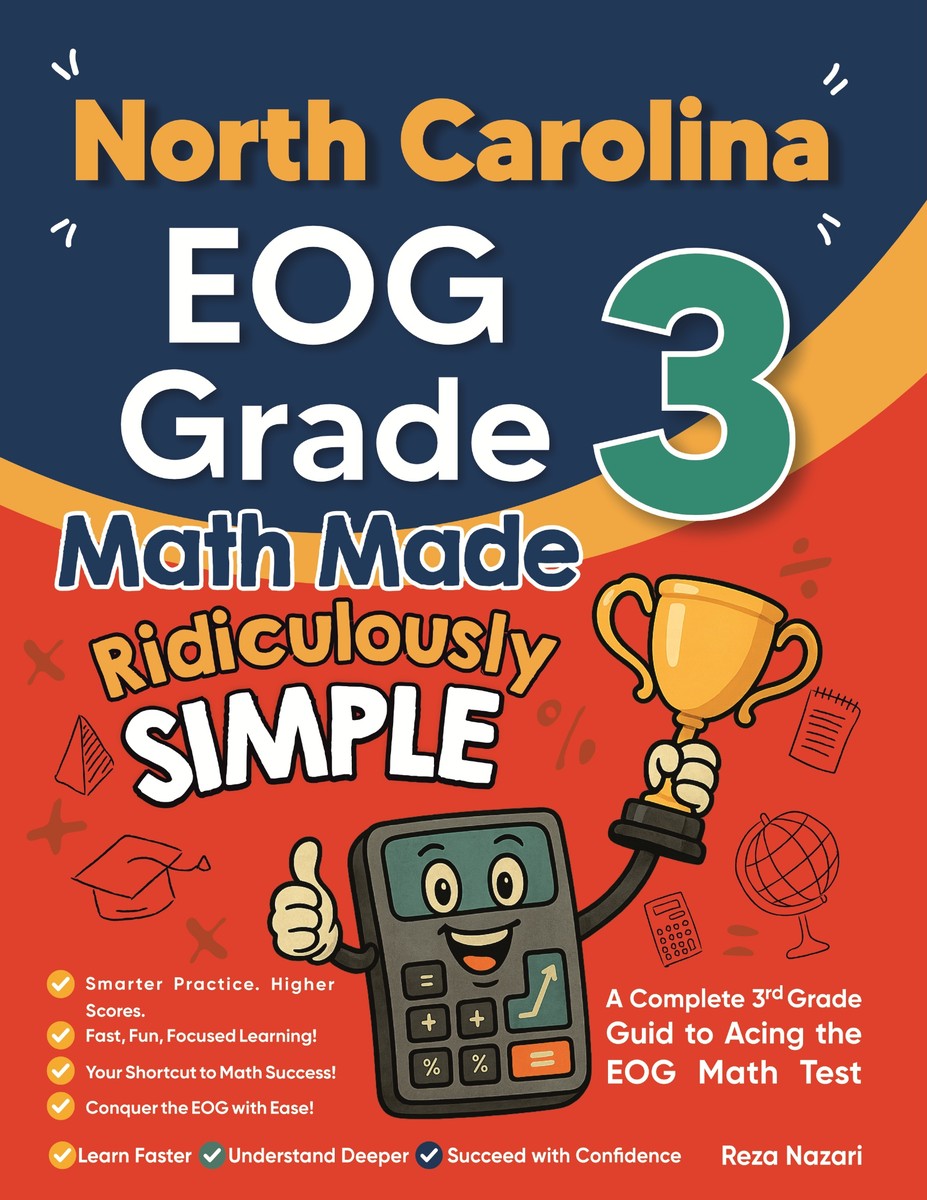
North Carolina EOG Grade 3 Math Made Ridiculously Simple
An independently published Grade 3 mathematics resource. Check its edition and contents against North Carolina’s adopted document and the school’s course before choosing preparation.
- Best starting point for the EOG math test
- Pairs with North Carolina flashcards and worksheets
- Use it before full timed practice tests
- Organized for students who need examples before drills
Step-by-step lessons
Short explanations show the move before the student practices it.
✍Worked examples
Check the listed book’s contents and edition against the learner’s course before choosing it.
Targeted practice
Rebuild one skill at a time instead of jumping around.
Test-day bridge
After each topic, connect to formulas, flashcards, and practice questions.
How to use it
- Read one lesson and copy the worked example.
- Do a short worksheet set on the same topic.
- Review the matching flashcards or formulas.
- Try a mixed quiz and mark every miss.
Pair it with free tools
Choose the right North Carolina Grade 3 math book
North Carolina EOG Grade 3 Math Made Ridiculously Simple
Start here for North Carolina Grade 3 math, step by step.
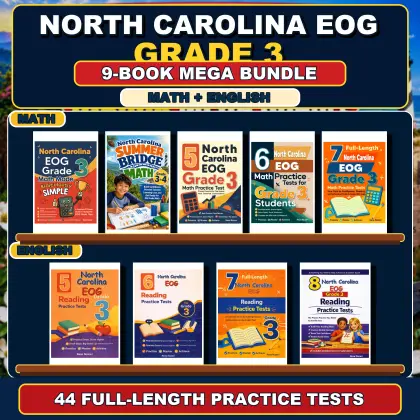
North Carolina EOG Grade 3 Math & ELA Mega Bundle
9 books and 44 full-length practice tests in one TPT bundle.
North Carolina Grade 3 math: useful study questions
Why is the total elapsed time not the final clock’s minute label?
The starting time already includes minutes after the hour. Add the elapsed interval to that starting minute value.
Which statewide mathematics assessment pathway applies to North Carolina Grade 3?
NCDPI’s March 2026 EOG assessment brief describes mathematics tests in Grades 3–8, including Grade 3. Use current school instructions for the assigned assessment pathway and accommodations. This scope reference does not establish every 2026–2027 administration detail. Independently published practice may use its own timer, tools, question count, and scoring; these are not official administration specifications or a prediction of a state performance level.
Grade 3 Math in Other States
Explore Grade 3 math standards, practice tests, and worksheets for every state.
- Alabama
- Alaska
- Arizona
- Arkansas
- California
- Colorado
- Connecticut
- Delaware
- Florida
- Georgia
- Hawaii
- Idaho
- Illinois
- Indiana
- Iowa
- Kansas
- Kentucky
- Louisiana
- Maine
- Maryland
- Massachusetts
- Michigan
- Minnesota
- Mississippi
- Missouri
- Montana
- Nebraska
- Nevada
- New Hampshire
- New Jersey
- New Mexico
- New York
- North Dakota
- Ohio
- Oklahoma
- Oregon
- Pennsylvania
- Rhode Island
- South Carolina
- South Dakota
- Tennessee
- Texas
- Utah
- Vermont
- Virginia
- Washington
- West Virginia
- Wisconsin
- Wyoming
- District of Columbia
Plan Your Next Grade 3 Math Task
Choose a related practice resource, compare its feedback with classroom explanations, and follow the school’s current learning and assessment guidance.
Start a practice testA USEFUL NEXT STEP
North Carolina Grade 3 Math: study questions
Why is the total elapsed time not the final clock’s minute label?
The starting time already includes minutes after the hour. Add the elapsed interval to that starting minute value.
Which statewide mathematics assessment pathway applies to North Carolina Grade 3?
NCDPI’s March 2026 EOG assessment brief describes mathematics tests in Grades 3–8, including Grade 3. Use current school instructions for the assigned assessment pathway and accommodations. This scope reference does not establish every 2026–2027 administration detail. Independently published practice may use its own timer, tools, question count, and scoring; these are not official administration specifications or a prediction of a state performance level.
Official source ↗Resources from Effortless Math · Editorial standards