LEARN · PRACTICE · EXPLORE
West Virginia Grade 3 Math
Partition an L-shaped region into rectangles, add square units, and check with a different partition using a selected West Virginia Grade 3 reference.
Focused lessons · Useful practice · Clear next steps
Find Area without Counting a Region Twice
Partition an L-shaped region into rectangles, add square units, and check with a different partition using a selected West Virginia Grade 3 reference.
Two partitions of the same L-shaped region
An L-shaped region fits inside a 5-unit by 5-unit square. Its bottom strip is 5 units wide and 2 units high. Above that strip, its left arm is 2 units wide and 3 units high. Find the region’s area by adding non-overlapping rectangles. Check with a second partition.
Follow the reasoning
The bottom strip has area 5 × 2 = 10 square units. The left arm above it has area 2 × 3 = 6 square units. They meet at an edge and have no overlapping interior, so the total is 10 + 6 = 16 square units. Another partition uses the entire left strip, 2 × 5 = 10, plus the bottom-right piece, 3 × 2 = 6, again giving 16. Adding the entire left strip to the entire bottom strip would give 20, but their 2 × 2 corner would be counted twice. The correct partitions show why each part of the region contributes once. The outside square also provides a check: 25 − 9 = 16, subtracting its missing 3 × 3 corner.
Check the explanation
The drawing represents a flat region with whole-number lengths, not a volume or perimeter. Each square unit belongs to the region once. The 5-unit outside square includes a missing corner; its full area is not the L-shape’s area.
Try the next step
Keep the bottom strip 5 by 2 units, but make the left arm above it 2 by 4 units. Explain 10 + 8 = 18 square units. Check using the whole left strip, 2 by 6, and the bottom-right piece, 3 by 2: 12 + 6 = 18.
West Virginia reference for this worked activity
The West Virginia mathematics policy and standards page provides grade-specific documents under Policy 2520.2B. The linked Grade 3 document includes Mathematical Habits of Mind and content standards. These should be developed together in classroom work. Read the complete requirements and the school’s current curriculum sequence. The reference below selects one worked focus.
| Selected reference | Activity focus | Complete requirement |
|---|---|---|
| M.3.24 | Decompose a region into non-overlapping rectangles (part d) | Read the state-linked PDF page 10 |
This selected reference identifies the activity focus. The complete standard and grade curriculum include additional work. These labels do not certify alignment of every independent lesson, worksheet, or quiz in the broader directory.
Choose a next task from the student’s explanation
Use a different set of numbers to check whether the student can explain the same relationship. If the explanation is unclear, return to the model; if the reasoning is sound but a calculation is wrong, work through a shorter calculation and check it against the model. Use the related learning resources alongside the teacher’s assigned goals.
The West Virginia Department of Education General Summative Assessment overview lists English language arts and mathematics in Grades 3–8, with science in Grades 5 and 8. Grade 3 is included in that mathematics range. Follow the school’s current directions and accommodations. Independently published practice follows its own timing, tools, question count, and scoring; its result does not establish a state performance level. This original activity is not an official state assessment question. Read West Virginia assessment guidance.
State sources and the selected complete PDF page checked October 6, 2026. Confirm later guidance and local assignments before planning assessment preparation.
Standards source: West Virginia mathematics standards.
Start with Grade 3 Math Practice
Use this general Grade 3 math practice test to check your skills, then review the missed topics below. It is independent practice, not an official state assessment or a replica of its timing, scoring, or question types.
Open the Grade 3 practice test Explore Grade 3 lessons and worksheetsClassroom practice and state assessment
The West Virginia Department of Education General Summative Assessment overview lists English language arts and mathematics in Grades 3–8, with science in Grades 5 and 8. Grade 3 is included in that mathematics range. Follow the school’s current directions and accommodations. Independently published practice follows its own timing, tools, question count, and scoring; its result does not establish a state performance level. This original activity is not an official state assessment question. Read official assessment guidance.
West Virginia Grade 3 Math Topics
Choose a related lesson, printable resource, or quiz. This broader directory may include review and enrichment. Compare the task with the school’s learning goals; use the separately linked state reference for the worked activity above.
Official source: West Virginia mathematics standards and guidance.
Place Value & Number Sense
Addition & Subtraction
Multiplication
Division
Problem Solving & Patterns
Fractions
Measurement, Time & Data
West Virginia Grade 3 Math Books and Resources
Compare each resource’s contents, edition, and worked explanations with the student’s current assignment before choosing a book.
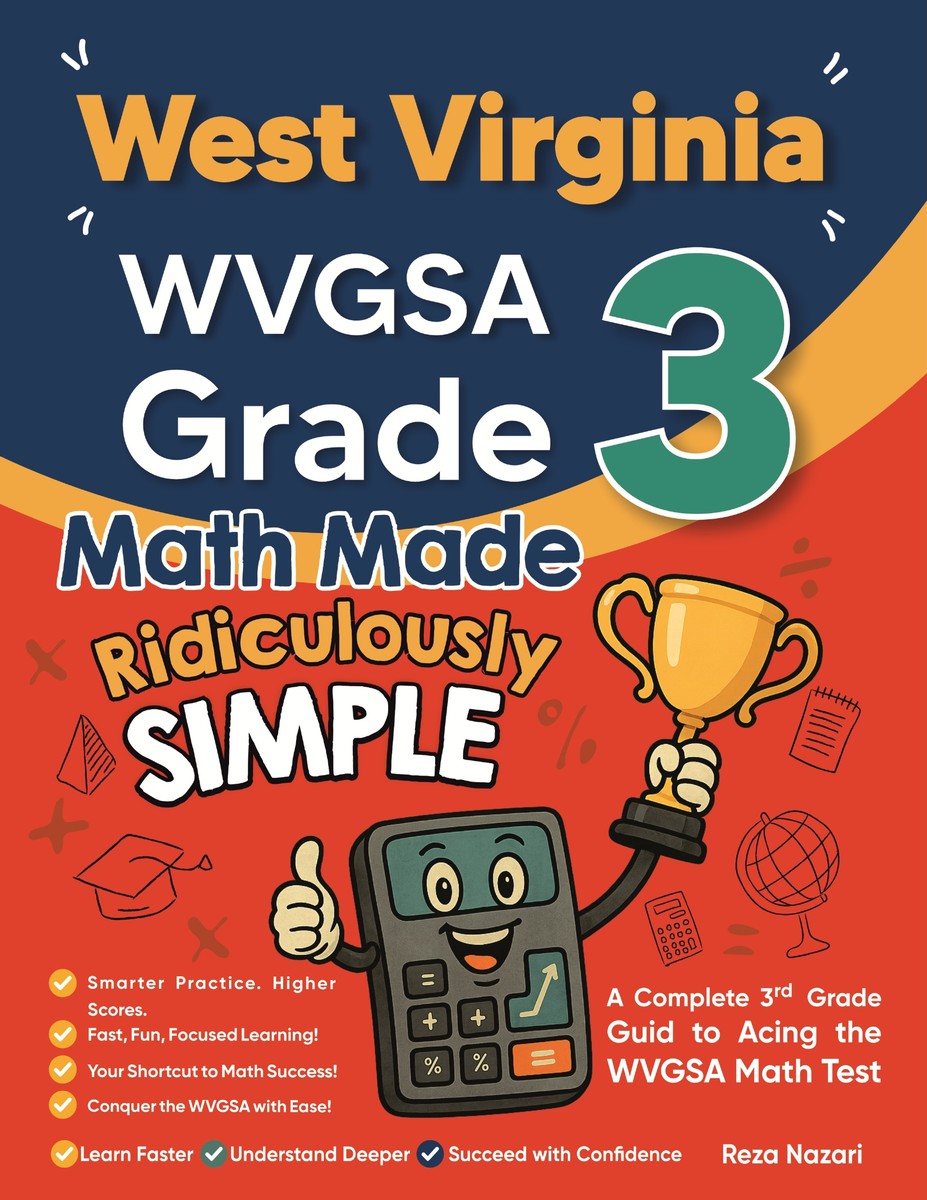
West Virginia WVGSA Grade 3 Math Made Ridiculously Simple
An independently published Grade 3 mathematics resource. Compare its contents and worked explanations with the current classroom unit and complete state requirements.
- Best starting point for the WVGSA math test
- Pairs with West Virginia flashcards and worksheets
- Use it before full timed practice tests
- Organized for students who need examples before drills
Step-by-step lessons
Short explanations show the move before the student practices it.
✍Worked examples
Read an explanation, try a related problem, and compare the reasoning with the classroom method.
Targeted practice
Rebuild one skill at a time instead of jumping around.
Test-day bridge
After each topic, connect to formulas, flashcards, and practice questions.
How to use it
- Read one lesson and copy the worked example.
- Do a short worksheet set on the same topic.
- Review the matching flashcards or formulas.
- Try a mixed quiz and mark every miss.
Pair it with free tools
Choose the right West Virginia Grade 3 math book
West Virginia WVGSA Grade 3 Math Made Ridiculously Simple
Start here for West Virginia Grade 3 math, step by step.
Grade 3 math: useful planning questions
Why must the rectangles avoid overlapping?
Area addition counts each part once. Overlapping rectangles count their shared region twice unless that overlap is explicitly removed.
How does Grade 3 mathematics connect with state assessment?
The West Virginia Department of Education General Summative Assessment overview lists English language arts and mathematics in Grades 3–8, with science in Grades 5 and 8. Grade 3 is included in that mathematics range. Follow the school’s current directions and accommodations. Independently published practice follows its own timing, tools, question count, and scoring; its result does not establish a state performance level. This original activity is not an official state assessment question.
Grade 3 Math in Other States
Explore Grade 3 math standards, practice tests, and worksheets for every state.
- Alabama
- Alaska
- Arizona
- Arkansas
- California
- Colorado
- Connecticut
- Delaware
- Florida
- Georgia
- Hawaii
- Idaho
- Illinois
- Indiana
- Iowa
- Kansas
- Kentucky
- Louisiana
- Maine
- Maryland
- Massachusetts
- Michigan
- Minnesota
- Mississippi
- Missouri
- Montana
- Nebraska
- Nevada
- New Hampshire
- New Jersey
- New Mexico
- New York
- North Carolina
- North Dakota
- Ohio
- Oklahoma
- Oregon
- Pennsylvania
- Rhode Island
- South Carolina
- South Dakota
- Tennessee
- Texas
- Utah
- Vermont
- Virginia
- Washington
- Wisconsin
- Wyoming
- District of Columbia
Choose the Next Topic to Review
Review a practice response alongside classroom work. Choose a related lesson or printable task, explain the method, and check a new example with the teacher.
Start a practice testA USEFUL NEXT STEP
West Virginia Grade 3 Math: study questions
Why must the rectangles avoid overlapping?
Area addition counts each part once. Overlapping rectangles count their shared region twice unless that overlap is explicitly removed.
How does Grade 3 mathematics connect with state assessment?
The West Virginia Department of Education General Summative Assessment overview lists English language arts and mathematics in Grades 3–8, with science in Grades 5 and 8. Grade 3 is included in that mathematics range. Follow the school’s current directions and accommodations. Independently published practice follows its own timing, tools, question count, and scoring; its result does not establish a state performance level. This original activity is not an official state assessment question.
Official source ↗Resources from Effortless Math · Editorial standards