LEARN · PRACTICE · EXPLORE
Kansas Grade 3 Math
Compare two thirds with two fourths using an original equal-whole strip model, explain why denominator size changes piece size, and study a Kansas Grade 3 fraction expectation.
Focused lessons · Useful practice · Clear next steps
Standards source: Kansas Mathematics Standards, Kansas State Department of Education.
Start with Grade 3 Math Practice
Use this general Grade 3 math practice test to check your skills, then review the missed topics below. It is independent practice, not an official state assessment or a replica of its timing, scoring, or question types.
Open the Grade 3 practice test Explore Grade 3 lessons and worksheetsClassroom practice and state assessment information
Grade 3 is within Kansas’s general summative KAP mathematics testing range. The linked learning resources have their own directions and scoring; a practice score does not establish an official state performance level. Read the state assessment overview for official guidance.
Use the worked activity and lesson directory to choose a skill. Confirm the directions of an independent practice resource before assigning it.
Compare equal numerators while keeping the whole the same
Two identical paper strips each represent one whole. Shade two of three equal parts on the first and two of four equal parts on the second. Compare 2/3 and 2/4. This original mathematical model uses equal-sized wholes; its measurements are chosen for illustration rather than collected from a classroom.
Explain what each number means
The denominator names the number of equal parts in one whole. The numerator names how many of those parts are selected. Both numerators are two, but a third of this whole is larger than a fourth. Selecting two larger parts produces the greater shaded amount, so 2/3 > 2/4. The symbol points its open side toward the greater number. Count equal parts in each strip before comparing the shading.
Check a tempting shortcut
Four is greater than three as a whole number, but that does not make two fourths greater than two thirds. The denominators describe the partitions rather than the amount selected by themselves. Also avoid a rule that every fraction with a smaller denominator must be larger: the equal-numerator condition matters. A different pair can require different reasoning. State both the shared numerator and the equal whole when explaining this comparison.
Keep the model’s conditions visible
Two parts from an unequally divided strip do not necessarily represent two thirds or two fourths. The parts within each strip must be equal. A photograph of a large strip beside a small one can also mislead if the reader compares physical areas while the wholes differ. These identical strips make the mathematical comparison clear. For a word problem about pieces of actual food, establish the size of the original wholes before comparing the amounts eaten.
Transfer the comparison
Draw two more identical strips and compare 1/3 with 1/4. Then compare 3/4 with 1/4: now the denominator is shared, so the equal part size stays fixed while the selected count changes. Explain which condition changes between the two pairs. If the result is correct but the explanation relies only on guessing from the drawing, return to the meaning of numerator and denominator. Kansas’s selected expectation includes recording and justifying comparisons; a labeled model and a sentence should work together.
Selected references from Kansas mathematics standards
The Kansas mathematics standards directory links the current mathematics document, whose cover identifies adoption in 2017 and review in 2024. These selected references identify the worked activity’s focus. The expectations include numbered requirements, examples, and mathematical practices. Read the full document and confirm the school’s current instructional sequence.
| Adopted-document reference | Activity focus | Official document |
|---|---|---|
| 3.NF.3d | Compare fractions sharing a numerator or denominator using the same whole | Read the state PDF, page 29 |
Sources checked October 6, 2026. Read complete requirements, clarifications, limitations, and mathematical practices alongside the school’s sequence. This selected activity is an entry point for instruction.
Connect the explanation with practice
Use the lesson, worksheet, and quiz directory to choose a related skill. The existing resource links remain available; open each activity’s directions to understand its timer, tools, question count, and scoring.
Grade 3 is within Kansas’s general summative KAP mathematics testing range. The linked learning resources have their own directions and scoring; a practice score does not establish an official state performance level. Read Kansas’s assessment overview.
Keep one example of the student’s reasoning with the practice result. Choose a smaller model, a related question, or a new context according to the difficulty revealed in the worked activity.
Kansas Grade 3 Math Topics
Choose a lesson, printable worksheet collection, or topic quiz. This broader library includes review and enrichment. Use the school’s current sequence and the adopted Kansas document when choosing skills; these rows are not a certified full-course crosswalk.
Standards source: Standards, Kansas State Department of Education.
Place Value & Number Sense
Addition & Subtraction
Multiplication
Division
Problem Solving & Patterns
Fractions
Measurement, Time & Data
Best Kansas KAP Grade 3 Math Books
Each book has a job: start from scratch, drill weak skills, or build pacing with full tests. All of them pair with the free tools on this page.
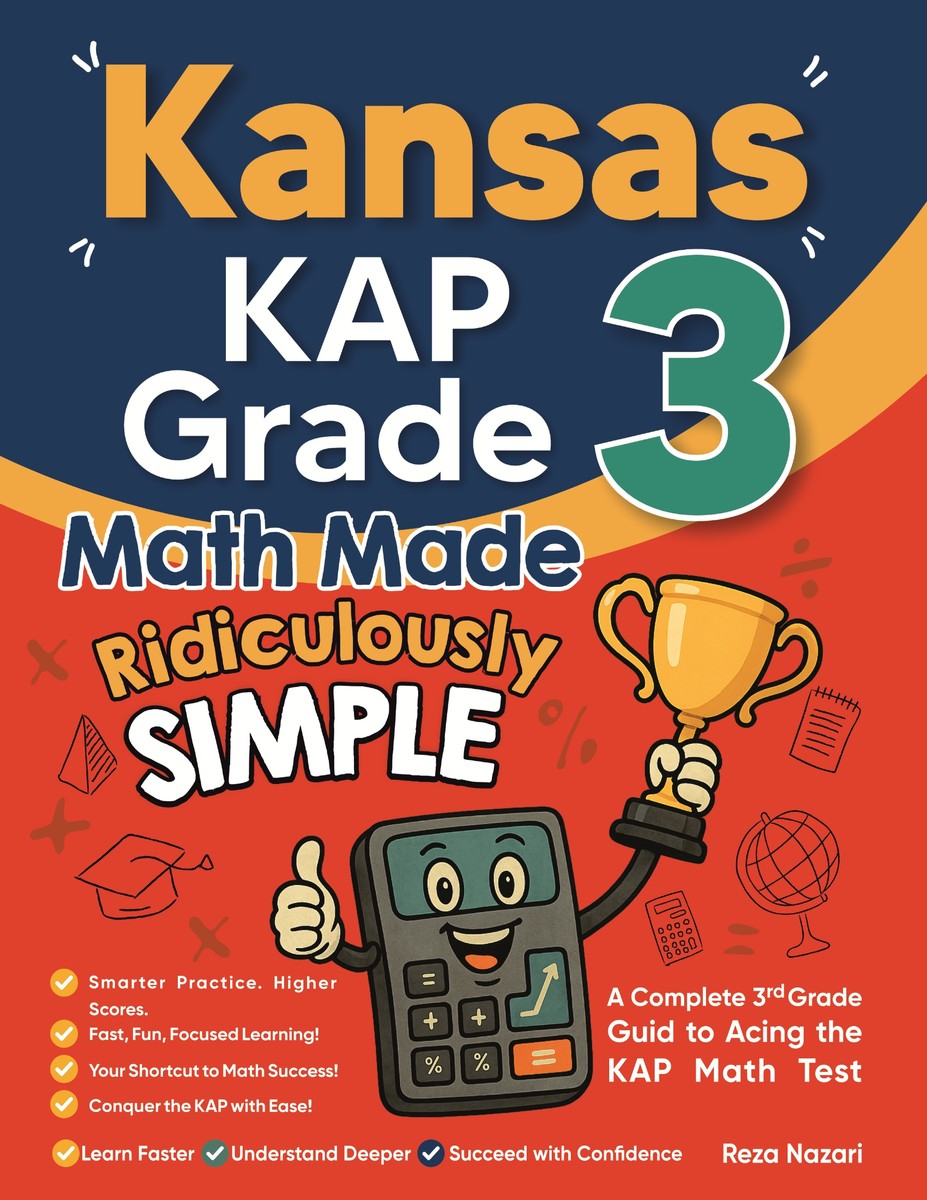
Kansas KAP Grade 3 Math Made Ridiculously Simple
An independently published Grade 3 mathematics resource. Check its edition and contents against Kansas’s adopted document and the school’s course before choosing preparation.
- Best starting point for the KAP math test
- Pairs with Kansas flashcards and worksheets
- Use it before full timed practice tests
- Organized for students who need examples before drills
Step-by-step lessons
Short explanations show the move before the student practices it.
✍Worked examples
Examples translate KAP-style wording into clear math steps.
Targeted practice
Rebuild one skill at a time instead of jumping around.
Test-day bridge
After each topic, connect to formulas, flashcards, and practice questions.
How to use it
- Read one lesson and copy the worked example.
- Do a short worksheet set on the same topic.
- Review the matching flashcards or formulas.
- Try a mixed quiz and mark every miss.
Pair it with free tools
Choose the right Kansas Grade 3 math book
Kansas KAP Grade 3 Math Made Ridiculously Simple
Start here for Kansas Grade 3 math, step by step.
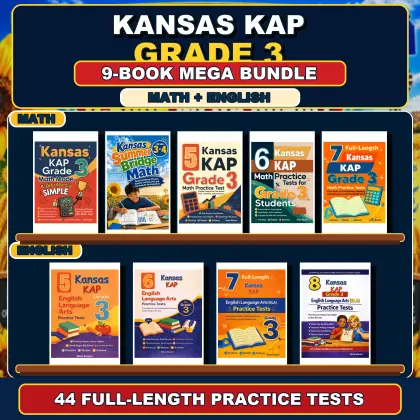
Kansas KAP Grade 3 Math & ELA Mega Bundle
9 books and 44 full-length practice tests in one TPT bundle.
Kansas Grade 3 math: useful study questions
Does a larger denominator always mean a larger fraction?
No. With equal numerators and the same whole, more equal partitions make smaller parts. Two thirds is greater than two fourths in this model.
Is Grade 3 included in Kansas KAP math testing?
Yes. Grade 3 is within Kansas’s general summative KAP range of Grades 3–8 and 10. The linked activities are independently published practice with separate directions and scoring.
Grade 3 Math in Other States
Explore Grade 3 math standards, practice tests, and worksheets for every state.
- Alabama
- Alaska
- Arizona
- Arkansas
- California
- Colorado
- Connecticut
- Delaware
- Florida
- Georgia
- Hawaii
- Idaho
- Illinois
- Indiana
- Iowa
- Kentucky
- Louisiana
- Maine
- Maryland
- Massachusetts
- Michigan
- Minnesota
- Mississippi
- Missouri
- Montana
- Nebraska
- Nevada
- New Hampshire
- New Jersey
- New Mexico
- New York
- North Carolina
- North Dakota
- Ohio
- Oklahoma
- Oregon
- Pennsylvania
- Rhode Island
- South Carolina
- South Dakota
- Tennessee
- Texas
- Utah
- Vermont
- Virginia
- Washington
- West Virginia
- Wisconsin
- Wyoming
- District of Columbia
Make This Your Kansas KAP Starting Point
Take a timed practice test, find your weakest topic, and study it with the linked lessons, worksheets, and the KAP study guide.
Start a practice testA USEFUL NEXT STEP
Kansas Grade 3 Math: study questions
Does a larger denominator always mean a larger fraction?
No. With equal numerators and the same whole, more equal partitions make smaller parts. Two thirds is greater than two fourths in this model.
Is Grade 3 included in Kansas KAP math testing?
Yes. Grade 3 is within Kansas’s general summative KAP range of Grades 3–8 and 10. The linked activities are independently published practice with separate directions and scoring.
Official source ↗Resources from Effortless Math · Editorial standards