Rhode Island Algebra 1 Free Worksheets: Printable Algebra 1 Practice, Fully Worked Keys
There is something almost philosophical about Algebra I. For nine years before this course, a student has been answering questions that have one right answer, what is 7 times 8, what is three-quarters of sixteen, and the work has been about reaching that answer accurately. Then, almost overnight, the question changes. Find every value of x that makes this equation true. Describe the relationship. Sketch the function. Explain whether the solution makes sense in this situation. The math is no longer about a particular number. It is about a general way of describing how numbers behave. A teenager who has been quietly good at arithmetic for years can find that shift surprising in ways that feel personal, not because they lack ability, but because the ground rules of the game have changed.
Rhode Island is a small state with a strong sense of place, and the students sitting in front of an Algebra I textbook in Providence, working through homework in a kitchen in Warwick, taking the course on a hybrid schedule in Cranston, or fitting study time around a job near the river in Pawtucket are all making that same shift. The math in front of them is identical: linear equations and inequalities, slope and lines, linear and exponential functions, systems, exponents and radicals, factoring, quadratic equations and functions. What helps is not more problems. It is the same problems sorted into smaller, finishable pieces, with honest feedback after each one.
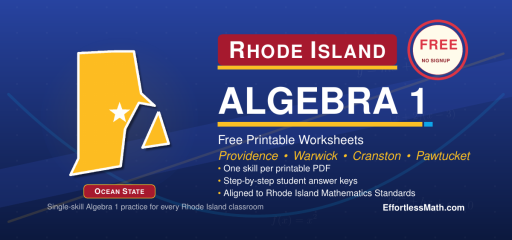
This set is that sorting. Seventy-two pages, one skill each.
Pre-Algebra for Beginners 2026 The Ultimate Step by Step Guide to Preparing for the Pre-Algebra Test
What’s on this page
Seventy-two single-skill PDFs, each aligned to the Rhode Island Algebra 1 standards. The set follows the actual structure of the course but breaks each unit finer than a textbook chapter does. There is a separate worksheet for solving two-step equations and another for multi-step equations. Slope and slope-intercept form are separate pages. Factoring trinomials and solving quadratic equations by factoring are separate pages. That granularity is the point. It lets a student spend twenty quiet minutes on the actual sticking point rather than on a vague unit review.
Each PDF begins with a one-page Quick Review: the skill stated in plain English with one worked example. Twelve practice problems follow, sequenced from easy to genuinely challenging. The last page is a student-facing answer key written in a friendly, tutoring tone, patient enough for a 14- or 15-year-old to read alone, complete enough to actually teach where their reasoning slipped.
Foundations of Algebra
Foundations come first, writing and evaluating expressions, honoring the order of operations, and stretching the ideas into everyday money math. Time spent here is time saved when the Rhode Island Algebra 1 course rolls around.
- Variables, Expressions, and Properties
- Order of Operations and Evaluating Expressions
- Simplifying Algebraic Expressions
- Introduction to Equations and Solutions
- Personal Financial Literacy
Solving Linear Equations
Solving linear equations takes center stage, progressing from quick solves to multi-step reasoning and formula rearrangement. Across Rhode Island, this is one of the skills that rewards regular reps.
- Solving One-Step Equations
- Solving Two-Step Equations
- Solving Multi-Step Equations
- Equations with Variables on Both Sides
- Literal Equations and Formulas
Inequalities and Absolute Value
Inequalities behave like equations but answer with a range, and absolute value adds the idea of distance from zero. It is worth the extra reps for Rhode Island learners aiming for a strong score on the Rhode Island Algebra 1 course.
- Solving One-Step Inequalities
- Solving Multi-Step Inequalities
- Compound Inequalities
- Absolute Value Equations
Relations, Functions, and Sequences
Students formalize relations and functions, read domain and range, and meet arithmetic and geometric sequences. Providence families can use these pages to lock the skill in before it’s tested.
- Relations and Functions
- Function Notation and Evaluating Functions
- Domain and Range
- Graphing Functions and Transformations
- Arithmetic Sequences as Linear Functions
- Geometric Sequences
- Comparing Functions
- Piecewise Functions
- Combining Functions
- Inverse Functions
Linear Functions and Their Graphs
Students graph and write linear functions, connect slope to rate of change, and explore direct and inverse variation. In Providence classrooms it tends to separate confident students from hesitant ones.
- Slope and Rate of Change
- Slope-Intercept Form
- Point-Slope Form
- Standard Form of a Linear Equation
- Writing Linear Equations from Graphs and Tables
- Parallel and Perpendicular Lines
- Inverse Variation
- Understanding Graphs as Solution Sets
Systems of Equations and Inequalities
Systems of equations, and inequalities, anchor this unit, with three solution methods and applied problems. Steady practice now makes the Rhode Island Algebra 1 course feel far more manageable later.
- Solving Systems by Graphing
- Solving Systems by Substitution
- Solving Systems by Elimination
- Applications of Systems of Equations
- Systems of Linear Inequalities
- Solving Linear-Quadratic Systems
Exponents, Polynomials, and Real Numbers
Exponent laws and polynomial work drive the unit, with special products and the real-number system rounding it out. Master it early and the rest of the Rhode Island course leans on it with ease.
- Properties of Exponents
- Adding and Subtracting Polynomials
- Multiplying Polynomials
- Special Products of Polynomials
- Rational and Irrational Numbers
Factoring
Factoring runs multiplication in reverse, pulling out common factors, factoring trinomials, and spotting special patterns. It’s a frequent early hurdle for learners in Providence and across the state.
- Greatest Common Factor and GCF Factoring
- Factoring Trinomials: \(x^2 + bx + c\)
- Factoring Trinomials: \(ax^2 + bx + c\)
- Factoring Special Products
Quadratic Functions and Equations
Students explore quadratic functions and solve them several ways, with the discriminant predicting the number of solutions. These worksheets give Rhode Island students focused, low-pressure practice.
- Graphing Quadratic Functions
- Characteristics of Quadratic Functions
- Solving Quadratics by Factoring
- Solving Quadratics by Completing the Square
- Solving Quadratics by Square Roots
- The Discriminant
- The Quadratic Formula
- Quadratic Applications and Modeling
Statistics and Probability
The chapter turns to data and chance, measures of center and spread, graphical displays, and counting and probability. For Rhode Island students, fluency here shows up directly on the Rhode Island Algebra 1 course.
- Measures of Center and Spread
- Scatter Plots and Correlation
- Lines of Best Fit and Predictions
- Counting Principles
- Probability
- Two-Way Frequency Tables
Exponential Functions and Modeling
Exponential functions round out the course, modeling rapid growth or decay and contrasting model types. Getting comfortable here pays off all the way through the Rhode Island Algebra 1 course.
- Graphing Exponential Functions
- Comparing Linear, Quadratic, and Exponential Models
- Exponential Growth
- Interpreting Functions and Parameters
More Topics
- Absolute Value Inequalities
- Direct Variation
- Displaying Data with Box Plots
- Displaying Data with Histograms
- Exponential Decay
- Graphing Cube Root Functions
- Graphing Square Root Functions
How to use these worksheets at home
Print pages in pairs that share a prerequisite, and the second page costs noticeably less effort than it would in isolation. “Solving Two-Step Equations” the night before “Solving Multi-Step Equations”, the second sheet is the first with one extra move added. “Slope and Rate of Change” right before “Slope-Intercept Form,” and the slope a student has just calculated walks directly into the m of y = mx + b. “Factoring Trinomials” the evening before “Solving Quadratics by Factoring,” and the second worksheet is the first one finished. The pairings are doing real teaching work; following them turns a year of independent leaps into a year of comfortable next steps.
Sessions should be short and the calendar should be steady. Two afternoons a week, fifteen to twenty minutes each, kept as faithfully as any other appointment, is enough to move a Rhode Island ninth or tenth grader through the full set with weeks of breathing room before whatever cumulative test ends the course. Print one PDF, hand it over, and walk away. Teenagers concentrate best when nobody is hovering near the page, and the dignity of finishing a worksheet without supervision is part of what makes the skill stick.
End every session by handing over the answer key. Let your student grade themselves, circle anything missed, read the friendly explanation, and rewrite the corrected version on a clean sheet. That four-step loop, page, key, mark, fix, is the single habit that turns “saw it” into “have it.” It will also continue to pay dividends through Geometry, Algebra II, and any cumulative state-level math measure your student meets along the way.
A note about Algebra 1 in Rhode Island
Rhode Island high schools build Algebra 1 around the state’s Algebra 1 standards, which align with the Common Core framework for high school mathematics. The course is typically capped in the spring by a cumulative assessment, whether a state-supported math measure given to ninth or tenth graders, a district end-of-course exam, or a teacher-built final, and whatever form that assessment takes, the underlying skill list is consistent. Solve linear equations and inequalities. Graph and interpret lines. Work fluently with linear and exponential functions. Solve systems by graphing, substitution, and elimination. Manipulate expressions, including those with exponents and radicals. Factor quadratic expressions and solve quadratic equations. Reason about real-world data and the key features of functions.
Because each PDF here is mapped to a single standard, the set functions as a personal pre-test checklist for that spring window. Print a sheet. See how the page goes. If it lands cleanly, move on; if it stalls, the next worksheet to print is usually the one whose title names the prerequisite skill. That kind of evidence-based study is much faster than re-reading whole textbook chapters, and it leaves a visible stack of finished pages that says, more honestly than any single test score, how much of the course has actually been learned.
A short closing
Algebra I is a big course, but it is made of small completable pieces, and those pieces are exactly what fit on a kitchen table. Bookmark this page, print one PDF tonight, and let your Rhode Island student start with the friendliest skill on the list. The next page will be easier than the first one looked, and by spring the staircase will have built itself behind you a step at a time.
New to Algebra? Start with the basics


Related to This Article
More math articles
- Advanced Vocabulary Words: Abate to Ardent
- The Ultimate HSPT Math Formula Cheat Sheet
- Introduction to Complex Numbers: Navigating the Realm Beyond the Real
- Tangible Learning: How to Represent Addition of Fractions with Unlike Denominators Using Everyday Objects
- The Best Grade 5 ELA Practice Tests for North Carolina Students
- Environmental Chemistry: Carbon, Water and Nutrients
- How to Master the Road to Achievement: “Praxis Core Math for Beginners” Comprehensive Answer Guide”
- Converting Units of Length (Metric) for 4th Grade
- The Best Grade 7 Math Book for Tennessee Students
- Free Grade 6 English Worksheets for Pennsylvania Students











What people say about "Rhode Island Algebra 1: Free Worksheets"?
No one replied yet.