Texas Grade 4 Math Worksheets and STAAR Review
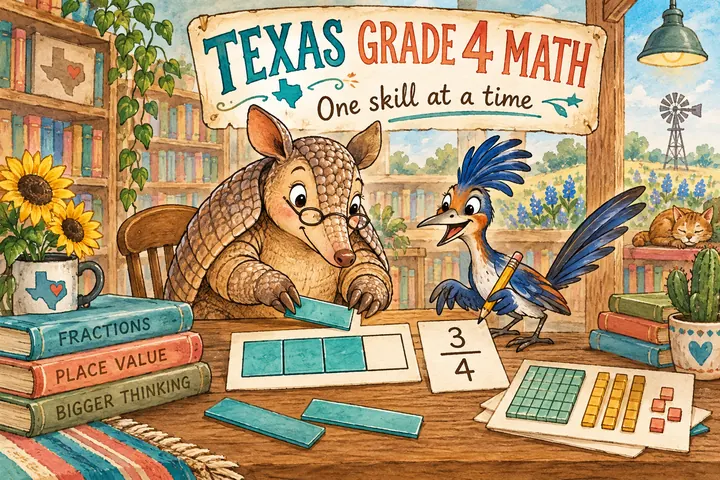
Choose from 43 Texas Grade 4 math worksheet links by topic. Start with the skill your student needs, then use the STAAR hub and official Texas Education Agency resources to plan assessment preparation. This collection supports skill review; it is not an official STAAR test or a verified checklist of every Grade 4 TEKS expectation.
Quick answer: This page links 43 free Grade 4 math worksheets grouped by topic: place value, multi-digit arithmetic, problem solving, fractions, decimals, measurement, angles and geometry. Pick the skill your child finds hardest, work a few problems together, then move on. For full released tests, use the TEA practice test site alongside these skill worksheets.
Texas Grade 4 Math Worksheet Topics
The links below are grouped by their existing resource titles. Texas TEKS and Common Core use different standards and coding systems. Match a resource to the skill your student is learning instead of treating a filename or topic heading as proof of complete assessment coverage.
Place Value & Multi-Digit Numbers
- Understanding Place Value Relationships: each place is ten times the one to its right
- Reading and Writing Multi-Digit Numbers: standard form, word form, and expanded form
- Comparing and Ordering Multi-Digit Numbers: use place value and the symbols >, <, and =
- Rounding Multi-Digit Numbers: round to any place from tens to hundred-thousands
Multi-Digit Arithmetic
- Adding Multi-Digit Whole Numbers: the standard addition algorithm, with regrouping
- Subtracting Multi-Digit Whole Numbers: the standard subtraction algorithm, including across zeros
- Multiplying by a One-Digit Number: multiply up to four digits by a single digit
- Multiplying Two Two-Digit Numbers: the area model and the standard algorithm side by side
- Dividing with Remainders: divide and name the leftover as a remainder
- Finding Factors and Multiples: list every factor of a number and its first multiples
- Prime and Composite Numbers: exactly two factors means prime; more means composite
Operations & Problem Solving
- Multiplicative Comparisons: read ‘4 times as many’ as a multiplication statement
- Multiplicative Comparison Word Problems: solve ‘times as many’ stories with multiplication or division
- Multi-Step Word Problems: two or more operations in one real-world problem
- Interpreting Remainders: decide what the leftover means, round up, drop it, or use it
- Number and Shape Patterns: follow a rule and find the next terms in a pattern
Fractions
- Equivalent Fractions: the same amount written with different numbers
- Comparing Fractions: compare fractions with unlike denominators using benchmarks
- Adding Fractions with Like Denominators, [4.NF.B.3a] add the numerators, keep the denominator
- Subtracting Fractions with Like Denominators, [4.NF.B.3a] subtract the numerators, keep the denominator
- Decomposing Fractions, [4.NF.B.3b] break a fraction into a sum of unit fractions
- Adding and Subtracting Mixed Numbers, [4.NF.B.3c] work with the whole and fraction parts, including regrouping
- Multiplying a Fraction by a Whole Number, [4.NF.B.4b] repeated addition of a fraction, written as multiplication
- Fraction Word Problems, [4.NF.B.3d] real-world stories that call for adding or subtracting fractions
Decimals
- Fractions with Denominators 10 and 100: rename tenths as hundredths and add the two
- Decimal Notation for Fractions: write tenths and hundredths as decimals, and back
- Comparing Decimals to Hundredths: line up the place values and compare with >, <, =
- Adding Decimal Fractions: add decimals to the hundredths place
Measurement & Data
- Converting Measurement Units: change from a larger unit to a smaller one
- Measurement Word Problems: length, weight, volume, and time in real situations
- Area of Rectangles: length times width, the space inside a rectangle
- Perimeter of Rectangles: the distance all the way around a rectangle
- Area and Perimeter Word Problems: decide whether a problem needs area or perimeter
- Line Plots with Fractions: read and use a line plot of fraction measurements
Angles
- Angles as Fractions of a Circle: a full turn is 360 degrees, find a fraction of it
- Measuring Angles with a Protractor: name angles acute, right, or obtuse by their measure
- Drawing Angles with Given Measures: know what a given degree measure should look like
- Adding and Subtracting Angles: an angle split into parts, find the missing part
Geometry
- Points, Lines, Rays, and Angles: the building blocks of geometry and how to tell them apart
- Parallel and Perpendicular Lines: lines that never meet, and lines that cross at a square corner
- Classifying Triangles: sort triangles by their angles and their sides
- Classifying Quadrilaterals: name four-sided shapes by their sides and angles
- Lines of Symmetry: find the lines that fold a shape onto itself
Choose a Starting Skill
Begin with a recent classwork error. If place-value columns are causing mistakes, review place value before multi-digit arithmetic. If a student cannot compare fractions, review equivalent fractions before combining skills. Ask the student to explain a method aloud; an answer alone may hide a misunderstanding.
Use a manageable practice session and adjust it to the student’s concentration. Revisit a few earlier problems later to check what the student remembers. When a skill feels steady, mix it with another topic rather than repeating only one familiar problem type.
Use Official STAAR Guidance Alongside Skill Practice
STAAR is based on the Texas Essential Knowledge and Skills. TEA’s STAAR Mathematics Resources page provides Grade 4 assessed-curriculum and blueprint links. Its STAAR Resources page points families to official online practice. Use those resources for current assessment scope and format, and ask the school about the applicable testing window and support arrangements.
A printable topic collection and an online assessment serve different purposes. Practise calculations and reasoning here, then use official online practice to become familiar with assessment tools. Do not assume this list covers personal financial literacy or every other tested expectation.
Compare Grade 4 Books Before Choosing
For a paid resource, open the current listing and compare its format, contents and preview with the support your student needs: Mastering Grade 4 Math or Mastering Grade 4 Math Word Problems. A general Grade 4 resource should not be assumed to provide complete Texas assessment coverage.
Common Questions
Are these official STAAR test papers?
No. This page is an independent collection of topic-practice links. Use TEA resources separately for official assessment information and online practice.
Does the collection cover every Grade 4 TEKS expectation?
Complete coverage has not been established. Choose resources by skill and compare them with the current Grade 4 assessed curriculum and your teacher’s guidance.
How should I choose a starting worksheet?
Choose a skill your student found difficult in class, work through one example together, and use a few problems to decide whether to review a prerequisite or continue.
Related Lessons
For a worked explanation before returning to practice, try How to add and subtract fractions with like denominators or How to solve multi-step word problems.
What the Grade 4 STAAR math test looks like
Knowing the format helps you choose practice that fits. Here are the key facts from the Texas Education Agency (TEA) for the current STAAR design.
- Online test. STAAR has been given mainly online since the 2022–23 school year. Released tests are posted on TEA’s online practice test site, with answer keys you can download.
- Length. The test has 32 questions worth 40 points. Most questions are worth 1 point, and 8 questions are worth 2 points.
- Question types. Besides multiple choice, students see drag and drop, multiselect, hot spot and inline choice questions.
- No calculator. Calculators are not allowed on Grade 3–7 STAAR math unless a student qualifies for one as an accommodation.
- Reference sheet. Students get a Grade 4 reference sheet with perimeter and area formulas for squares and rectangles and common unit conversions.
| Reporting category | Number of questions |
|---|---|
| Numerical representations and relationships | 7 to 9 |
| Computations and algebraic relationships | 10 to 12 |
| Geometry and measurement | 8 to 10 |
| Data analysis and personal financial literacy | 3 to 5 |
Because calculators are not allowed, regular practice with the multi-digit arithmetic and fraction worksheets above pays off. Texas law (House Bill 8) replaces STAAR with three shorter tests starting in 2027–28, so check with your school for the testing plan in your child’s year.
Frequently Asked Questions
Is there an official 4th grade STAAR math practice test?
Yes. TEA posts released Grade 4 math tests on its online practice test site, with answer keys and item explanations you can download. PDF versions of the full tests are no longer posted. Use a released test to see the format, and use topic worksheets to practice the skills that need work.
How many questions are on the 4th grade STAAR math test?
The Grade 4 STAAR math test has 32 questions worth 40 points in total. Twenty-four questions are worth 1 point each and eight are worth 2 points each. Questions include multiple choice plus drag and drop, multiselect, hot spot and inline choice items.
Can 4th graders use a calculator on STAAR math?
No. TEA’s calculator policy does not allow calculators on the Grade 3 to 7 STAAR math tests, unless a student meets the criteria for a calculator as an accommodation. That makes steady practice with multiplication, division and fraction work without a calculator worth the time.
What topics should my child practice for 4th grade STAAR math?
The test covers number sense and place value, computation and algebraic thinking, geometry and measurement, and data and financial literacy. On this page that means place value, multi-digit arithmetic, fractions, decimals, measurement, angles and geometry. Start with the area your child finds hardest.
Are these worksheets official STAAR tests?
No. They are free topic-practice worksheets made to build Grade 4 skills. They are not official TEA materials and do not copy STAAR questions. Pair them with a released test from TEA’s practice site to see the real format, then come back to the topics that caused trouble.

Related to This Article
More math articles
- HiSET Math Practice Test Questions
- Package Inspection and Integrity
- How to Write Linear Equations? (+FREE Worksheet!)
- 6th Grade WY-TOPP Math Worksheets: FREE & Printable
- How to Prepare for the ALEKS Math Placement Test
- What Kind of Math Is on the AFOQT Test?
- Free Grade 6 English Worksheets for Oregon Students
- Word Problems: Multiplication for 4th Grade
- Civil War Home Fronts: Soldiers, Women, Shortages and Dissent
- What’s The Best Laptop for Online Teaching?









What people say about "4th Grade STAAR Math Practice: 43 Free Worksheets"?
No one replied yet.