Arkansas ATLAS Algebra 1 Free Worksheets: 64 Free PDF Worksheets with Friendly Answer Keys

Most students walk into Algebra 1 having spent years getting good at one kind of math problem: read the question, do the operation, write the answer. The problem in front of them is the problem they solve. Algebra 1 changes that arrangement. Now the page asks: what would the operation have to be so that the answer comes out a certain way? It’s a small reversal in phrasing but a big one in thinking. Suddenly the work is detective work. You’re not following instructions. You’re figuring out which instructions, applied to the unknown, produced the situation in front of you. That mental flip is the heart of the course.
Arkansas families know that ninth grade is already a lot, a new building, a heavier schedule, the first year that grades start mattering for transcripts. Adding Algebra 1 on top of all that can feel like a lot. But the course doesn’t actually require talent. It rewards patience. A student in Little Rock who solves three equations carefully every other night will pull ahead of a classmate who solves twelve in a panic the night before the test. A student in Fayetteville or Fort Smith or Jonesboro who works through one topic at a time, in the right order, will end the year knowing exactly what they know. These worksheets are built to make that kind of patient, ordered practice easy.
Sixty-four free PDFs, one skill apiece. Each is short. Each is self-contained. Each comes with its own answer key.
What’s on this page
Sixty-four single-skill worksheets aligned to the Arkansas Algebra 1 standards, which sit on the Common Core framework. The set walks through the whole high school Algebra 1 course: writing and evaluating expressions, the properties of operations, every level of linear-equation solving from one-step to literal, inequalities and absolute value, functions and their graphs, sequences, slope and lines, parallel and perpendicular lines, direct and inverse variation, systems of equations and inequalities including linear-quadratic systems, exponents and polynomials, special products, factoring trinomials, three full methods for solving quadratics, plus statistics, probability, and exponential models.
Every PDF follows the same layout. The first page is a Quick Review, the skill stated plainly, one example carried through with every step shown, and a short heads-up on the most common error. The second page is 12 practice problems building from straightforward to challenging. The last page is a friendly, student-facing answer key written like a tutor talking, not a textbook. There’s no login, no signup, and no email harvest. Click, print, work.
Algebra Foundations
- Variables, Expressions, and Properties, use letters for unknown values and the laws that govern them
- Order of Operations and Evaluating Expressions, PEMDAS in action, what to do first, second, and last
- Simplifying Algebraic Expressions, combine like terms and distribute to tidy any expression
- Introduction to Equations and Solutions, what it means for a value to ‘solve’ an equation
- Personal Financial Literacy, real-money algebra: interest, discount, markup, tax
Solving Linear Equations
- Solving One-Step Equations, undo one operation to isolate the variable
- Solving Two-Step Equations, two careful moves, in the right order
- Solving Multi-Step Equations, distribute, combine, then isolate, a full solve
- Equations with Variables on Both Sides, collect like terms on one side first
- Literal Equations and Formulas, solve a formula for a different letter
Inequalities and Absolute Value
- Solving One-Step Inequalities, one move, with one new rule for negatives
- Solving Multi-Step Inequalities, solve like an equation; flip the sign when dividing by a negative
- Compound Inequalities, AND vs. OR, and how to graph each
- Absolute Value Equations and Inequalities, split into two cases and read ‘and’ vs ‘or’ correctly
Functions and Sequences
- Relations and Functions, every input gets exactly one output, and how to check
- Function Notation and Evaluating Functions, read \(f(x)\) and plug in to evaluate
- Domain and Range, the inputs you may use and the outputs you get back
- Graphing Functions and Transformations, shift, stretch, and flip a parent graph
- Arithmetic Sequences as Linear Functions, add the same step each time, a line in disguise
- Geometric Sequences, multiply by the same ratio each time
- Graphing Square Root, Cube Root, and Piecewise Functions, graph nonlinear parent functions and split rules
- Comparing Functions, compare functions given as equations, tables, and graphs
- Combining Functions, add, subtract, multiply, and divide functions
- Inverse Functions, swap input and output, then solve for \(y\)
Linear Functions and Graphs
- Slope and Rate of Change, rise over run, a real-world rate of change
- Slope-Intercept Form, \(y = mx + b\), read slope and intercept right off it
- Point-Slope Form, build a line from one point and a slope
- Standard Form of a Linear Equation, \(Ax + By = C\), and when it’s most useful
- Writing Linear Equations from Graphs and Tables, turn a graph or a table into an equation
- Parallel and Perpendicular Lines, equal slopes for parallel, negative reciprocals for perpendicular
- Direct and Inverse Variation, \(y = kx\) versus \(y = k/x\)
- Understanding Graphs as Solution Sets, every point on the line satisfies the equation
Systems of Equations and Inequalities
- Solving Systems by Graphing, two lines, one shared point
- Solving Systems by Substitution, solve one equation for a variable, then substitute
- Solving Systems by Elimination, add or subtract the equations to cancel a variable
- Applications of Systems of Equations, two unknowns, two equations, one word problem
- Systems of Linear Inequalities, shade two regions and find where they overlap
- Solving Linear-Quadratic Systems, find where a line crosses a parabola
Exponents and Polynomials
- Properties of Exponents, product, quotient, power, zero, and negative-exponent rules
- Adding and Subtracting Polynomials, combine like terms in higher-degree expressions
- Multiplying Polynomials, FOIL and the box method, when each one helps
- Special Products of Polynomials, perfect squares and difference-of-squares patterns
- Rational and Irrational Numbers, tell a fraction-able number from one whose decimal never repeats
Factoring Polynomials
- Greatest Common Factor and GCF Factoring, pull out the biggest common piece first
- Factoring Trinomials: \(x^2 + bx + c\), two numbers that multiply to \(c\) and add to \(b\)
- Factoring Trinomials: \(ax^2 + bx + c\), the AC method and trial-and-error, side by side
- Factoring Special Products, spot difference of squares and perfect-square trinomials
Quadratic Functions
- Graphing Quadratic Functions, the parabola, its vertex, and the axis of symmetry
- Characteristics of Quadratic Functions, zeros, vertex, max/min, and end behavior
- Solving Quadratics by Factoring, set the product to zero, then each factor
- Solving Quadratics by Completing the Square, rewrite as \((x-h)^2 = k\) and take square roots
- The Quadratic Formula and the Discriminant, the formula every Algebra 1 student remembers, plus what the discriminant tells you
- Solving Quadratics by Square Roots, isolate the square, then take both roots
- Quadratic Applications and Modeling, real-world parabolas: projectiles, area, profit
Statistics and Probability
- Measures of Center and Spread, mean, median, range, and the feel of standard deviation
- Displaying Data: Histograms and Box Plots, two ways to picture a distribution
- Scatter Plots and Correlation, read clustering, outliers, and the direction of a trend
- Lines of Best Fit and Predictions, draw a trend line and predict the next value
- Probability and Counting Principles, count outcomes by multiplying and combine events
- Two-Way Frequency Tables, organize categorical data and read relative frequencies
Exponential Functions and Models
- Graphing Exponential Functions, the shape of \(y = ab^x\), growth or decay
- Exponential Growth and Decay, real-world doubling, half-life, and interest
- Comparing Linear, Quadratic, and Exponential Models, which model fits the pattern, and how to tell
- Interpreting Functions and Parameters, what every letter in the model actually means
How to use these worksheets at home
The single most useful habit in Algebra 1 is pairing related skills. Almost every topic in the course shows up twice, once as a foundation and once as an extension. “Solving Two-Step Equations” is the foundation; “Solving Multi-Step Equations” is the same idea with more steps strung together. “Slope and Rate of Change” is the foundation; “Slope-Intercept Form” is what slope looks like inside an equation. “Factoring Trinomials” is the foundation; “Solving Quadratics by Factoring” is factoring used for a purpose. When you sit down with your student to plan practice for the week, pull two PDFs that form a pair, do the foundation first, and circle back to the extension a day or two later. That small rhythm, same idea, slightly harder, is how Algebra 1 actually gets learned.
Fifteen-year-olds need room to work on their own. The most helpful thing a parent can do is print the PDF the night before, set the answer key somewhere visible but not in the student’s face, and stay out of the way until the work is done. Then, together, look at the two or three problems that didn’t come out right and read the answer-key explanation slowly. That post-mortem step is where most of the learning happens. It’s also short, usually five minutes, which makes it sustainable across a full school year.
Arkansas teachers can use these the same way, scaled up: warm-ups, exit slips, sub-day folders, extra-practice handouts for the student who finishes early. Because each PDF is one standard, you can target exactly the skill the class needs.
A note about ATLAS at Algebra 1
ATLAS, Arkansas Teaching and Learning Assessment System, is the state’s testing program, and at the high school level it includes an Algebra I assessment given in the spring. The test is built on the Arkansas Algebra 1 standards, which are Common Core-aligned, so the topics your student practices in class and the topics ATLAS measures sit on the same framework. The Algebra I assessment expects students to manipulate expressions, solve and reason about linear equations and inequalities, work with functions and graphs, operate on polynomials, factor and solve quadratics, and pull conclusions from data and exponential models.
Because each worksheet here isolates one standard, the spring test window becomes a checklist instead of a vague worry. You don’t have to review the whole year. Look at which skills feel uncertain, pull the matching PDFs, and work through them in the weeks leading up to ATLAS. A student who walks into the test having tightened up four or five soft spots will feel the difference within the first ten problems.
A short closing
The whole course is built from small wins stacked carefully. Bookmark this page, print a single PDF tonight on a skill that feels almost ready, and let your student finish it before bed. Arkansas ninth graders do thoughtful work when the next step is in front of them. One worksheet on the desk in the morning is exactly that step.
Best Bundle to Ace the Arkansas ATLAS Algebra 1 Test
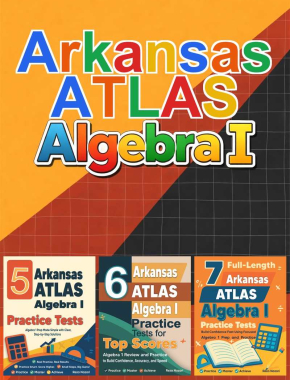
Want the fastest path through Arkansas ATLAS Algebra 1 math? This bundle pulls it together, four full practice-test books with complete, step-by-step answer keys, instant PDF download.

Related to This Article
More math articles
- Chapter 13: The Federal Bureaucracy
- 4th Grade PSSA Math FREE Sample Practice Questions
- How to Develop Foundational Math Skills for Career Success
- The Real Job an RNG Does Inside a Slot Machine
- Active Reading Strategies
- 6th Grade OST Math Practice Test Questions
- Maine Through Year Assessment Grade 8 Math Free Worksheets: Printable Grade 8 Math Practice for Every Skill
- The Best AFOQT Math Worksheets: FREE & Printable
- Best Scientific Calculators for School and College: Casio vs. TI
- Tips You MUST Know to Retake the Praxis Core Math Test










What people say about "Arkansas ATLAS Algebra 1: Free Worksheets"?
No one replied yet.