Free Washington, D.C. Grade 2 Math Worksheets
Free Washington, D.C. Grade 2 Math Worksheets: a free, printable set you can download and use right away, with answer keys, organized by topic so students can practice one skill at a time and teachers can assign exactly what a lesson needs.
Printable practice that turns counting, time, and place value into something your second grader actually looks forward to.
There’s a moment a lot of D.C. Parents will recognize. Your second grader spreads a handful of coins across the kitchen table, lines up three quarters and two dimes, and announces, with total confidence, that they have “a hundred dollars.” It’s wrong, it’s wonderful, and it tells you exactly what they’re ready to practice next.
Second grade math is full of those moments. Kids in classrooms from Capitol Hill to Petworth are building the skills that hold up everything else: reading three-digit numbers, adding and subtracting without counting on fingers, telling time, measuring with a ruler. None of it happens overnight, and a little steady practice at home goes a long way.
That’s why we put together this free collection of Grade 2 math worksheets for Washington, D.C. Families. Every page is a printable PDF with a clear answer key. No account, no email, no paywall, just download what you need and print it.
The worksheets line up with the Grade 2 math standards Washington, D.C. Has adopted, so the practice your child does at the kitchen table connects directly to the work their teacher is doing in the classroom.
What’s Inside This Collection
The collection holds 34 worksheets, sorted into eight chapters that follow the natural shape of a second grade math year. You don’t have to start at the top and march through. If your child just came home talking about arrays, jump straight to that chapter.
Each worksheet keeps a tidy, predictable layout: a short “Key Ideas” box that explains the skill in plain language, a couple of worked examples, a set of practice problems, and an answer key on the last page. That structure means a child can often work a page mostly on their own, and you can check it together when they’re done.
Here are the eight chapters and the worksheets in each.
Place Value and Number Sense
- Understanding Place Value, Shows how the same digit means something different in the ones, tens, and hundreds spot.
- Reading and Writing Numbers to 1,000, Practice moving between number words and digits, all the way up to 1,000.
- Expanded Form, Breaks a number like 358 into 300 + 50 + 8 so its parts are easy to see.
- Skip Counting, Counting by 5s, 10s, and 100s, the rhythm that makes bigger math feel quick.
- Comparing and Ordering 3-Digit Numbers, Greater than, less than, and putting numbers in the right order.
Addition and Subtraction
- Addition Facts Within 20, Friendly repetition that builds toward quick, confident recall.
- Subtraction Facts Within 20, The other half of fact fluency, with plenty of varied practice.
- Adding Within 100, Two-digit addition, including the tricky business of regrouping.
- Subtracting Within 100, Two-digit subtraction with borrowing, one careful step at a time.
- Adding Within 1,000, Stretching addition into three-digit numbers.
- Subtracting Within 1,000, Three-digit subtraction that rewards neat, organized work.
- Mentally Adding and Subtracting 10 and 100, Quick jumps in your head, no pencil required.
Word Problems and Equations
- One-Step Word Problems, Turning a short story into a single math sentence.
- Two-Step Word Problems, Problems that ask kids to do two things in the right order.
- Finding the Unknown Number, Solving for the missing piece in an equation.
Odd, Even, and Arrays
- Odd and Even Numbers, Spotting which numbers split into equal pairs and which don’t.
- Even Numbers as Equal Addends, Seeing an even number as two equal groups added together.
- Rectangular Arrays, Rows and columns of dots, the first quiet step toward multiplication.
- Repeated Addition with Arrays, Adding equal rows to find a total.
Measurement and Length
- Measuring Length with Tools, Using rulers and measuring tapes the right way.
- Estimating Lengths, Making a smart guess before measuring to check.
- Comparing Lengths, Deciding which object is longer and by how much.
- Adding and Subtracting Lengths, Combining and comparing measurements in word problems.
- Length on a Number Line, Showing distance and length on a number line.
Time and Money
- Telling Time to the Nearest Five Minutes, Reading analog clocks down to five-minute marks.
- A.M. And P.M., Knowing whether 7:00 means breakfast or bedtime.
- Counting Coins, Adding up pennies, nickels, dimes, and quarters.
- Money Word Problems, Real-life buying and change-making problems.
Data and Graphs
- Line Plots, Plotting measurement data above a number line.
- Picture Graphs, Reading graphs where pictures stand in for numbers.
- Bar Graphs, Comparing categories and answering questions from the bars.
Geometry
- Recognizing and Drawing Shapes, Naming and sketching shapes by their sides and angles.
- Partitioning Rectangles into Rows and Columns, Splitting a rectangle into a grid of equal squares.
- Equal Shares: Halves, Thirds, and Fourths, The fair-sharing ideas that lead toward fractions.
How to Get the Most Out of Them
A stack of worksheets is just paper until it’s used well. A few small habits make a big difference.
Print one page at a time. A single sheet feels doable; a thick packet feels like a chore. Let your child finish one and feel good about it.
Read the Key Ideas box together before anything else. Those few sentences are the whole lesson in miniature. Two quiet minutes there saves ten minutes of confusion later.
Walk through the worked examples out loud. Have your child explain the example back to you in their own words. If they can teach it, they’ve got it.
Check the answer key side by side. A wrong answer isn’t a problem. It’s a clue. Ask “show me how you got that,” and you’ll usually find exactly where things slipped.
Circle back. If a skill felt shaky, set that page aside and print a fresh one a week later. The second pass is where real fluency shows up.
A Note About the DC CAPE
If you’ve heard about the DC CAPE, the assessment Washington, D.C. Uses. Here’s the honest, reassuring picture: the DC CAPE doesn’t begin until third grade. There is no big standardized math test in second grade.
That’s genuinely good news. It means second grade is the foundation year, a stretch of time to build number sense, fact fluency, and steady habits without the pressure of a test on the horizon. Every worksheet in this collection strengthens exactly the skills the DC CAPE will eventually check in later grades. A child who can confidently work with three-digit numbers, solve two-step word problems, and read a graph in second grade walks into third grade ready, not rattled.
So treat this year as practice for learning itself, not test prep. The test can wait.
Frequently Asked Questions
Are these worksheets really free?
Yes, completely free. Download and print as many as you want. There’s no account to create and no email required.
Do they include answer keys?
Every worksheet has an answer key on the last page, so you can check the work without solving each problem yourself.
My child is ahead in math. Can they skip around?
Definitely. The chapters are independent. A child who’s already comfortable with addition facts can move straight to word problems or measurement.
How often should we practice?
Short and regular beats long and rare. Ten or fifteen focused minutes a few times a week keeps skills sharp without burning anyone out.
Can a D.C. Teacher use these in the classroom?
Of course. Many teachers use them for warm-ups, homework, small-group practice, or extra support. Print as many copies as you need.
One Last Thing
Second grade is the year math starts to feel solid, the year a child stops guessing and starts knowing. Pick a chapter that matches what’s happening in class this week, print a page, and sit down together. A little practice, a little encouragement, and a lot of patience will carry your D.C. Second grader a long way. You’ve got this, and so do they.
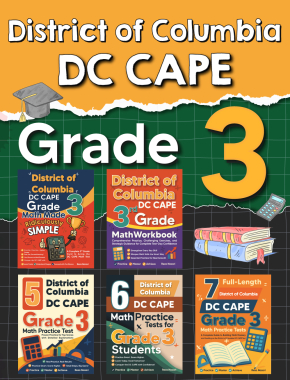
Ready for Grade 3 Math? The Washington, D.C. Grade 3 Math Bundle
Second grade is the build-up year, and when your child is ready for what comes next, this bundle makes the jump to Grade 3 math feel easy. It packs full practice-test books, complete answer keys, and step-by-step explanations for the Grade 3 math skills just ahead.
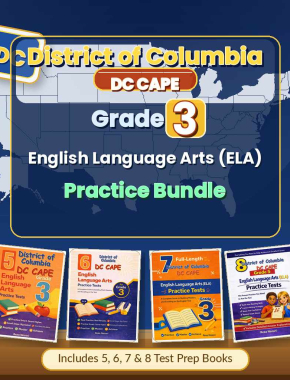
Getting Ready for Grade 3 English, Too? The Washington, D.C. Grade 3 English Bundle
Reading and writing grow right alongside math. If your second grader could use a head start in English as well, this Washington, D.C. Grade 3 English bundle covers it — practice tests, answer keys, and friendly explanations in one download.

Related to This Article
More math articles
- District of Columbia Algebra 1 Free Worksheets: 64 Free Printable Algebra 1 Practice PDFs
- Top Calculators for the TASC 2026: Quick Review
- Top 10 Tips You MUST Know to Retake the ISEE Math
- The Best Grade 7 Math Book for Washington Students
- How to Solve Trigonometric Equations?
- Executive Office of the President
- Checks and Limits on Judicial Power
- The Harlem Renaissance and Garveyism
- Goals and concerns of the framers
- Solutions and Separating Mixtures







What people say about "Washington DC Grade 2 Math Worksheets"?
No one replied yet.