Grade 2 Math Practice for South Carolina Second Graders
TL;DR: Free printable Grade 2 math worksheets for South Carolina families and teachers – place value, two- and three-digit addition and subtraction, time, money, measurement, and word problems aligned with the SC College- and Career-Ready math standards.
Key takeaways:
- South Carolina’s SC READY math test starts in grade 3, so grade 2 is the foundation year.
- Worksheets cover place value to \(1{,}000\), addition and subtraction within 1000, time, money, measurement, and word problems.
- All worksheets are free PDFs – print as many copies as you need.
- Aligned with the South Carolina College- and Career-Ready Standards for Mathematics at grade 2.
- Short daily practice (10-15 minutes) builds the fluency SC READY expects in grade 3.
Free printable worksheets that build real number sense, no signup, no stress.
Hand a second grader a fistful of base-ten blocks and ask them to build the number 234. Watch what happens. They reach for two of the big flat hundred-squares, count out three of the ten-rods, and grab four little unit cubes. Just like that, a number on paper turns into something they can hold. That’s second-grade math at its best, abstract ideas made real enough to touch.
If you’re raising or teaching a second grader in South Carolina, this page is for you. We’ve gathered a complete collection of free, printable Grade 2 math worksheets that cover every major topic of the year, from place value to fractions of a shape.
Each worksheet is a clean, ready-to-print PDF. Each set comes with a full answer key. And nothing is locked behind a form, no account, no email, no subscription. Find the worksheet you want, print it, and you’re set.
The pages follow the Grade 2 math standards South Carolina has adopted, so they line up with what your child is learning in class. Use them to reinforce a wobbly skill, to review before moving on, or simply to keep math sharp during a school break.
A Look at What’s Inside
The collection is split into eight chapters. Each chapter covers a major strand of second-grade math, and the worksheets within build up gradually from easier ideas to harder ones.
The eight chapters are:
- Place Value and Number Sense
- Addition and Subtraction
- Word Problems and Equations
- Odd, Even, and Arrays
- Measurement and Length
- Time and Money
- Data and Graphs
- Geometry
Feel free to skip around. Whatever your child is working on this week is a fine place to start. Each worksheet leads off with a short Key Ideas box, includes a worked example, offers a set of practice problems, and finishes with an answer key.
The Worksheets
Place Value and Number Sense
- Understanding Place Value, Learning that where a digit sits decides how much it’s worth.
- Reading and Writing Numbers to 1,000, Translating between number words and numerals all the way to 1,000.
- Expanded Form, Splitting a number into hundreds plus tens plus ones.
- Skip Counting, Counting by 2s, 5s, 10s, and 100s until the pattern sticks.
- Comparing and Ordering 3-Digit Numbers, Deciding which number is larger and putting numbers in order.
Addition and Subtraction
- Addition Facts Within 20, Practice that makes sums under 20 feel automatic.
- Subtraction Facts Within 20, Quick subtraction drills to match the addition facts.
- Adding Within 100, Two-digit addition, regrouping and all.
- Subtracting Within 100, Two-digit subtraction with borrowing, taken one step at a time.
- Adding Within 1,000, Three-digit addition that stretches your child’s skills.
- Subtracting Within 1,000, Three-digit subtraction that rewards neat, careful work.
- Mentally Adding and Subtracting 10 and 100, Adding or subtracting tens and hundreds without a pencil.
Word Problems and Equations
- One-Step Word Problems, Story problems that need a single operation to solve.
- Two-Step Word Problems, Two-part problems that build planning and patience.
- Finding the Unknown Number, Working out the missing number that makes an equation true.
Odd, Even, and Arrays
- Odd and Even Numbers, Testing numbers by pairing objects to see what’s left over.
- Even Numbers as Equal Addends, Showing that even numbers are made of two equal parts.
- Rectangular Arrays, Arranging objects in neat rows and columns to count.
- Repeated Addition with Arrays, Adding equal rows to find a total, a gentle lead-in to multiplication.
Measurement and Length
- Measuring Length with Tools, Using rulers and tape measures the proper way.
- Estimating Lengths, Sizing something up by eye before measuring to check.
- Comparing Lengths, Working out the difference between two lengths.
- Adding and Subtracting Lengths, Combining lengths to answer measurement word problems.
- Length on a Number Line, Showing length and distance on a number line.
Time and Money
- Telling Time to the Nearest Five Minutes, Reading analog clocks down to each five-minute mark.
- A.M. And P.M., Telling whether a time falls in the morning or the evening.
- Counting Coins, Adding pennies, nickels, dimes, and quarters into a total.
- Money Word Problems, Everyday questions about buying things and getting change.
Data and Graphs
- Line Plots, Plotting measurements above a number line to see the spread.
- Picture Graphs, Reading graphs that use pictures to represent counts.
- Bar Graphs, Building and reading bars to compare amounts.
Geometry
- Recognizing and Drawing Shapes, Naming shapes by their sides and corners, then drawing them.
- Partitioning Rectangles into Rows and Columns, Splitting a rectangle into equal squares and counting them.
- Equal Shares: Halves, Thirds, and Fourths, Dividing shapes into fair pieces, the first step toward fractions.
How to Use These Worksheets Well
Printing pages is the easy part. Using them in a way that actually helps your child takes a little intention. Here’s what works for most second graders:
- Stick to one page at a time. A single worksheet, done carefully, teaches far more than a thick packet rushed through. Short sessions keep kids engaged.
- Read the Key Ideas box first. It’s compact for a reason. Going over it together gets your child’s mind ready before the problems begin.
- Work the example out loud. Don’t breeze past it. Talking through the worked example gives your child a clear model to follow.
- Check the answer key as a team. When an answer’s wrong, treat it as a puzzle. Help your child track down the slip and correct it themselves.
- Revisit weak skills. Set the page aside, wait a week, then try it again. That space between attempts is what makes a skill stick.
What to Know About SC READY
South Carolina’s statewide test is SC READY, South Carolina College- and Career-Ready Assessments. Here’s something worth knowing if you have a second grader: the SC READY math test begins in third grade. Your child won’t take it in second grade.
That’s reassuring, and it shapes how to think about this year. Second grade is the foundation year. Without a state test hanging over it, there’s freedom to focus on real, lasting understanding instead of test-day strategies.
And the skills on these worksheets are exactly the ones SC READY will eventually expect. Place value, fluent computation, measuring length, reading a clock, making sense of graphs and word problems. That’s the toolkit a third grader needs walking into the test. Build it solidly now, and the rest gets a whole lot easier later.
Frequently Asked Questions
Are these worksheets free? Yes, every one of them. There’s no charge, no account to create, and no email to provide. Just download and print.
Do they include answer keys? They do. Each set comes with answers so you can check work together and pinpoint where your child needs more help.
How long should a practice session last? For second graders, ten to fifteen focused minutes is plenty. Short and consistent beats long and tiring.
Can these help a child who’s behind in math? Yes. Start a chapter or two earlier than grade level if needed and build up. The gradual progression makes it easier to fill in gaps.
Will this prepare my child for SC READY? Indirectly, and powerfully. SC READY starts in third grade, but strong second-grade math is the best foundation your child can have for it.
To Wrap Up
Second grade is when math quietly becomes part of daily life, counting change, checking the clock, sharing a treat fairly. These free worksheets are here to support that, one friendly page at a time. Print a set, settle in next to your South Carolina second grader, and let the practice build. Steady effort now turns into real confidence down the road.
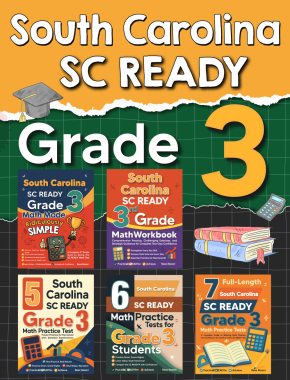
Ready for Grade 3 Math? The South Carolina Grade 3 Math Bundle
Second grade is the build-up year, and when your child is ready for what comes next, this bundle makes the jump to Grade 3 math feel easy. It packs full practice-test books, complete answer keys, and step-by-step explanations for the Grade 3 math skills just ahead.
Getting Ready for Grade 3 English, Too? The South Carolina Grade 3 English Bundle
Reading and writing grow right alongside math. If your second grader could use a head start in English as well, this South Carolina Grade 3 English bundle covers it — practice tests, answer keys, and friendly explanations in one download.
Recommended EffortlessMath Books
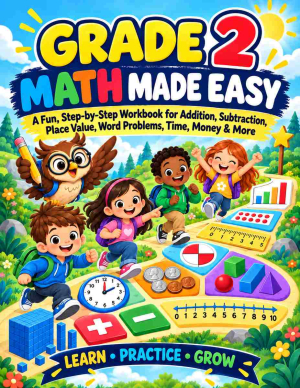
For a workbook that pairs neatly with these printable practice pages, Mastering Grade 2 Math walks your child through every second-grade topic with clear examples and lots of try-it-yourself problems. For extra word-problem practice (the part many second graders find hardest), see Mastering Grade 2 Math Word Problems.
Related EffortlessMath Lessons
If a topic on this page feels rusty, these short lessons go deeper:
- How to add and subtract two-digit numbers
- Place value to the hundreds
- How to tell time to the nearest five minutes
- How to count coins and dollar bills
- How to solve word problems

Related to This Article
More math articles
- Words for Character and Attitude
- Free Grade 4 English Worksheets for Texas Students
- Presidential nomination process
- DAT Quantitative Reasoning Math Practice Test Questions
- How to Multiply Decimals and Whole Numbers?
- How limited attention and framing affect choices
- Reaction Types and Redox: Recognizing What Changes
- The Best Grade 3 ELA Practice Tests for Maine Students
- Biotechnology: PCR, DNA Gels, and Gene Editing
- How to Analyze Cross Sections of 3D Solids: A Step-by-Step Guide







What people say about "Grade 2 Math Worksheets for South Carolina"?
No one replied yet.