New Mexico Algebra 1 Free Worksheets: Printable Algebra 1 PDFs with Worked Solutions
Every long subject has a moment where the inside view becomes more important than the outside view. In reading, it is the day a child stops sounding out letters and starts hearing the sentence. In music, it is the day a student stops counting beats and starts feeling the meter. In math, that moment shows up in Algebra 1. A student stops chasing the answer one operation at a time and begins to see whole equations as objects, things that can be rearranged, balanced, factored, and read like sentences. The work is the same, but the way it lives in the mind has changed.
Reaching that inside view is mostly a matter of practice on small pieces, repeated calmly across a year. From Albuquerque to Las Cruces, from a quiet study afternoon in Rio Rancho to a kitchen table in Santa Fe, the path looks the same: a worked example, a few problems, an honest self-check, then the next skill. Algebra 1 is a long sequence of small skills, and the year goes well for the students who get to spend unhurried time with each of them in turn.
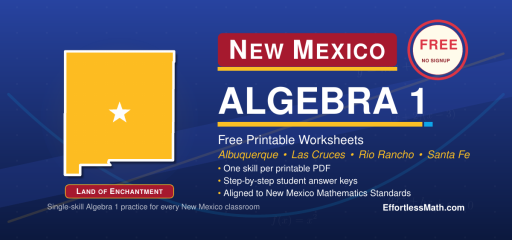
These 71 worksheets are made to give a student unhurried time with each one. One skill per page, one example, one student-friendly answer key.
What’s on this page
Seventy-one single-skill PDFs aligned to the New Mexico Algebra 1 standards. The list mirrors the bones of the course: linear equations and inequalities, slope and lines, linear and exponential functions, systems of equations, exponents and radicals, factoring, and quadratic equations and functions. Each PDF stays inside one skill, no surprise topic switches halfway through.
Every page opens with a one-page Quick Review: the skill in plain words and one example worked all the way through, with the reasoning visible step by step. Then twelve practice problems climb from comfortable into thoughtfully harder. The final page is a student-facing answer key, not just final answers, but short, friendly explanations a fifteen-year-old can read on their own and learn from.
Foundations of Algebra
Algebra opens by turning words and quantities into symbols, then leaning on the order of operations and core properties to keep them honest. In Albuquerque classrooms it tends to separate confident students from hesitant ones.
- Variables, Expressions, and Properties
- Order of Operations and Evaluating Expressions
- Simplifying Algebraic Expressions
- Introduction to Equations and Solutions
- Personal Financial Literacy
Solving Linear Equations
Equation work begins in earnest, balancing both sides through one-, two-, and multi-step problems and variables that appear on each side. Steady practice now makes the New Mexico Algebra 1 course feel far more manageable later.
- Solving One-Step Equations
- Solving Two-Step Equations
- Solving Multi-Step Equations
- Equations with Variables on Both Sides
- Literal Equations and Formulas
Inequalities and Absolute Value
Students extend equation skills to inequalities, learn exactly when the inequality flips, and treat absolute value as distance. Master it early and the rest of the New Mexico course leans on it with ease.
- Solving One-Step Inequalities
- Solving Multi-Step Inequalities
- Compound Inequalities
- Absolute Value Equations
Relations, Functions, and Sequences
Functions, their notation, and their domains and ranges anchor the chapter, with sequences as a first concrete example. It’s a frequent early hurdle for learners in Albuquerque and across the state.
- Relations and Functions
- Function Notation and Evaluating Functions
- Domain and Range
- Graphing Functions and Transformations
- Arithmetic Sequences as Linear Functions
- Geometric Sequences
- Comparing Functions
- Piecewise Functions
- Combining Functions
- Inverse Functions
Linear Functions and Their Graphs
Lines get the full treatment, from slope and its meaning to the equation forms and variation models built on them. These worksheets give New Mexico students focused, low-pressure practice.
- Slope and Rate of Change
- Slope-Intercept Form
- Point-Slope Form
- Standard Form of a Linear Equation
- Writing Linear Equations from Graphs and Tables
- Parallel and Perpendicular Lines
- Inverse Variation
- Understanding Graphs as Solution Sets
Systems of Equations and Inequalities
Two conditions at once: solving systems by graphing, substitution, and elimination, then extending to systems of inequalities. For New Mexico students, fluency here shows up directly on the New Mexico Algebra 1 course.
- Solving Systems by Graphing
- Solving Systems by Substitution
- Solving Systems by Elimination
- Applications of Systems of Equations
- Systems of Linear Inequalities
- Solving Linear-Quadratic Systems
Exponents, Polynomials, and Real Numbers
Students master exponent properties, operate on polynomials, and place every value within the real-number system. Getting comfortable here pays off all the way through the New Mexico Algebra 1 course.
- Properties of Exponents
- Adding and Subtracting Polynomials
- Multiplying Polynomials
- Special Products of Polynomials
- Rational and Irrational Numbers
Factoring
The chapter is the key to many quadratics, teaching how to break expressions back into their factors. Time spent here is time saved when the New Mexico Algebra 1 course rolls around.
- Greatest Common Factor and GCF Factoring
- Factoring Trinomials: \(x^2 + bx + c\)
- Factoring Trinomials: \(ax^2 + bx + c\)
- Factoring Special Products
Quadratic Functions and Equations
Quadratics anchor this unit, their graphs, multiple solving methods, and the role of the discriminant. Across New Mexico, this is one of the skills that rewards regular reps.
- Graphing Quadratic Functions
- Characteristics of Quadratic Functions
- Solving Quadratics by Factoring
- Solving Quadratics by Completing the Square
- Solving Quadratics by Square Roots
- The Discriminant
- The Quadratic Formula
Statistics and Probability
Here numbers describe the world: spread and center, visual displays, correlation, and the basics of probability. It is worth the extra reps for New Mexico learners aiming for a strong score on the New Mexico Algebra 1 course.
- Measures of Center and Spread
- Scatter Plots and Correlation
- Lines of Best Fit and Predictions
- Counting Principles
- Probability
- Two-Way Frequency Tables
Exponential Functions and Modeling
Growth and decay by a constant factor, graphing exponential functions, and comparing them with linear and quadratic models. Albuquerque families can use these pages to lock the skill in before it’s tested.
- Graphing Exponential Functions
- Comparing Linear, Quadratic, and Exponential Models
- Exponential Growth
- Interpreting Functions and Parameters
More Topics
- Absolute Value Inequalities
- Direct Variation
- Displaying Data with Box Plots
- Displaying Data with Histograms
- Exponential Decay
- Graphing Cube Root Functions
- Graphing Square Root Functions
How to use these worksheets at home
Algebra 1 has a small number of natural pairings, and using them is the single highest-use thing you can do with this set. Print “Solving Two-Step Equations” right before “Solving Multi-Step Equations”, the second is the first with one more move added. Run “Slope and Rate of Change” the day before “Slope-Intercept Form,” and the slope number a student just calculated walks straight onto a graph as the m of y = mx + b. Print “Factoring Trinomials” the night before “Solving Quadratics by Factoring,” and what felt like two separate topics becomes one continuous idea: factor first, then set each factor to zero.
The rhythm at home should be short and frequent rather than rare and long. Twenty minutes, two or three times a week, finished cleanly and checked against the answer key, will outperform a desperate weekend session every time. New Mexico evenings have their own shape, family, work, weather, sports, and the worksheets are designed to fit inside that shape, not push against it. One quiet sitting per page is the whole expectation.
Give the answer key to the student. At 14 and 15, owning the self-check is part of the math. Let them grade the page, let them be the one to spot the missed negative or the forgotten distribution, and ask them, gently, for one sentence about where the reasoning slipped. That sentence is where the skill becomes permanent, and it is hard to manufacture from the other side of the table.
A note about Algebra 1 in New Mexico
New Mexico students take Algebra 1 under the state’s Algebra 1 standards, which align with the Common Core framework. The course typically closes with a cumulative assessment in the spring window, either a state-supported end-of-course exam or a district final, drawing from the same standards these worksheets are aligned to. The expected skills are familiar: solve linear equations and inequalities, work fluently with linear and exponential functions, solve systems, manipulate algebraic expressions including those with exponents, factor and solve quadratic equations, and reason about real-world data and the key features of graphs.
Because every PDF here is built around a single standard, the set works as a calm, evidence-based checklist as that spring window approaches. Print a sheet, see how it goes, and let the page itself decide the next one. A clean self-check is permission to move on; a stumble is a clear pointer to the prerequisite worksheet that will fix it faster than rereading the whole chapter. That kind of focused study is what turns a year-long course into a finishable line of work.
A short closing
Algebra 1 turns from overwhelming into steady about the time a student finishes one quiet PDF on their own, checks it themselves, and sees that the page is done. Bookmark this set, print one tonight, and let your New Mexico student begin with whichever skill is closest to almost-easy. The rest of the course tends to follow that first finished page more naturally than you might expect.
New to Algebra? Start with the basics


Related to This Article
More math articles
- Near Synonyms and Commonly Confused Words
- How long Is the CBEST Test Valid?
- Pocket veto
- Reading Scientific Diagrams and Captions
- Liters and Milliliters for 4th Grade
- Lines of Symmetry for 4th Grade
- The Best Grade 3 ELA Practice Tests for Maine Students
- Estimation Expedition: How to Solve Word Problems with Approximate Sums and Differences
- How to Unravel the Mysteries of Infinite Limits
- How to Decipher the Secrets: “CLEP College Math for Beginners” Complete Solution Manual









What people say about "New Mexico Algebra 1: Free Worksheets"?
No one replied yet.