NCLEX-PN Select N vs. SATA: How Scoring Differs (2027 Prep)
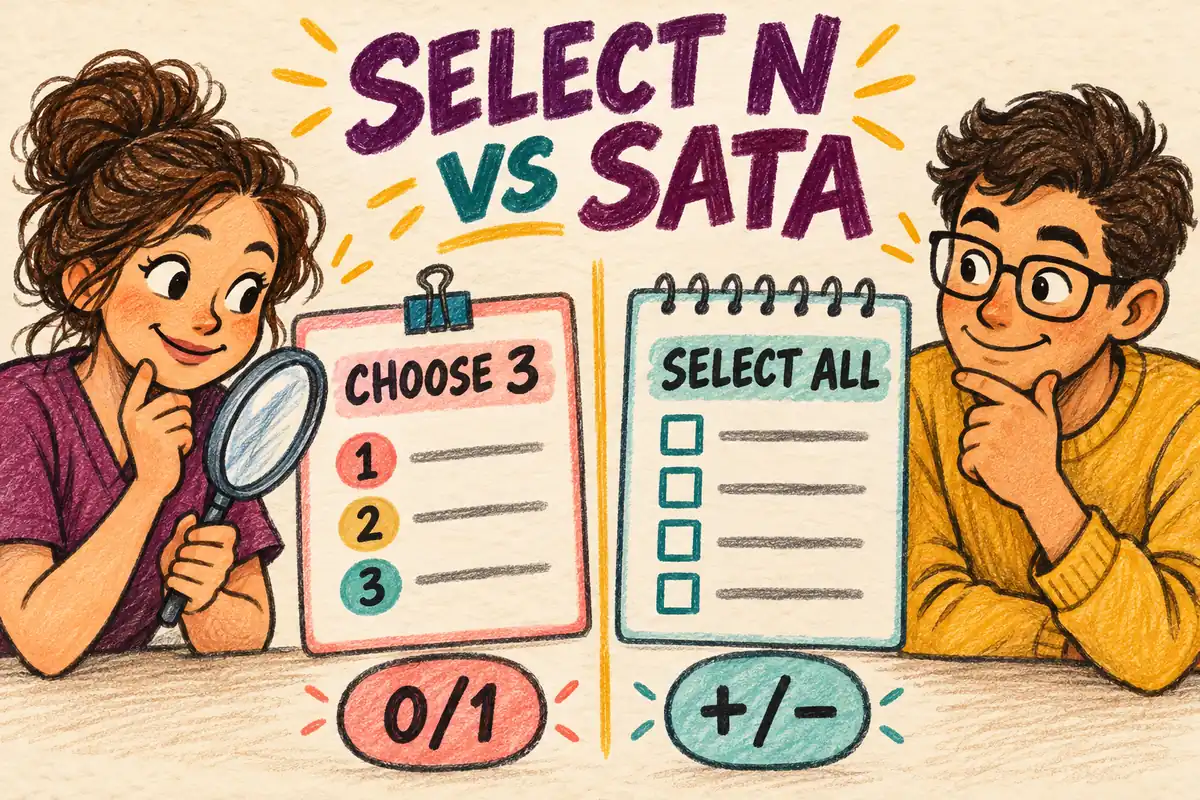
On a Select N item, the stem tells you how many responses to choose. “Select all that apply” (SATA) leaves that number open. That line changes the score. Mark it before weighing the choices.
The examples here use made-up answer labels. They show scoring mechanics only, not real NCLEX questions or clinical guidance.
Read the response command first
NCSBN’s FAQ sorts them by the stem’s command. A specified count such as “Choose 3” uses zero/one scoring. A SATA item permits as many or as few selections as apply and uses plus/minus scoring. Correct picks earn one point. Wrong picks earn zero. Under plus/minus, a correct selection adds a point, an incorrect one subtracts a point, and the item score cannot fall below zero. The 2026 PN Test Plan lists all three.
| Stem says | Key and your response | Rule | Fictional raw score |
|---|---|---|---|
| Choose 3 | Key: A, C, E. You choose A, B, C. | Zero/one: correct picks add points. Wrong picks add zero. | 2 of 3 |
| Select all that apply | Key: A, C, E. You choose A, B, C. | Plus/minus: two correct selections minus one incorrect selection. | 1 of 3 |
The response is identical in both rows. The command changes the arithmetic. A and C earn points. B earns zero. On SATA, B subtracts one. The score is one. This is a small raw-score example built from the published rules, not an estimate of how any real candidate will perform.
Try three quick checks
- The prompt says “Select 2.” You identify one keyed choice and one distractor. Which rule applies, and how many raw points do you earn?
Check your reasoning
Zero/one applies because the stem gives a fixed count. You earn one point for the correct choice. The distractor earns zero. Your point stays.
- The prompt says SATA. The key is A and D. You choose A, B, and D. What is the item score?
Check your reasoning
A and D add two. B subtracts one. The fictional item score is one point.
- Can an item score go below zero?
Check your reasoning
No. The NCSBN FAQ says negative plus/minus totals are rounded up to zero. A zero floor applies to that item. It does not create a negative score to carry elsewhere.
Keep the item score in its lane
These examples explain points on one fictional item. A question-bank percentage cannot predict an NCLEX result. NCLEX-PN uses computerized adaptive testing to estimate each candidate’s ability against the passing standard described in the 2026 Test Plan. A practice platform can use its own scoring and readiness labels, so keep those results separate from an official exam result.
There’s a third method: rationale scoring. It links an action to its reason. Both parts must be correct to earn credit. You do not need that extra rule to tell Select N from SATA, but it explains why not every multi-part item follows the same arithmetic.
Before you tap an answer
Underline the words that set the count. When the stem names a number, decide which options answer the prompt, then count correct targets within the limit it gives you. For SATA, test each option against the stem. Extra wrong picks can lower the score. Do not add choices just to chase points.
For practice materials, visit the NCLEX-PN study hub. Check NCSBN’s current PN Test Plan and official scoring FAQ when you need the source rule.
Independent exam-preparation material. The examples are fictional and do not reproduce official NCLEX items or provide clinical or legal advice. Effortless Math is not affiliated with NCSBN or Pearson VUE.

Related to This Article
More math articles
- Louisiana LEAP Grade 6 Math Free Worksheets: Free PDF Math Worksheets with Clear Answer Keys
- 6th Grade Math Worksheets for California (CAASPP): 72 Free Printable PDFs
- 10 Tips for Advanced Studying Mathematics
- How to Solve Multiplication Inequalities
- Congressional caucuses
- Grade 2 English Worksheets for Washington, D.C. Students
- How to Perform Vector Addition and Subtraction
- Free Grade 3 English Worksheets for Pennsylvania Students
- 6th Grade ACT Aspire Math Worksheets: FREE & Printable
- High School Geometry: A Friendly Overview for Students

















What people say about "NCLEX-PN Select N vs. SATA: How Scoring Differs (2027 Prep) - Effortless Math"?
No one replied yet.