NCLEX-PN Priority and Delegation: 3 Practice Questions (2027 Prep)

A priority question asks which finding needs attention first. Delegation questions can test who is suitable, whether the situation fits, or whether the directions and follow-up are clear. They may share a shift report. Read the last line first.
Every scenario is fictional. Practice only. Local rules, policy, client needs, and competence all matter.
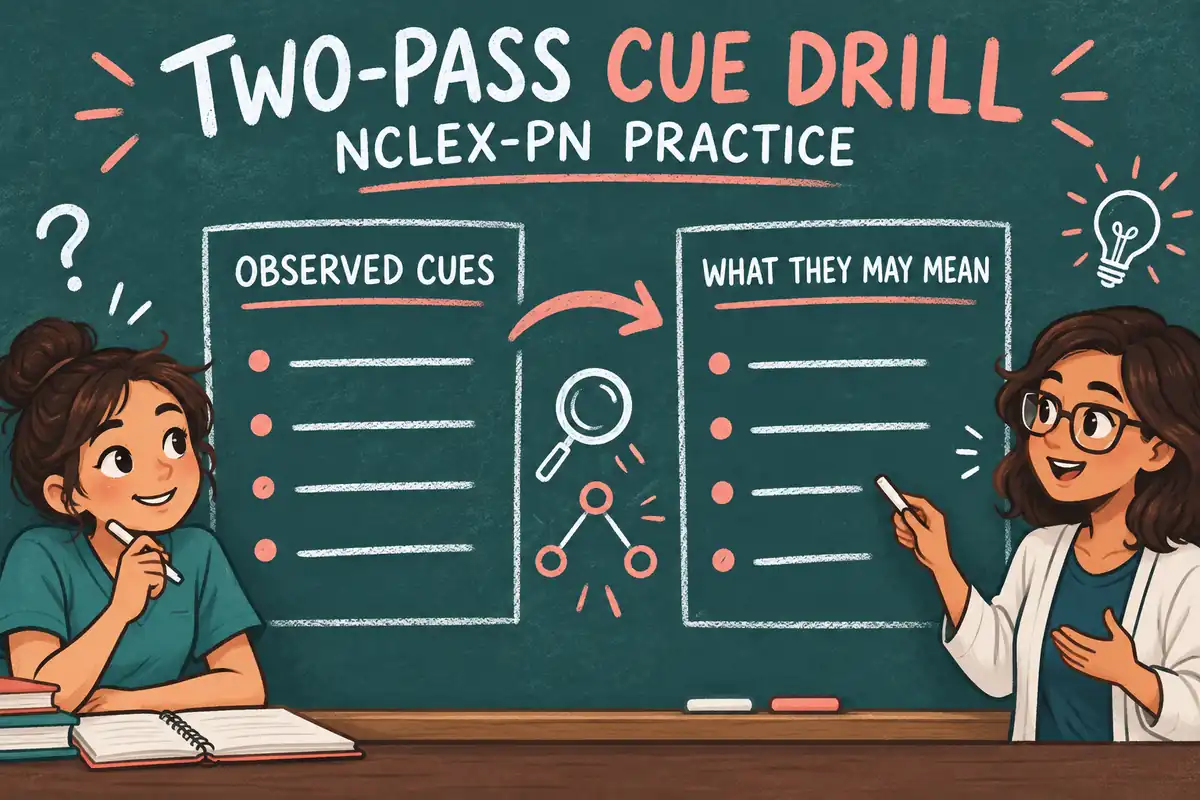
First, name the job the question is asking you to do
Look at the verb in the question. “Which client should be reported first?” asks you to rank urgency. “Which instruction is clearest?” tests communication. “Which task fits this person?” points toward role, skill, and circumstances. Those questions use different clues.
| Question type | Your first check | Clue to underline |
|---|---|---|
| Priority | Which need could become unsafe soonest? | A new or worsening finding |
| Assignment or delegation | Does the task, situation, person, direction, and follow-up fit? | Role, competency, stability, or missing instructions |
The 2026 NCLEX-PN Test Plan lists both organizing and prioritizing care and assignments/delegation. It also calls out comparing a client’s needs with staff knowledge and ability, and telling a supervisor when a status change means an assignment may need revision. Read the official NCLEX-PN Test Plan.
Practice 1: Which cue calls for emergency action now?
In this fictional shift report, which finding needs emergency action now?
- A client suddenly has new trouble breathing and can no longer speak a full sentence.
- A client with a long-standing knee ache asks when the next scheduled comfort measure is due.
- A stable client asks when routine discharge teaching will begin.
- A client asks whether lunch can arrive before a scheduled activity.
Check the answer and reasoning
Answer: A. New breathing difficulty that prevents a full sentence can signal an immediate threat. The stem asks what needs emergency action now, so follow the setting’s emergency process. This is not a routine report.
B describes long-standing pain. C is routine teaching for a stable client, and D is a scheduling preference. All three deserve follow-up. Option A gives the immediate emergency cue.
Practice 2: Which delegation direction is complete?
Assume the client is stable, the helper is trained and competent, and policy permits the task. Which direction gives clear steps and a report-back cue?
- “Help Ms. Lee get moving today.”
- “Walk Ms. Lee 20 feet with her walker at 0900 and 1300, as listed in the plan. Tell the assigned nurse before continuing if she reports dizziness.”
- “Walk her when the hall is quiet.”
- “Keep her active if you can.”
Check the answer and reasoning
Answer: B. The distance and times make the task observable. The NCSBN plan includes a sample assignment item with a measurable distance and interval. This original example also states what to report before continuing.
A and D leave the task open to interpretation. C leaves timing vague and says nothing about reporting. Clear direction answers what to do and when, then marks the detail that should return to the nurse.
Practice 3: What status change can alter the assignment?
A helper is carrying out a planned walk. Which update changes the circumstances and should be passed to the supervising nurse for assignment review?
- The helper asks where the walking log is kept.
- The client who usually bears weight for the planned walk now cannot bear weight.
- The client asks to walk after a scheduled phone call.
- The helper has completed the planned walk and recorded the distance.
Check the answer and reasoning
Answer: B. The client’s status has changed, so the circumstances behind the assignment have changed too. The 2026 plan specifically names reporting a client-status change to a supervisor when care assignments may need to change.
A asks for a location. C is a timing preference. D reports a completed routine task. Only B describes a client-status change that can alter the assignment.
Keep a small review card
When you miss one, copy the exact word that decided it: “first,” “clearest,” or “changed.” Then label the missing check: urgency, task, circumstances, person, direction, or follow-up. A short error log like that helps you see whether you misread the question or missed a role clue.
For more practice, visit the NCLEX-PN study hub, which has the full practice test and related preparation resources. For test-plan details, check NCSBN’s official NCLEX-PN page as your exam date approaches.
Independent exam-preparation material. These fictional practice questions are not official NCLEX items and do not give clinical or legal advice. Effortless Math is not affiliated with NCSBN or Pearson VUE.
Independent NCLEX-PN practice-test preparation. Sources checked October 14, 2026. Practice examples are fictional and do not replace applicable law, policy, role scope, or worker competence. Effortless Math is independent of NCSBN and Pearson VUE.

Related to This Article
More math articles
- Unified government
- 8th Grade Common Core Math FREE Sample Practice Questions
- The Best Grade 4 Math Book for Missouri Students
- 3rd Grade MAAP Math Worksheets: FREE & Printable
- Action, Linking, and Helping Verbs
- Virginia Grade 2 Math Worksheets — Free Printable PDFs
- Using Number Lines to Represent Rational Numbers
- Free Grade 4 English Worksheets for Massachusetts Students
- The Ultimate FSA Algebra 1 Course (+FREE Worksheets)
- FREE 3rd Grade PSSA Math Practice Test
















What people say about "NCLEX-PN Priority and Delegation: 3 Practice Questions (2027 Prep) - Effortless Math"?
No one replied yet.