The Writing Process and Citing Sources
Nobody writes a clean final draft in one pass — not professional writers, not professors, and not the people who write test passages. Good writing is built in stages, and exams check whether you know what belongs in each stage: what you do before drafting, what “revising” actually means, and how it differs from “editing.”
Tangled up with all of this is one more skill: knowing when the words and ideas you are using belong to someone else, and what you owe that person. That is what citing sources is about, and it is far simpler than students fear.
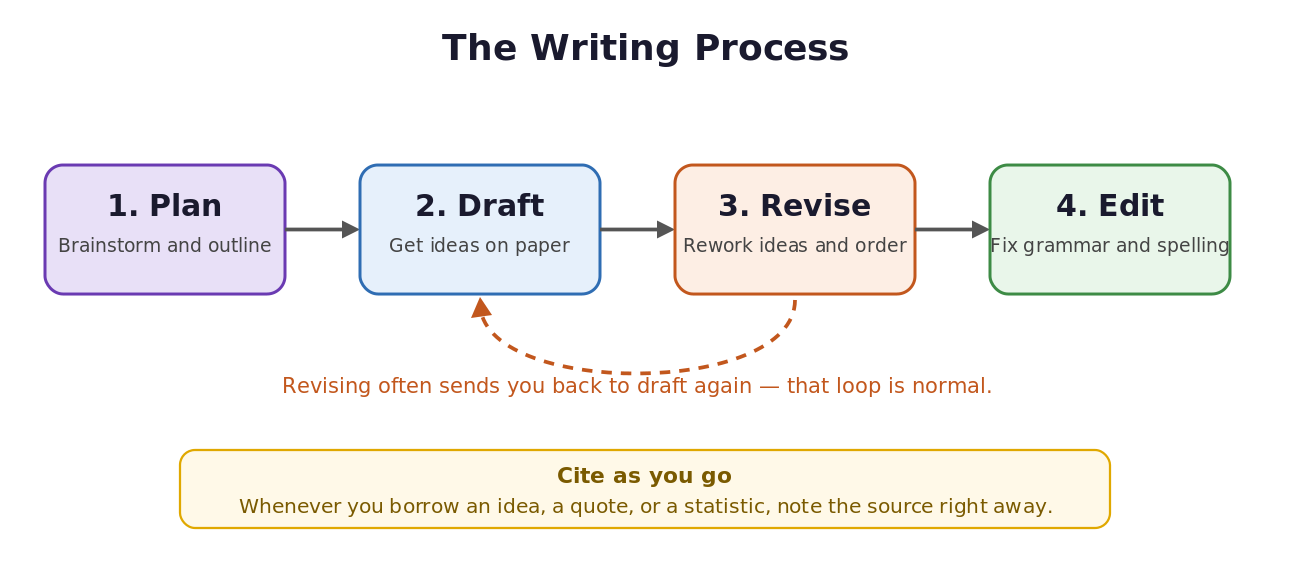
The writing process is the sequence of stages a writer moves through to produce a finished piece: planning (choosing a topic, gathering and organizing ideas), drafting (writing the ideas out in full sentences), revising (reworking content, order, and clarity), and editing (correcting grammar, spelling, and punctuation). Citing a source means crediting the original author whenever you borrow words, ideas, or data.
What happens in the planning stage?
Planning (also called prewriting) is everything you do before writing full sentences: brainstorming, narrowing the topic, jotting ideas, researching, and sketching an outline. If a question describes a student “making a list of ideas” or “organizing notes into an outline,” that student is planning. The purpose is to decide what to say and in what order before worrying about how each sentence sounds.
What is the difference between drafting, revising, and editing?
These three get confused constantly, and test writers know it. Drafting is getting complete sentences onto the page without chasing perfection. The last two stages are where the real mix-ups happen:
| Revising | Editing | |
|---|---|---|
| Looks at | Ideas, organization, clarity | Grammar, spelling, punctuation |
| Typical moves | Reorder paragraphs, cut a weak point, add an example, sharpen the thesis | Fix a comma splice, correct “recieve,” change a verb tense |
| Question it asks | “Does this say the right things in the right order?” | “Is every sentence technically correct?” |
| When | Before editing — big changes first | Last — no point polishing sentences you may delete |
A memory hook: revising re-sees the ideas; editing polishes the surface. Moving a paragraph is revising. Fixing its commas is editing.
When do I need to cite a source?
Cite whenever the material came from someone else’s work. That includes:
- Direct quotations — someone else’s exact words, in quotation marks.
- Paraphrases and summaries — someone else’s ideas restated in your own words. Changing the wording does not remove the debt.
- Facts, statistics, and research findings that are not common knowledge — “a 2019 study found that…” always needs a source.
You do not need to cite common knowledge (facts an educated reader could find in any general reference, like “the heart has four chambers”) or your own observations, experiences, and conclusions.
What is plagiarism?
Plagiarism is presenting someone else’s words, ideas, or work as your own — whether you meant to or not. Copying a sentence without quotation marks, paraphrasing an article without naming it, and reusing a friend’s paper are all plagiarism. Intent does not rescue you: a sloppy paraphrase with no citation is treated the same as deliberate copying. In nursing and other health programs the stakes are high because academic honesty policies are strict, so the working habit to build is simple: when in doubt, cite. A citation never hurts you; a missing one can.
Worked examples: which stage, and does it need a citation?
Example 1. Dana reads her draft and realizes the second paragraph would work better as the opener, so she moves it. Which stage? She is changing organization, not correcting errors — this is revising.
Example 2. Marcus writes, “Nearly one in three new nurses reports significant sleep disruption during the first year.” He read this figure in a journal article. Citation? Yes. It is a specific statistic from someone else’s research, even though he wrote the sentence himself.
Example 3. Priya writes, “Blood carries oxygen from the lungs to the body’s tissues.” Citation? No. That is common knowledge available in any anatomy reference.
What is my writing-and-citing routine?
- Plan: brainstorm, narrow the topic, and outline before drafting.
- Draft: write complete sentences without stopping to perfect them.
- Note every source as you use it — do not trust yourself to remember later.
- Revise: fix ideas, order, and clarity first.
- Edit: then correct grammar, spelling, and punctuation.
- Final check: every quote, paraphrase, and statistic points to its source.
Watch: A Short Video Lesson
Dr. Dan Lawrence walks through this skill clearly in a few minutes. It is a helpful companion to the reading above:
Practice: stages and sources
- A student jots a list of possible topics and circles one. Which stage of the writing process is this?
- Put these in order: editing, drafting, planning, revising.
- A student deletes an off-topic paragraph and adds a stronger example. Revising or editing?
- A student fixes “their” to “there” in three places. Revising or editing?
- You restate a researcher’s theory entirely in your own words. Do you need a citation?
- Which of these needs no citation: (a) a direct quote from a textbook, (b) the fact that water freezes at 32 degrees Fahrenheit, (c) a statistic from a nursing journal?
Answers
- Planning (prewriting).
- Planning, drafting, revising, editing.
- Revising — the changes are about content and organization.
- Editing — surface-level corrections.
- Yes. Paraphrasing borrows the idea, and ideas require credit.
- (b). It is common knowledge; the quote and the statistic both need citations.
Where this fits in your prep
The writing process is the frame that all your sentence-level skills hang on. Explore the rest of the toolkit in our English and language usage hub, see the process pay off when editing a whole passage, learn what strong revision looks like in cutting wordiness and fixing word order, build the paragraphs your drafts are made of in building a well-organized paragraph, and keep your register in check with standard, formal English.
Recommended Prep Books
These study guides and practice books help you keep building momentum as you prepare:

Related to This Article
More math articles
- Different Question Types on the ACT Math Test
- Comte, Martineau, and Spencer
- Math for Sports Stats: From Batting Averages to Advanced Analytics in 2026
- The Best Grade 3 ELA Practice Tests for Delaware Students
- Perimeter for 4th Grade
- Decimal Subtraction for 4th Grade
- 5th Grade North Carolina End-of-Grade Math Worksheets: FREE & Printable
- SSAT Upper Level Math Flashcards (Free Online: Formulas, Terms & Concepts)
- Free Grade 2 English Worksheets for Michigan Second Graders
- A Comprehensive Collection of FREE PSAT Math Practice Tests



















What people say about "The Writing Process and Citing Sources: A Clear Guide"?
No one replied yet.