Missouri MAP Grade 6 Math Free Worksheets: Printable Practice for Every Sixth-Grade Math Topic
There is a particular kind of question a sixth grader meets for the first time and cannot solve the old way. If 3 pounds of apples cost $4.50, what does one pound cost? A fourth grader would stare at it. A sixth grader is expected to recognize a rate hiding inside it, divide their way to a unit price, and then use that unit price to answer a dozen related questions. That single move, finding the rate, then reasoning from it, is one of the quiet engines of sixth-grade math, and it runs through ratios, percents, and proportional thinking all year long.
Grade 6 is full of moments like that. Fractions stop being things you add and start being things you divide. Numbers stretch below zero and onto a four-quadrant grid. Letters slip into arithmetic as variables, and a string of symbols becomes an expression you can evaluate or an equation you can solve. Whether a student is doing homework in Kansas City, St. Louis, Springfield, or Columbia, the year asks them to hold ideas a little longer and reason a little further than before.
These 72 worksheets give them room to practice each of those ideas on its own, without the noise of everything else.
What’s on this page
Seventy-two single-skill PDFs, each aligned to the Missouri Mathematics Standards at Grade 6. The design is deliberately narrow: one skill per file. A student practicing the division of fractions is not also being asked about box plots, and a student working on the area of triangles is not distracted by integers on the number line. Narrow focus is what makes a short practice session actually productive.
Every PDF starts with a one-page Quick Review, the skill in plain words, with one example worked all the way through. Then 20 practice problems climb from easy to hard, followed by 4 word problems that drop the skill into a real situation. The final page is a student-facing answer key written for the student: short, friendly explanations they can read alone and understand without a teacher hovering nearby.
Ratios, Rates, and Percents
- What Is a Ratio?, [6.RP.1] compare two quantities and write the comparison three ways
- Using Ratio Language, [6.RP.1] describe a ratio in words, ‘for every,’ ‘to,’ and ‘per’
- What Is a Rate?, [6.RP.2] a ratio that compares two different units, like miles per hour
- Finding the Unit Rate, [6.RP.2] divide to find the cost or amount for exactly one
- Tables of Equivalent Ratios, [6.RP.3] build a ratio table and fill in the missing values
- Graphing Ratios, [6.RP.3] plot a ratio table and see the straight line it makes
- What Is a Percent?, [6.RP.3] a percent is just a ratio out of 100, and how to read it
- Solving Percent Problems, [6.RP.3] find the part, the percent, or the whole
- Solving Rate and Ratio Word Problems, [6.RP.3] turn a real-world story into a ratio you can solve
- Converting Measurement Units, [6.RP.3] use ratios to switch between units like feet and inches
- Personal Financial Literacy, [6.RP.3] real-money math: prices, tips, and simple percent work
- Proportional vs. Non-Proportional Relationships, [6.RP.2] tell which relationships keep a constant ratio and which don’t
- Financial Literacy: Budgeting and Saving, [6.RP.3] plan a budget, track spending, and set a savings goal
- Ratios with Scale Drawings, [6.RP.3] use a scale to move between a drawing and real life
The Number System
- Dividing Fractions by Fractions, [6.NS.1] multiply by the reciprocal, and understand why it works
- Multi-Digit Division, [6.NS.2] the standard algorithm for dividing large whole numbers
- Decimal Operations, [6.NS.3] add, subtract, multiply, and divide decimals cleanly
- Greatest Common Factor and Least Common Multiple, [6.NS.4] find the GCF and LCM and know when to use each
- The Distributive Property with Common Factors, [6.NS.4] rewrite a sum by pulling out the greatest common factor
- Understanding Positive and Negative Numbers, [6.NS.5] what negative numbers mean in temperature, money, and elevation
- Opposites and Absolute Value, [6.NS.7] opposites flip the sign; absolute value is distance from zero
- Rational Numbers on the Number Line, [6.NS.6] place fractions, decimals, and negatives exactly where they go
- The Coordinate Plane, [6.NS.6] plot points in all four quadrants using ordered pairs
- Comparing and Ordering Rational Numbers, [6.NS.7] use the number line to order positives, negatives, and fractions
- Distance on the Coordinate Plane, [6.NS.8] find the distance between two points that share a line
- Integer Addition and Subtraction, [6.NS.5] add and subtract positives and negatives with confidence
- Integer Multiplication and Division, [6.NS.5] the sign rules for multiplying and dividing integers
- Compute with Integers in Context, [6.NS.5] real situations where negative numbers do the work
Expressions and Equations
- Exponents and Order of Operations, [6.EE.1] evaluate powers and run PEMDAS in the right order
- Translating Words into Expressions, [6.EE.2] turn a phrase into an algebraic expression
- Terms, Factors, and Coefficients, [6.EE.2] name the parts of an expression so you can talk about them
- Evaluating Expressions, [6.EE.2] substitute a value for the variable and compute
- Equivalent Expressions, [6.EE.3] use properties to show two expressions are the same
- Variables in Real-World Problems, [6.EE.6] let a letter stand for an unknown and model a situation
- Solving One-Step Equations, [6.EE.7] undo one operation to isolate the variable
- Writing Inequalities, [6.EE.8] translate ‘at least,’ ‘no more than,’ and ‘fewer than’ into symbols
- Graphing Inequalities on a Number Line, [6.EE.8] open or closed circle, then shade the right direction
- Two Quantities That Change Together, [6.EE.9] independent and dependent variables, tables, and graphs
Geometry
- Area of Triangles, [6.G.1] one-half base times height, for every kind of triangle
- Area of Parallelograms and Trapezoids, [6.G.1] the area formulas for two more four-sided shapes
- Volume of Rectangular Prisms, [6.G.2] volume with fractional edge lengths, using unit cubes
- Polygons on the Coordinate Plane, [6.G.3] draw a polygon from coordinates and find its side lengths
- Finding Area on the Coordinate Plane, [6.G.3] use coordinates to find the area of a plotted figure
- Nets and Surface Area, [6.G.4] unfold a solid into a net and add up every face
- Transformations on the Coordinate Plane, [6.G.3] slide and reflect figures and track the new coordinates
- Area of Circles Introduction, [6.G.1] a first look at radius, diameter, and the area of a circle
Statistics and Probability
- Statistical Questions, [6.SP.1] tell a question that has variability from one that does not
- Describing Data: Center, Spread, and Shape, [6.SP.2] the three things every data set has, and how to name them
- Mean and Median, [6.SP.3] two measures of center and when each one tells the truth
- Measures of Spread, [6.SP.3] range and mean absolute deviation, how spread out the data is
- Dot Plots and Histograms, [6.SP.4] two ways to picture how often each value shows up
- Box Plots, [6.SP.4] the five-number summary and the box it builds
- Summarizing Data and Making Comparisons, [6.SP.5] describe a data set in a sentence and compare two of them
- Introduction to Probability, [6.SP.5] how likely is it, from impossible to certain, as a number
- Stem-and-Leaf Plots, [6.SP.4] organize a data set while keeping every original value
- Circle Graphs, [6.SP.4] read a pie chart and connect each slice to a percent
- Data Displays Extended, [6.SP.4] choose the right graph and read it carefully
Number and Operations Practice
- Writing Ratios in Different Forms, [6.RP.1] the same ratio as a fraction, with a colon, and in words
- Equivalent Ratios, [6.RP.3] scale a ratio up or down and keep it the same
- Comparing Unit Rates, [6.RP.2] find the better buy by comparing rates for one
- Proportions and Cross Multiplication, [6.RP.3] set two ratios equal and solve for the missing value
- Simplifying Fractions, [6.NS.4] divide out the common factor to write a fraction lowest-terms
- Adding Fractions with Unlike Denominators, [6.NS.4] find a common denominator, then add
- Subtracting Fractions with Unlike Denominators, [6.NS.4] find a common denominator, then subtract
- Adding and Subtracting Mixed Numbers, [6.NS.4] work with the whole and fraction parts, including regrouping
- Multiplying Fractions, [6.NS.1] multiply across, and simplify before or after
- Multiplying Mixed Numbers, [6.NS.1] rename as improper fractions, then multiply
- Dividing Fractions, [6.NS.1] keep, change, flip, divide by multiplying the reciprocal
- Dividing Mixed Numbers, [6.NS.1] rename as improper fractions, then divide
- Decimal Place Value, [6.NS.3] name each digit’s value, from tenths to thousandths
- Comparing and Ordering Decimals, [6.NS.7] line up the place values and order decimals correctly
- Area of Rectangles and Squares, [6.G.1] length times width, including fractional and decimal sides
How to use these worksheets at home
Think in small, repeatable units rather than big plans. A worksheet is roughly a fifteen-minute commitment, short enough that a sixth grader will sit down for it on a school night without a fight. Two of those a week, done consistently, will carry a student further than an occasional marathon.
When you pick what to do next, let the skills lead. Many of them come in natural pairs, and working them back to back makes the second one feel earned rather than sudden. Try “Understanding Percent” and then “Percent of a Number.” Try writing expressions before solving one-step equations. Try plotting points on the coordinate plane before measuring distances between them. Each pairing turns two separate lessons into one connected idea.
Missouri sits right in the middle of the country, and homework happens in every corner of it, a table in a St. Louis apartment, a kitchen on a farm road outside Columbia, the half hour before dinner in a Springfield subdivision. Print the page the night before, set the answer key aside until the work is finished, and then hand it over so your student can check their own reasoning. Reading those explanations is not the afterthought of the practice; it is the part where it sticks.
A note about MAP at Grade 6
Missouri students take the MAP, the Missouri Assessment Program Grade-Level Assessment, in mathematics each spring. It is built on the Missouri Mathematics Standards, so the worksheets here and the test itself are drawing from the same set of expectations.
At Grade 6, the MAP wants more than correct arithmetic. It asks students to set up and reason through ratio and rate problems, work fluently with fractions and decimals, handle negative numbers and the coordinate plane, write and solve expressions and equations, find area and volume, and interpret real data sets. Because each PDF here lines up with a single standard, the collection doubles as a checklist. You can see at a glance which skills are steady and which still need a few more passes before spring.
A short closing
Sixth-grade math is a year of new moves, and a student learns them the way anyone learns anything, one at a time, with enough repetition to make them automatic. Bookmark this page, print one PDF tonight, and let your student begin with something small. Missouri kids do steady, careful work well when the path is laid out clearly, and a single worksheet on the table makes the next step impossible to miss.
Best Bundle to Ace the Missouri MAP Grade 6 Math Test
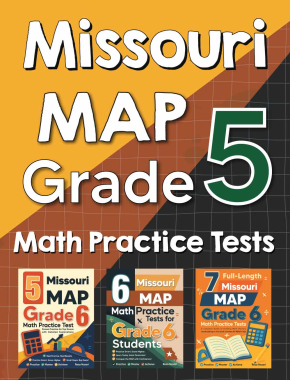
Want the fastest path through Missouri MAP Grade 6 math? This bundle pulls it together, four full practice-test books with complete, step-by-step answer keys, instant PDF download.

Related to This Article
More math articles
- Top 10 DAT Quantitative Reasoning Practice Questions
- The Enchanted Forest of How to Compare Ratios – A Tale of Mathematical Adventure
- How to Master Polynomial Functions
- Third parties and minor parties
- Solving the Unsolvable: How to Master Systems of Non-linear Equations with Elimination
- Political speech
- Measurements – Time
- Mastering Algebra II in Virginia: A Complete Guide for Students and Parents
- How to Inscribe a Regular Polygon within a Circle
- 5 Skills You Need to Study Mathematics in College



What people say about "Missouri MAP Grade 6 Math: Free Worksheets"?
No one replied yet.