Free Louisiana Grade 2 English Worksheets
Free Louisiana Grade 2 English Worksheets: a free, printable set you can download and use right away, with answer keys, organized by topic so students can practice one skill at a time and teachers can assign exactly what a lesson needs.
Printable reading and writing practice for second graders, aligned to Louisiana’s Grade 2 standards.
There’s a moment a lot of Louisiana parents will recognize. Your second grader is reading on the couch, and instead of stopping at every hard word, they’re turning pages. Then they look up and say something that surprises you, about why a character was sad, or about a fact they didn’t know an hour ago. The reading got out of the way, and the thinking showed up.
That shift is what second grade is for. First grade was the heavy lifting: letters into sounds, sounds into words, words off the page. Second grade builds on it. Reading becomes steadier, and a kid suddenly has the room to wonder what a story is really saying and what a true-fact book is really teaching.
This page exists to support that. It’s a free set of Grade 2 English worksheets for Louisiana students, covering reading, writing, grammar, spelling, and vocabulary. Every worksheet is a printable PDF, and every one has an answer key. You won’t hit a signup form or an email wall. Click, print, and you’re set.
Use them at the kitchen table in Baton Rouge or run off copies for a classroom in Lafayette. They’re free to anybody who can use them.
What you’ll find here
Everything below is built around the Grade 2 English Language Arts standards Louisiana has adopted, the reading and language skills a second grader is meant to grow over the year. It’s the same set of skills shaping the lessons in your child’s classroom.
The worksheets sit in eight strands. Each one zeroes in on a single skill, and that’s by design. A second grader does far better with one clear page than with a thick packet that touches everything lightly. So pick the skill your child needs this week and leave the rest for another day.
Reading: Literature
- Asking and Answering Questions About Stories, finding answers right inside the story
- Central Message, Lesson, or Moral, naming the lesson a story is trying to share
- How Characters Respond to Events, watching how a character reacts when things change
- Rhythm and Meaning in Stories, Poems, and Songs, feeling the beat and rhyme, and why a writer used it
- The Structure of a Story, how the beginning, middle, and end fit together
- Points of View of Characters, noticing that characters can see the same thing differently
- Using Illustrations to Understand Stories, reading the pictures along with the words
- Comparing Two Versions of the Same Story, finding what changes when a story is retold
Reading: Nonfiction
- Asking and Answering Questions About Nonfiction, locating real answers in a fact-based text
- Main Topic and Focus of Paragraphs, naming what a paragraph is mostly about
- Connections Between Events, Ideas, and Steps, tracing how one idea or step leads to the next
- Nonfiction Vocabulary, understanding the special words in science and history texts
- Text Features, using headings, bold words, and captions to find information
- The Author’s Main Purpose, asking whether the writer set out to teach, explain, or persuade
- How Images Help a Text, seeing how a photo or diagram makes the words clearer
- How Reasons Support the Author’s Points, matching a writer’s point to the reasons that hold it up
- Comparing Two Texts on the Same Topic, reading two books on one subject and weighing what each gives
Foundational Reading Skills
- Long and Short Vowels, telling hop from hope by ear
- Vowel Teams, pairs of vowels that join to make one sound
- Decoding Two-Syllable Words, breaking a longer word into chunks you can read
- Prefixes and Suffixes, word parts like un- and -less that shift a meaning
- Words with Tricky Spelling Patterns, spellings that don’t follow the usual road
- Irregularly Spelled Words (Sight Words), words like they and who you learn by sight
- Reading Fluency: Accuracy, Rate, and Expression, reading smoothly, at a comfortable pace, with feeling
- Self-Correcting While You Read, noticing when a sentence breaks down and fixing it
Writing
- Opinion Writing, sharing a point of view and giving a reason for it
- Informative and Explanatory Writing, writing to explain something true to a reader
- Narrative Writing, telling a story in order, with details that make it real
- Revising and Editing, reworking a draft until it’s clearer and cleaner
- Shared Research Projects, digging into a topic together and writing up the finds
- Gathering Information to Answer a Question, rounding up facts that truly answer a question
Speaking and Listening
- Recounting Ideas from a Read-Aloud, listening carefully, then retelling the main points
- Asking and Answering Questions About a Speaker, asking helpful questions when someone is presenting
- Telling a Story or Sharing an Experience, speaking clearly so a listener can keep up
Grammar
- Collective Nouns, one word for a whole group, like team or swarm
- Irregular Plural Nouns, when child becomes children, not childs
- Reflexive Pronouns, using myself, yourself, and ourselves correctly
- Past Tense of Irregular Verbs, verbs like ran, came, and told that skip -ed
- Adjectives and Adverbs, words that describe nouns and words that describe verbs
- Expanding and Rearranging Sentences, making a short sentence longer and clearer
Capitalization, Punctuation, and Spelling
- Capitalizing Holidays, Products, and Place Names, knowing which words call for a capital letter
- Commas in Greetings and Closings of Letters, placing the comma in Dear Mr. Lee, and Sincerely,
- Apostrophes: Contractions and Possessives, one mark for it’s and another job in Maria’s
- Spelling Patterns, patterns that make new words simpler to spell
- Using Reference Materials to Check Spelling, checking a word instead of hoping it’s right
Vocabulary and Word Study
- Formal and Informal English, chatting with a friend vs. Writing something official
- Context Clues, using nearby words to figure out a new one
- Prefixes, how re- or un- changes a word’s meaning
- Root Words and Word Endings, spotting the base word inside a longer one
- Compound Words, two words clicking together, like butterfly
- Using Glossaries and Dictionaries, looking up a word’s meaning the proper way
- Real-Life Word Connections, connecting new words to a kid’s everyday world
- Shades of Meaning, the steps between tired, sleepy, and exhausted
- Using Describing Words and New Vocabulary, working fresh, vivid words into writing and talk
Making these worksheets count
Worksheets only help if they’re used the right way. Print a hundred and the learning doesn’t follow. A few small habits make all the difference:
Choose one and stick with it. One worksheet on one skill, done with care, beats a fat stack done in a rush. Look at where your child needs help this week and start there.
Read the Quick Review first. The box at the top of each page is the lesson itself. Read it together, talk through the example, then let your child take the pencil.
Go over the answer key together. When the page is finished, sit side by side with the answers. Don’t just count up the score, talk about why. The questions your child missed are the ones worth a real conversation.
Revisit tough skills later, not right away. If a skill gives your child trouble, set it aside for about a week, then try a different worksheet on the same thing. That short break helps it stick far better than repeating it the same night.
A note on the LEAP
If you’ve been hearing about the LEAP assessment, here’s some welcome news: Louisiana second graders don’t take the LEAP English language arts test. It begins in third grade.
So second grade isn’t a testing year. It’s the foundation year, the season when kids quietly build the reading and writing skills the LEAP will eventually measure. A second grader who reads with ease, finds the main topic, writes a clear sentence, and figures out new words from context is already on solid ground. None of that calls for cramming. It calls for steady, friendly practice, exactly what these worksheets are for.
Not sure where to begin? Main Topic and Focus of Paragraphs and Context Clues are two of the best skills to grow early. They quietly hold up nearly everything else a reader does.
Questions Louisiana families ask
Do these worksheets follow Louisiana’s standards? Yes. Each one is built around a skill from the Grade 2 English Language Arts standards Louisiana has adopted, the same skills driving classroom instruction.
Is there any catch with “free”? None. No account, no email collection, no trial. You click the link, the PDF opens, and the answer key is included at the end.
My child won’t sit still for long. What should I do? Keep sessions short and stay close. Ten focused minutes with you nearby beats a long stretch alone. Let your child help pick the topic when you can.
Are these good for a homeschool setup? Very much so. They work as a daily practice routine or as a quick check after a lesson. Homeschool families across Louisiana use printable worksheets exactly this way.
What if my second grader is ahead of the pack? Give them something to stretch toward. Comparing Two Texts on the Same Topic and Shades of Meaning challenge strong readers while staying right at grade level.
Before you head off
If tonight’s worksheet ends up wrinkled and half-done, don’t read too much into it. That’s ordinary second grade. Try a shorter one tomorrow, or come back to the same skill in a week. A perfect page was never the goal. A child who keeps practicing, and keeps growing more confident, is. Stop back any time you need the next worksheet.
Ready for Grade 3 English? The Louisiana LEAP Grade 3 English Bundle
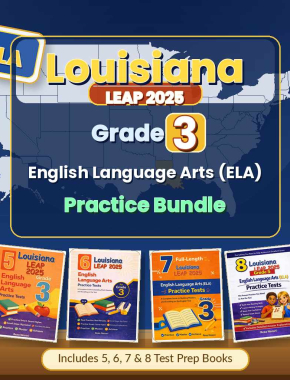
Second grade is the build-up year, and when your child is ready for what comes next, this bundle makes the jump to Grade 3 English feel easy. It includes four full practice-test books (5 + 6 + 7 + 8 tests) covering the Grade 3 reading, writing, and language skills just ahead, with explained answer keys and an instant PDF download.
Getting Ready for Grade 3 Math, Too? The Louisiana LEAP Grade 3 Math Bundle
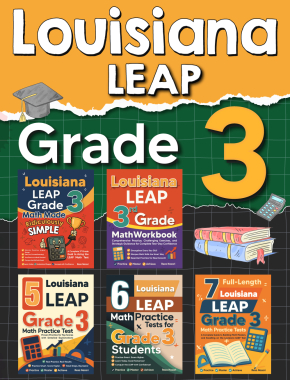
The same jump to Grade 3 happens in math. If your second grader could use a head start there as well, this Louisiana LEAP Grade 3 Math bundle is the shortest path, workbook, study guide, and full practice tests in one instant download, with answer keys throughout.

Related to This Article
More math articles
- Algebra 1 Formula Flashcards (Free Visual Review)
- Filibuster
- The Best Grade 3 Math Book for Pennsylvania Students
- ISEE Middle Level Math Flashcards (Free Online: Formulas, Terms & Concepts)
- House Rules Committee
- Alabama ACAP Algebra 1 Free Worksheets: 72 Printable PDFs with Step-by-Step Answer Keys
- Missouri MAP Grade 8 Math Free Worksheets: Printable Practice for Every Eighth-Grade Math Topic
- Best Online Math Tutoring Equipment
- Tips for Solving Calculus Problems Efficiently
- How to Score 800 on SAT Math?










What people say about "Louisiana Grade 2 English Worksheets: Free PDFs"?
No one replied yet.