How to Unlock the Secrets of Success: “ISEE Upper Level Math for Beginners” Solution Guide

The ISEE Upper Level Math for Beginners solution guide gives a full worked method for every practice question in the book. Below: how to use it alongside the exercises, a five-week study plan, and a sample algebraic word problem walked through from start to finish.
This Solution Guide is a rich repository of learning materials, meticulously providing solutions to each practice question in the book. It includes a precise answer key and elaborate, step-by-step explanations aimed at enriching your understanding and bolstering your confidence. We invite you to explore this indispensable tool, crafted to assist you in acing the ISEE Upper Level Math test with finesse!
Starting Your ISEE Upper Level Math Adventure
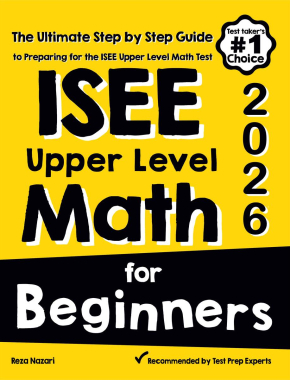
Preparing for the ISEE Upper Level Math test and feeling daunted? Cast aside your apprehensions! Our book, “ISEE Upper Level Math for Beginners”, has been specially curated to streamline and optimize your study experience. This guide transcends the ordinary; it’s a comprehensive blueprint engineered for your ISEE Upper Level Math triumph in 2026.
The Absolute Best Book to Ace the ISEE Upper Level Math Test
How to Use This Solution Guide Effectively
The solution guide that pairs with ISEE Upper Level Math for Beginners is meant to be worked through, not just read. Treat each problem as a self-test: try it on your own first, then check the solution to see where your reasoning matched the book and where it diverged. The growth comes from the diverged moments. Those are the gaps in your understanding worth closing.
A common mistake students make with any solution guide is reading the answer key passively. That feels productive but builds almost no test-day skill. Force yourself to attempt every problem cold, even if you only get partway through.
A Five-Week Study Plan
If you have five weeks before your ISEE Upper Level test, here’s a workable plan:
- Week 1, Diagnostic. Take a full-length ISEE math practice test. Note every topic where you missed two or more questions. Those topics are your priority list for weeks 2 to 4.
- Week 2, Number sense and algebra fundamentals. Work the corresponding chapters in the book. Use the solution guide to check every fifth problem in detail.
- Week 3, Geometry and measurement. Same workflow. Pay extra attention to coordinate geometry. It’s heavily tested on the Upper Level.
- Week 4, Data analysis, probability, advanced topics. Mix in timed problem sets so you start getting comfortable with the test pace.
- Week 5, Mock tests + targeted review. Take two more full-length practice tests. After each, use the solution guide to dig into every wrong answer.
Sample Topic Walkthrough: Algebraic Word Problems
Algebraic word problems trip up more ISEE Upper Level test takers than almost any other topic. The standard approach in the solution guide: read the problem twice, identify what’s unknown, assign a variable, translate the relationships into an equation, solve, then verify.
Worked example: “Sarah is twice as old as Tom. In four years, the sum of their ages will be 32. How old is each now?” Let \(t = \) Tom’s age. Then Sarah is \(2t\). In 4 years: \((t+4) + (2t+4) = 32\). Solve: \(3t + 8 = 32\), so \(3t = 24\), \(t = 8\). Tom is 8, Sarah is 16. Check: in 4 years they’ll be 12 and 20, summing to 32. ✓
Notice the solution guide doesn’t just hand you the answer. It shows the framework. That framework is what transfers to test day. If you only memorize the answers, you’ll be lost when the next problem changes the numbers.
When You’re Stuck on a Problem
Resist the urge to flip immediately to the solution. Instead, work through this checklist:
- Re-read the problem slowly. Underline the question being asked. (Sometimes the question is buried in the middle of the prompt.)
- Identify the topic family. Is this an algebra problem? A geometry problem? A ratio problem?
- List what you know and what you need to find.
- Try a smaller or simpler version of the problem first. If the original asks about a 7-step pattern, try the 3-step version and see if you can spot the rule.
- Try a different representation: draw a picture, make a table, write an equation.
- If you’ve spent more than 5 minutes and made no progress, then check the solution. Read it actively, at each step, ask why did they do that?
Related Resources
- The Ultimate ISEE Upper Level Math Formula Cheat Sheet
- ISEE vs. SSAT: Which Is Right for You?
- Top 10 ISEE Upper Level Prep Books
- The Ultimate SAT Math Course
Frequently Asked Questions
Should I read the book chapter first, or jump to problems?
Read the chapter first. ISEE Upper Level Math for Beginners is built around concept introductions, then worked examples, then practice problems. Skipping the explanation and going straight to problems is a fast way to feel frustrated.
How much practice is “enough” for the ISEE Upper Level math?
If you can finish two full-length practice tests in a row scoring 80%+ on the math section, you’re in good shape. Most students need at least 40 to 60 hours of focused prep to get there from a cold start.
Can I use this guide if I’m self-studying without a tutor?
Yes. That’s exactly what it’s designed for. The book + solution guide combination gives you the explanation, the practice, and the check. The one thing a tutor adds that the book can’t is real-time feedback on your reasoning, but the guide’s worked solutions cover that gap as long as you actually compare your work step-by-step.
Is the ISEE math section calculator-allowed?
No. The ISEE does not allow calculators on any section, including math. Practice all your problems by hand from day one.

Related to This Article
More math articles
- FTCE Test Facts and FAQs
- Collective Behavior and Routine Organization
- FREE 8th Grade Common Core Math Practice Test
- 7th Grade SBAC Math Worksheets: FREE & Printable
- Party-in-the-electorate
- Assembly, Testing, Storage, Charging, and Distribution
- How to Divide Polynomials Using Long Division?
- Find a Parabola’s Focus, Vertex, and Directrix: Formulas & Examples
- Grade 5 Literary Analysis: Theme, Character Change, and Text Evidence Made Practical
- Equipment Needed for Online Math Teaching









What people say about "ISEE Upper Level Math: Solution Guide"?
No one replied yet.