The Best Grade 2 Math Worksheets for Connecticut Students
The Best Grade 2 Math Worksheets for Connecticut Students: a free, printable set you can download and use right away, with answer keys, organized by topic so students can practice one skill at a time and teachers can assign exactly what a lesson needs.
Free printable practice that helps your Connecticut second grader grow into a confident math thinker.
Watch a second grader take on a two-step word problem and you’ll see something new clicking into place. The problem says a class had 24 books, gave 9 to another room, then got 15 more. Your child solves the first part, writes the number down, looks at it, and says, “Wait, I’m not done yet.” That pause, realizing a problem has more than one part, is a genuine leap in thinking, and it happens in second grade.
If you’re a Connecticut parent or teacher looking for clear, encouraging math practice for a second grader, this set of worksheets is for you. It’s free and printable from start to finish. Every worksheet is a PDF with the answer key included, and there’s no signup, no account, and no email to provide. You choose a page, print it, and you’re ready.
Second grade is a busy, rewarding year for math. Kids reach numbers up to 1,000, get fluent with addition and subtraction, learn to tell time and count money, measure with rulers, read graphs, and discover patterns in rows and columns. Each piece builds the next.
These worksheets are aligned with the Grade 2 math standards Connecticut has adopted, and they’re organized so you can move skill by skill, at whatever pace fits your child best.
What’s Inside the Collection
The worksheets are grouped into eight chapters. Each chapter covers one major area of second grade math, with the skills inside arranged from simpler to more advanced. The chapters stand on their own, so feel free to begin wherever your child needs the most support.
Every worksheet starts with a Key Ideas box that explains the skill in plain language, then gives worked examples, then practice problems. The answer key is at the end of each page. Here’s the full collection.
Place Value and Number Sense
- Understanding Place Value, The idea that a digit’s position decides its value.
- Reading and Writing Numbers to 1,000, Moving between number words and digits with confidence.
- Expanded Form, Showing a number as hundreds plus tens plus ones.
- Skip Counting, Counting by 5s, 10s, and 100s, a quiet warm-up for multiplication.
- Comparing and Ordering 3-Digit Numbers, Telling which number is greater and ordering a group.
Addition and Subtraction
- Addition Facts Within 20, Building quick recall of the core sums.
- Subtraction Facts Within 20, Practicing the matching take-away facts toward automatic speed.
- Adding Within 100, Two-digit addition, including problems that need regrouping.
- Subtracting Within 100, Two-digit subtraction with borrowing, broken down clearly.
- Adding Within 1,000, Extending addition into three-digit numbers.
- Subtracting Within 1,000, Three-digit subtraction, carefully scaffolded.
- Mentally Adding and Subtracting 10 and 100, Jumping by tens and hundreds in your head.
Word Problems and Equations
- One-Step Word Problems, Solving a short story problem with a single operation.
- Two-Step Word Problems, Two-part problems that reward a moment of planning.
- Finding the Unknown Number, Solving for the missing value in an equation.
Odd, Even, and Arrays
- Odd and Even Numbers, Sorting numbers by whether they pair up evenly.
- Even Numbers as Equal Addends, Writing an even number as a double, such as 14 = 7 + 7.
- Rectangular Arrays, Setting objects in rows and columns to count them faster.
- Repeated Addition with Arrays, Adding equal rows again and again, the runway to multiplication.
Measurement and Length
- Measuring Length with Tools, Using a ruler or tape measure accurately.
- Estimating Lengths, Making a thoughtful guess, then measuring to check it.
- Comparing Lengths, Finding how much longer or shorter one object is.
- Adding and Subtracting Lengths, Solving word problems by combining measurements.
- Length on a Number Line, Showing length as a jump along a number line.
Time and Money
- Telling Time to the Nearest Five Minutes, Reading analog and digital clocks to the five-minute mark.
- A.M. And P.M., Telling morning hours from afternoon and evening.
- Counting Coins, Adding mixed coins together to find a total.
- Money Word Problems, Calculating costs and change in everyday situations.
Data and Graphs
- Line Plots, Plotting measurement data above a number line.
- Picture Graphs, Reading graphs where a picture stands for several items.
- Bar Graphs, Comparing categories with bars and answering questions about them.
Geometry
- Recognizing and Drawing Shapes, Naming and sketching shapes by their sides and angles.
- Partitioning Rectangles into Rows and Columns, Dividing a rectangle into equal squares and counting them.
- Equal Shares: Halves, Thirds, and Fourths, Splitting shapes into fair pieces, a soft start on fractions.
Getting the Most from These Worksheets
The worksheets work best when a few simple habits come along with them. You’re after understanding that lasts, not a thick binder.
Work one worksheet at a time. Second graders do their best thinking in short, focused sessions, and one page done carefully teaches more than three rushed. Begin each session by reading the Key Ideas box together, out loud. Then go through the worked examples side by side, so your child sees the method demonstrated before trying it alone.
When the page is finished, sit down and check the answer key together. Treat a missed problem as a clue, not a verdict. Ask, “Walk me through how you did this one.” Most of the time the answer points straight to the spot where the thinking slipped, and that’s exactly the spot you can fix.
One more thing: come back to skills. If adding within 1,000 felt shaky this week, give your child a fresh worksheet on it next week. That short gap between practice sessions is one of the simplest ways to make a skill permanent.
A Word About the Smarter Balanced Assessment
Connecticut uses the Smarter Balanced assessment to measure how students are doing in math and English. Here’s the reassuring part for second grade families: Smarter Balanced math testing starts in third grade. Your second grader won’t take a state math test this year.
That makes second grade a true foundation year, and a calm one. There’s no exam on the horizon, just space to build the skills the third grade test will eventually count on. Place value, fluent addition and subtraction, careful word-problem reading, measurement, and reading data, those are exactly the things Smarter Balanced will check later. A second grader who’s comfortable with this material now steps into third grade prepared, not pressured.
So use this year to build, not to cram. Steady, friendly practice today is what makes Smarter Balanced feel manageable when it eventually comes around.
Frequently Asked Questions
Is there any cost or signup?
None. Every worksheet is a free printable PDF. No payment, no membership, no email required. Print exactly what you need.
Do the chapters have to be done in order?
No. The eight chapters follow a logical path, but each one works on its own. Start with whatever your child is learning in class or finding tricky.
How much practice is enough?
For most families, two or three short sessions a week works well. One focused page is a good day’s work. Consistency matters more than volume.
My child struggles with word problems. Where do we start?
Begin with the one-step word problems and the Key Ideas box on that page. Read the problems together out loud at first. Once those feel steady, move on to two-step problems.
Can teachers use these in the classroom?
Yes. They’re well suited to homework, warm-ups, review stations, and extra practice for students who need another pass at a skill.
A Confident Start, One Page at a Time
Your Connecticut second grader has a year of real progress ahead, two-step problems cracked, clocks read with ease, three-digit numbers handled without a flinch. These free worksheets are here to help that progress along. Choose a chapter that matches where your child is now, print a page, and settle in together. Short, regular practice and an open answer key will carry them a long way.
Ready for Grade 3 Math? The Connecticut Grade 3 Math Bundle
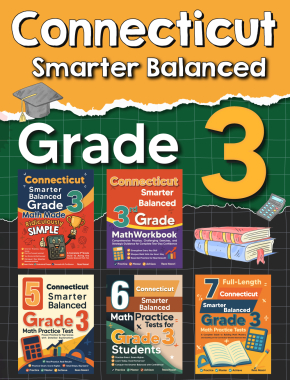
Second grade is the build-up year, and when your child is ready for what comes next, this bundle makes the jump to Grade 3 math feel easy. It packs full practice-test books, complete answer keys, and step-by-step explanations for the Grade 3 math skills just ahead.
Getting Ready for Grade 3 English, Too? The Connecticut Grade 3 English Bundle
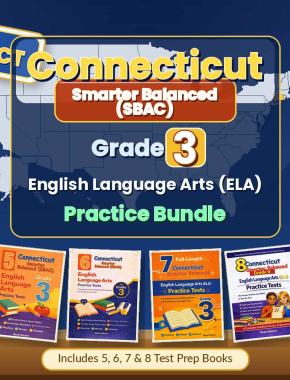
Reading and writing grow right alongside math. If your second grader could use a head start in English as well, this Connecticut Grade 3 English bundle covers it — practice tests, answer keys, and friendly explanations in one download.

Related to This Article
More math articles
- Free Grade 7 English Worksheets for Indiana Students
- How to Sketch Trigonometric Graphs?
- Top 10 7th Grade NYSE Math Practice Questions
- 3rd Grade STAAR Math Practice Test Questions
- 4th Grade IAR Math Worksheets: FREE & Printable
- How to Multiply Monomials? (+FREE Worksheet!)
- The Best Grade 5 ELA Practice Tests for West Virginia Students
- 4th Grade ILEARN Math Worksheets: FREE & Printable
- Unions, Unemployment, and Work-Family Boundaries
- The Best Grade 6 ELA Practice Tests for Kentucky Students







What people say about "Connecticut Grade 2 Math Worksheets: Free PDFs"?
No one replied yet.