Free Grade 7 English Worksheets for Colorado Students
The bus comes early in a Colorado mountain town. The seventh grader is up before sunrise, lunch packed by 6:20, and the descent into the valley starts with the headlights still on. By the time the kid walks into homeroom in Leadville, Salida, Glenwood Springs, or Durango, they have already had a full hour to think, read, or watch the ridgeline change colors. That hour is the one that ends up mattering. A reader who has been awake and attentive before first period is a reader who can stack three pieces of evidence and explain how they fit. A reader who is still half-asleep at 7:45 is the one who writes a one-sentence answer and loses two points.
That is what Grade 7 changes. Seventh-grade Colorado readers are expected to make inferences that rest on several pieces of textual evidence, not one. Seventh-grade writers are expected to acknowledge a counterclaim before refuting it. Seventh-grade vocabulary now includes allusion, references to mythology, the Bible, and classic literature that a student is expected to catch on sight. None of these moves were required at Grade 6. All of them are required now.
The worksheets on this page address those expectations one at a time. Forty-three free printable PDFs, every one aligned to the Colorado Academic Standards for Reading, Writing, and Communicating at Grade 7. Print them at home, work them at the kitchen table, leave them on the desk for whichever quiet evening shows up next.
What’s on this page
Each PDF holds three things in a fixed order. A Quick Review your seventh grader can read on their own without parent translation. Practice items in the middle. A student-facing answer key at the end that explains why each wrong option was tempting and why the right one is justified.
Click, print, work, check. No login. No email.
Reading: Literature
- Citing Several Pieces of Textual Evidence, [RL.7.1] stack two or three quotes that all point at the same inference
- Theme and Its Development Over the Text, [RL.7.2] write the theme as a sentence and track how it grows
- How Setting, Character, and Plot Interact, [RL.7.3] show how one story element pushes another into motion
- Word Choice, Figurative Language, and Tone, [RL.7.4] denotation, connotation, and the mood a single word can carry
- How Form Shapes Meaning in Drama and Poetry, [RL.7.5] line breaks, stanzas, and stage directions as meaning carriers
- Developing and Contrasting Points of View, [RL.7.6] analyze two perspectives the author builds in tension
- Comparing a Story to Its Audio, Film, or Stage Version, [RL.7.7] what each medium can and cannot do
- Comparing Fictional and Historical Portrayals, [RL.7.9] separate the documented past from the novelist’s invention
Reading: Informational Text
- Citing Several Pieces of Evidence in Nonfiction, [RI.7.1] anchor a conclusion in two or more article details
- Two or More Central Ideas and Their Development, [RI.7.2] read articles that teach more than one big thing at once
- How Individuals, Events, and Ideas Interact, [RI.7.3] how people shape ideas and how ideas reshape people
- Word Meaning in Nonfiction: Figurative, Connotative, Technical, [RI.7.4] three jobs a single word can do in nonfiction
- How Text Structure Develops the Author’s Ideas, [RI.7.5] see the writer’s blueprint and what it accomplishes
- Author’s Point of View and How They Distinguish It, [RI.7.6] find the writer’s stance and the techniques that mark it
- Comparing a Text to Its Audio or Video Version, [RI.7.7] what each medium emphasizes and strips out
- Evaluating an Argument: Reasoning and Evidence, [RI.7.8] judge whether reasons and evidence actually support the claim
- How Two Authors Shape Their Presentation of the Same Topic, [RI.7.9] same subject, different choices, different effects
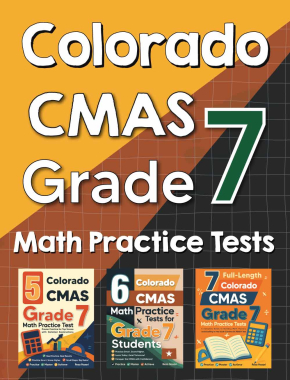
Working on Math Too? Try the Colorado CMAS Grade 7 Math Bundle
Many third graders are getting ready for the CMAS in both subjects. If your child also needs math practice that matches the same standards, this companion bundle is the shortest path, workbook, study guide, and full practice tests in one download.
Writing
- Argument Writing: Claims, Reasons, Evidence, and Counterclaims, [W.7.1] name the counterclaim before refuting it
- Informative and Explanatory Writing, [W.7.2] thesis, sections, transitions, and a real conclusion
- Narrative Writing, [W.7.3] pacing, dialogue, sensory writing, and an ending that lands
- Coherent Writing for Task, Purpose, and Audience, [W.7.4] same idea, three audiences, three drafts
- Planning, Revising, and Editing, [W.7.5] when revising means scrapping the plan
- Short Research Projects: Question and Refocus, [W.7.7] let early findings sharpen the question
- Gathering, Evaluating, and Citing Sources, [W.7.8] author, date, publisher, citation done right
Speaking & Listening
- Collaborative Discussions, [SL.7.1] prepared, listening first, building on what others said
- Analyzing Information in Diverse Media, [SL.7.2] read a chart, clip, and photo as one combined message
- Evaluating a Speaker’s Argument, [SL.7.3] claim, reasons, evidence, soft spots
- Presenting Claims with Focus and Coherence, [SL.7.4] clean opening, previewed structure, controlled close
- Adapting Speech to Context, [SL.7.6] match register to the room
Grammar
- Phrases and Clauses: Placement and Function, [L.7.1a] identify what each chunk of a sentence is doing
- Sentence Structures: Simple, Compound, Complex, Compound-Complex, [L.7.1b] count the clauses, then name the structure
- Avoiding Dangling and Misplaced Modifiers, [L.7.1c] the quiet sentence error that makes a paragraph absurd
Conventions: Punctuation, Spelling
- Commas with Coordinate Adjectives, [L.7.2a] when two adjectives in a row need a comma and when they do not
- Spelling Grade-Appropriate Words, [L.7.2b] homophones, doubled letters, and frequent seventh-grade trip-ups
Knowledge of Language and Style
- Precise and Concise Language, [L.7.3a] cut filler, pick the exact word, keep sentences tight
Vocabulary and Word Study
- Using Context Clues, [L.7.4a] name the kind of clue before using it
- Greek and Latin Roots and Affixes, [L.7.4b] one root unlocks ten unrelated words
- Using Reference Materials Effectively, [L.7.4c] pick the right tool for the actual question
- Verifying Word Meaning, [L.7.4d] confirm a guess before trusting it
- Allusions and Figures of Speech, [L.7.5a] the L.7.5a standard new to Grade 7, myth, Bible, and literary references
- Word Relationships: Synonyms, Antonyms, Analogies, [L.7.5b] name the relationship in plain words before answering
- Connotation and Denotation, [L.7.5c] same fact, different emotional weight
- Academic and Domain-Specific Vocabulary, [L.7.6] Tier 2 cross-subject words and Tier 3 field words
How to use these worksheets at home
Colorado families work around an unpredictable calendar. Snow days in February, half-day dismissals in March, a ski-team meet that runs past dinner, an altitude headache after a weekend climb. Build the practice into the small windows that are already there, fifteen minutes before dinner, ten minutes after homework, the bus-stop wait on a Wednesday morning.
Print one PDF at a time. Encourage your seventh grader to read the Quick Review aloud before they start the practice items, the rule has to be active in their head, not buried under the day’s other noise. After the practice, hand them the answer key and let them grade their own work. Self-grading is what turns a wrong answer into a corrected one.
Loop back. The wrong-answer pages from October are exactly the pages to revisit in November. Grade 7 reading and writing skills build slowly across the year, and the second look, after a gap, is usually when the rule actually sticks.
A note about CMAS ELA
The CMAS (Colorado Measures of Academic Success) is the state’s spring assessment, administered in a window the Colorado Department of Education typically opens between early April and the end of April, with districts scheduling within. The Grade 7 ELA portion is aligned to the Colorado Academic Standards for Reading, Writing, and Communicating, so what your child is doing in class all year is what the test draws from.
Expect reading items that ask for multiple pieces of textual evidence, vocabulary in context with attention to figurative and connotative meaning, writing items that require organized arguments with counterclaims or informational responses with a thesis, and language items on phrases, clauses, modifier placement, and coordinate-adjective commas. The worksheets on this page are not test-week filler. They are weekly skill maintenance, and that is what CMAS rewards.
Want everything in one bundle?
When a Colorado family would rather work from a single resource than a long catalog of individual PDFs, the Grade 7 ELA Preparation Bundle is built for that. Full-length practice tests in the same shape as the CMAS, answer keys with explanations written for the student, and a structured progression that touches every Grade 7 standard.
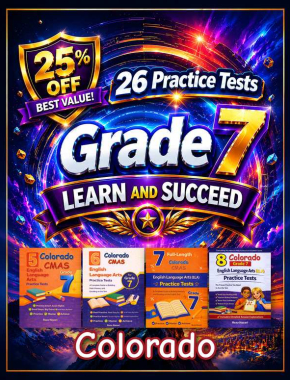
Colorado Grade 7 ELA Preparation Bundle, four practice-test books, 26 unique full-length tests, complete answer keys with explanations.
A short closing
Seventh grade lasts from August through May, and the reading and writing work inside it deserves to be paced like a long Colorado trail, small, steady, daily steps, not a single sprint at the summit. Bookmark this page, pull a PDF on the quiet evenings, and let one skill at a time accumulate into real Grade 7 fluency.
Best Bundle to Ace the Colorado CMAS Grade 7 ELA
Looking for the best resource to help your kid ace the Colorado CMAS? Try this bundle, four full practice-test books (5 + 6 + 7 + 8 tests) covering the same Grade 7 reading, writing, and language skills your child is already learning. Instant PDF download, answer keys included.

Related to This Article
More math articles
- The Best Grade 4 Math Book for Illinois Students
- Online participation
- Top 10 Pre-Algebra Prep Books (Our 2024 Favorite Picks)
- The Best Grade 7 ELA Practice Tests for Oklahoma Students
- How to Do Ratio, Proportion, and Percentages Puzzle -Critical Thinking 8
- The Best Grade 4 ELA Practice Tests for Indiana Students
- The Ultimate FSA Algebra 1 Course (+FREE Worksheets)
- Full-Length 7th Grade SBAC Math Practice Test-Answers and Explanations
- How to Find Asymptotes: Vertical, Horizontal and Oblique
- Network effects can accelerate both growth and concentration




What people say about "Free Grade 7 English Worksheets for Colorado"?
No one replied yet.