Invention, Discovery, Diffusion, and Cultural Change
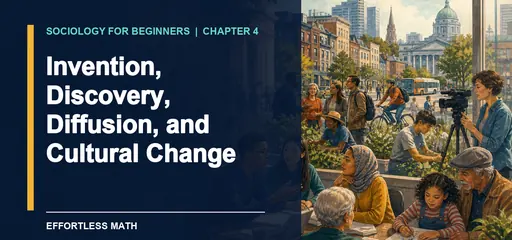
Chapter 4 of the Sociology for Beginners study guide on Effortless Math covers Invention, Discovery, Diffusion, and Cultural Change: the key terms, the core ideas, and worked examples showing how this topic is tested on this course.
Sociology for Beginners · Chapter 4
Invention, Discovery, Diffusion, and Cultural Change
Culture changes when people create new combinations, recognize previously unknown features, borrow across groups, and adjust rules to new conditions. Several processes may appear in one sequence, so the central question is what happens at each step.
Invention combines existing cultural elements into a new object or practice. An engineer who builds a low-cost water sensor from known electronic components has invented a device. The parts existed, but their arrangement and use are new. Social arrangements can also be invented, such as a new voting procedure or form of cooperative ownership.
Discovery is the recognition of something that already exists. If the new sensor reveals contamination in an underground water source, the contamination is discovered rather than invented. The distinction depends on whether people created the thing or newly recognized it.
Diffusion is the spread of a cultural trait from one group or setting to another. When other towns adopt the sensor, its use diffuses. Trade, migration, conquest, tourism, education, media, and digital communication can carry food, music, words, technologies, and institutional practices.
Diffusion rarely produces an exact copy. Recipients select, translate, combine, or resist what arrives. A musical style may travel through migration, be played on local instruments, and gain a political meaning absent from its earlier setting. This adaptation is evidence that people actively interpret borrowed culture.
Cultural lag, associated with William Ogburn, occurs when connected parts of culture change at different speeds, often when material technology changes before laws, norms, or organizations adjust. Facial recognition can spread before rules settle consent, bias, data ownership, and appeals. The delay between linked parts is the evidence for lag. A new tool by itself is only an invention.
Material culture does not always move first. A new value or legal rule can encourage engineers to create safer tools, and communities may reject an available technology. Cultural lag is a possible mismatch, not a law that technology inevitably leads and society follows.
Globalization increases social, economic, political, and cultural connections across long distances. It can speed diffusion, expand shared references, and concentrate the influence of organizations with global reach. It does not make all cultures identical. People localize imported forms, defend boundaries, create hybrids, and use global media to strengthen local identities.
Change also involves power. A platform can spread a format because it controls distribution, while smaller groups may struggle to circulate alternatives. An employer may adopt tracking software faster than workers can negotiate privacy rules. Asking who controls the technology, channel, or law explains why some innovations travel and whose concerns wait.
A cultural element can move faster than its original meaning. A community may adopt a tool, change its design, restrict who may use it, or connect it to a new purpose. To analyze diffusion, identify the source group, the receiving group, the channel that carried the element, and the feature that changed after adoption. Creation within one setting is invention. Recognition of an existing feature is discovery. Movement between settings is diffusion.
Quick review: Invention creates a new combination. Discovery recognizes what already existed. Diffusion carries a trait between groups. Cultural lag is delayed adjustment between connected parts of culture. Globalization can speed contact without producing simple sameness.
| Process | First question | Deciding evidence |
|---|---|---|
| Invention | What did people newly create? | A new object, practice, or combination |
| Discovery | What existing feature became known? | Recognition rather than creation |
| Diffusion | What moved between groups? | Adoption, borrowing, or adaptation |
| Cultural lag | Which connected parts changed at different speeds? | A delay between material and nonmaterial adjustment |
| Globalization | How did distant connections intensify? | Cross-border flows shaped by organizations and local response |
One Case Across the Whole Chapter
Consider a university that introduces an artificial-intelligence writing assistant. No single term explains the whole change. Each concept directs attention to a particular layer.
| Concept | Evidence in the campus case |
|---|---|
| Material culture | Devices, servers, campus networks, and the software interface |
| Nonmaterial culture | Ideas about authorship, fairness, learning, privacy, and acceptable assistance |
| Symbol and language | An “AI-assisted” label may signal honesty to one audience and weak ability to another |
| Value | The university may emphasize learning, integrity, access, or innovation |
| Belief | Faculty may accept as true that unrestricted assistance weakens skill development |
| Norm | Students may be required to disclose particular uses |
| Sanction | A compliant disclosure may receive approval. Concealed use may bring a penalty |
| Ideal and real culture | The university may promise equal access while students with better devices receive greater benefit |
| Dominant culture | Administrators and credentialing bodies may define the official standard of legitimate authorship |
| Subculture | One discipline may develop specialized conventions for permitted use |
| Counterculture | A student movement may reject individual authorship and advocate fully collaborative production |
| Ethnocentrism | One institution may treat its authorship rules as naturally correct everywhere |
| Cultural relativism | A researcher first examines how different disciplines define authorship and learning |
| Invention | Developers combine existing language technologies into a new tool |
| Diffusion | The tool spreads to other universities and is adapted locally |
| Cultural lag | Adoption moves faster than privacy, assessment, and appeal rules |
| Globalization | Firms, data, policies, and educational practices move across national borders |
Use the table as a classification exercise, not as a reason to attach every label to every case. A precise answer names the layer or process established by the evidence in the question.
How the Major Theories Read Culture
Chapter the related chapter introduced the major sociological perspectives. Culture gives each perspective a different question to pursue.
| Perspective | Main cultural question | Campus writing-assistant example |
|---|---|---|
| Functionalism | How do shared meanings coordinate people, and when does the arrangement become disruptive? | A disclosure rule creates a common expectation, though confusion across courses may produce dysfunction |
| Conflict theory | Who has the authority to define legitimate culture, and who gains access or advantage? | Administrators set authorship rules while unequal device access shapes who benefits |
| Symbolic interactionism | How do people create and revise meaning in interaction? | Students and instructors negotiate what the label “AI-assisted” signals in a particular class |
| Feminist and intersectional approaches | How do cultural rules distribute expectations and consequences across social positions? | Researchers compare whose writing is treated as competent, suspicious, or in need of surveillance |
The theories can study the same event without becoming interchangeable. Functionalism looks for coordination and consequences. Conflict analysis follows power over standards and resources. Interactionism studies meaning in situated encounters. Feminist and intersectional analysis asks how those meanings and rules produce unequal experiences across gender and connected social locations.
Misconceptions That Cost Points
[“Shared” means everyone agrees.] Shared culture requires enough common understanding for people to coordinate, argue, violate, or enforce a convention. It does not require unanimity. [Material culture means an object has no meaning.] Material culture names the physical object. Its use and significance depend on nonmaterial culture. [A norm is anything people commonly do.] A repeated behavior becomes a norm when a group expects it and responds meaningfully to conformity or violation. [A subculture is automatically rebellious.] Distinctive practices are enough for a subculture. A counterculture rejects or challenges an important dominant arrangement and promotes an alternative. [Dominant culture means majority culture.] Dominance rests on institutional capacity to make a standard consequential. [Cultural relativism means moral approval.] Cultural relativism calls for contextual investigation before evaluation. [Diffusion means exact copying.] Groups select, translate, combine, or resist borrowed elements. [Cultural lag means all cultural change is slow.] Lag is a mismatch in the rates of change among connected cultural elements.
Chapter Mastery Routine
For an unfamiliar cultural case, fill in as many lines as the evidence supports.
The physical object or technology is 2.2in. The learned meaning attached to it is 2.2in. The broad ideal or accepted truth claim is 2.2in. The expected conduct is 2.2in. The response to conduct is 2.2in. The institution or group that makes the standard consequential is 1.35in. The clearest evidence of cultural difference or change is 1.25in. The most precise concept is 2.0in because 1.35in.
A strong explanation names the concept, connects it to decisive evidence, and rules out the closest alternative in one or two clear sentences.
Return once more to the bakery. The floor and display case provide the material setting. Words establish arrival order, a norm directs the line, a glare discourages cutting, and the business gives the rule practical force. Culture connects those pieces by supplying learned meanings and expectations. Chapter the related chapter follows the process into families, schools, peer groups, and other settings where people learn to interpret such signals and build a social self.
Watch the lesson connection
Symbols, Values, and Norms gives you a second explanation of the ideas surrounding this lesson. As you watch, pause when the lesson concept appears and explain how the example fits.
Try the idea yourself
Write one original example, one close nonexample, and one observation that would help you tell them apart. That small exercise turns a definition into a sociological tool you can use in daily life.

Related to This Article
More math articles
- How to Ace the PSAT Math Test?
- Exponent Rules Calculator (Product, Quotient, Power)
- 4th Grade PARCC Math FREE Sample Practice Questions
- Free Grade 4 English Worksheets for West Virginia Students
- How AI Writing Tools Help Students Explain Math Solutions More Clearly
- How to Determine a Function Using the Vertical Line Test?
- How to Solve Systems of Equations: 3 Methods Explained
- CLEP U.S. History I 032: Yorktown, Peace, and International Consequences
- Why do I Struggle with Math so much?
- Which Test Should You Take: GED, TASC, or HiSET?


















What people say about "Invention, Discovery, Diffusion, and Change"?
No one replied yet.