How to Use Exponents to Write down Multiplication Expressions?

When you multiply the same number by itself several times, writing it out in full gets long fast: \(\color{blue}{4 \times 4 \times 4 \times 4 \times 4}\). Exponents give you a compact notation for exactly this kind of repeated multiplication. Understanding exponents is an essential building block for algebra, scientific notation, and many GED math problems.
What Is an Exponent?
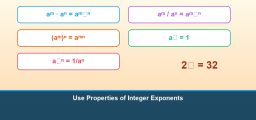
An exponent (also called a power or index) tells you how many times to use the base as a factor in a multiplication.

bn = \(\color{blue}{b \times b \times b}\) × … (n times)
In the expression \(\color{blue}{4^{3}}\):
- 4 is the base (the number being multiplied)
- 3 is the exponent (how many times 4 is used as a factor)
- \(\color{blue}{4^{3} = 4 \times 4 \times 4 = 64}\)
How to Write Multiplication Expressions Using Exponents
Step 1 — Identify the repeated factor
Look at the multiplication expression and find the number being multiplied by itself.
Example: \(\color{blue}{5 \times 5 \times 5 \times 5}\) — the repeated factor is 5.
Step 2 — Count the factors
Count how many times that factor appears. That count is the exponent.
Example: \(\color{blue}{5 \times 5 \times 5 \times 5}\) — the factor 5 appears 4 times. \(\color{blue}{\text{ Exponent } = 4}\).
Step 3 — Write in exponential form
Write the base with the exponent in superscript.
Example: \(\color{blue}{5 \times 5 \times 5 \times 5 = 5^{4}}\)
Special exponents to know
- Exponent of 1: Any number to the power of 1 equals itself: \(\color{blue}{7^{1} = 7}\).
- Exponent of 0: Any nonzero number to the power of 0 equals 1: \(\color{blue}{9^{0} = 1}\).
- Squared: exponent of 2 (e.g., \(\color{blue}{6^{2} = 36}\)).
- Cubed: exponent of 3 (e.g., \(\color{blue}{4^{3} = 64}\)).
Step-by-Step Summary
- Find the repeated base in the multiplication expression.
- Count how many times it appears — that is the exponent.
- Write \(\color{blue}{\text{ base }^{\text{ exponent }}}\).
- To expand back: write the base as a factor (exponent) times.
Watch: What Is an Exponent? (Video Lesson)
Math with Mr. J gives a clear introduction to exponents and what they mean:
Worked Examples
Example 1: Write \(\color{blue}{4 \times 4 \times 4}\) using an exponent and evaluate.
Base: 4, repeated 3 times. Exponential form: \(\color{blue}{4^{3}}\). Value: \(\color{blue}{4 \times 4 \times 4 = 64}\).
Answer: 43 = 64
Example 2: Write \(\color{blue}{2 \times 2 \times 2 \times 2 \times 2}\) using an exponent and evaluate.
Base: 2, repeated 5 times. Exponential form: \(\color{blue}{2^{5}}\). Value: \(\color{blue}{2 \times 2 \times 2 \times 2 \times 2 = 32}\).
Answer: 25 = 32
Example 3: Expand \(\color{blue}{3^{4}}\) and evaluate.
Expand: \(\color{blue}{3 \times 3 \times 3 \times 3}\). Value: \(\color{blue}{9 \times 9 = 81}\).
Answer: 81
Example 4: Evaluate \(\color{blue}{5^{2}}\).
\(\color{blue}{5 \times 5 = 25}\).
Answer: 25
More Practice: Math Antics — Intro to Exponents
Math Antics explains the concept of exponents and indices with visual examples:
Exercises
- Write \(\color{blue}{6 \times 6 \times 6}\) using an exponent. Evaluate.
- Expand \(\color{blue}{2^{6}}\) and evaluate.
- Write \(\color{blue}{10 \times 10 \times 10 \times 10}\) using an exponent. Evaluate.
- Evaluate \(\color{blue}{7^{2}}\).
- Write the expression “three to the fifth power” in exponential form and evaluate.
- Evaluate \(\color{blue}{1^{50}}\).
Answers
- \(\color{blue}{6^{3} = 216}\)
- \(\color{blue}{2 \times 2 \times 2 \times 2 \times 2 \times 2 = 64}\)
- \(\color{blue}{10^{4} = 10,000}\)
- \(\color{blue}{49}\)
- \(\color{blue}{3^{5} = 243}\)
- \(\color{blue}{1}\)

Pre-Algebra for Beginners 2026 The Ultimate Step by Step Guide to Preparing for the Pre-Algebra Test
Frequently Asked Questions
What is the difference between the base and the exponent?
The base is the number being multiplied (the factor). The exponent tells you how many times to multiply that base by itself. In \(\color{blue}{5^{3}}\), 5 is the base and 3 is the exponent.
Does the order of base and exponent matter?
Yes, it matters a lot. \(\color{blue}{2^{3} = 8}\) but \(\color{blue}{3^{2} = 9}\). The base and exponent cannot be swapped (except in special cases where they give the same result, like \(\color{blue}{2^{2} = 4 = 4^{1}}\)).
What does a negative exponent mean?
A negative exponent means take the reciprocal of the base raised to the positive exponent: \(\color{blue}{2^{-3} = \frac{1}{2^{3}} = \frac{1}{8}}\). This is covered in more advanced exponent lessons.
Related Topics

Related to This Article
More math articles
- 5 Best AFOQT Math Study Guides
- Interwoven Variables: The World of Implicit Relations
- Subtracting Multi-Digit Numbers for 4th Grade
- What Kind of Math Is on the CHSPE Test?
- How to Accurately Calculate the Area Between Polar Curves Using Integrals
- How to Prepare for the ASVAB Math Test?
- How to Make Math Lessons More Engaging?
- How to Factor the Difference between Two Perfect Squares?
- The Best Grade 3 Math Book for Texas Students
- Recognizing Other Viewpoints






What people say about "How to Use Exponents to Write down Multiplication Expressions? - Effortless Math"?
No one replied yet.