The Ultimate SHSAT Math Formula Cheat Sheet
TL;DR: The SHSAT does not provide a formula sheet, and the math section moves fast. This cheat sheet has every formula you need, grouped by topic for quick review.
Key takeaways:
- The SHSAT math section has 57 questions and shares a 180-minute time limit with the ELA section.
- No calculators allowed on the SHSAT — every calculation must be done by hand.
- The test covers pre-algebra, algebra, geometry, and basic probability.
- Grid-in questions appear on the test alongside multiple-choice.
- SHSAT scores are scaled, with a composite roughly out of 700.
If you (or your child) are prepping for the SHSAT, you already know the stakes — this is the test that decides admission to New York City’s specialized high schools, and the Math half is where most students gain or lose their ground. The good news: the SHSAT Math content is finite. There’s a fixed set of formulas, and once you know them cold, your job becomes solving puzzles, not remembering rules.
This page is the working formula sheet I use with my SHSAT students. Everything below comes straight from the test’s actual content domain — nothing extra, nothing missing.
How to use it: skim it now to see how much you recognize. Anything that makes you pause, write down in a notebook. That short list — usually five to ten formulas — is your real homework. Practice those first; the rest will come back faster than you’d expect.
The SHSAT Math Formula Cheat Sheet
Mixed Numbers
A number is composed of a whole number and a fraction. Example: \(2 \frac{2}{ 3}\) Converting between improper fractions and mixed numbers: \(a \frac{c}{b}=a+\frac{c}{b}= \frac{ab+ c}{b}\)
Factoring Numbers
Factor a number means breaking it up into numbers that can be multiplied together to get the original number. Example:\(12=2×2×3\)
Integers
\( \{…,-3,-2,-1,0,1,2,3,…\} \)
Includes: zero, counting numbers, and the negative of the counting numbers
Real Numbers
All numbers that are on a number line. Integers plus fractions, decimals, and irrationals, etc.) (\(\sqrt{2},\sqrt{3},π\), etc.)
Order of Operations
PEMDAS
(parentheses/ exponents/ multiply/ divide/ add/ subtract)
Absolute Value
Refers to the distance of a number from \(0\) on the number line. the distances are positive as the absolute value of a number cannot be negative. \(|-22|=22\)
or \(|x| =\begin{cases}x \ for \ x≥0 \\x \ for \ x < 0\end{cases} \)
\(|x|<n⇒-n<x<n\)
\(|x|>n⇒x<-n or x>n\)
Ratios
A ratio is a comparison of two numbers by division.
Example: \(3: 5\), or \(\frac{3}{5}\)
Percentages
Use the following formula to find part, whole, or percent
part \(=\frac{percent}{100}×whole\)
Proportional Ratios
A proportion means that two ratios are equal. It can be written in two ways:
\(\frac{a}{b}=\frac{c}{d}\), \(a: b = c: d \)
Percent of Change
\(\frac{New \ Value \ – \ Old \ Value}{Old Value}×100\%\)
Expressions and Variables
A variable is a letter that represents unspecified numbers. One may use a variable in the same manner as all other numbers: Addition: \(2+a\): \(2\) plus a
Subtraction: \(y-3\) : \(y\) minus \(3\)
Division: \(\frac{4}{x}\) : 4 divided by x
Multiplication: \(5a\) : \(5\) times a
Distributive Property
\(a(b+c)=ab+ac\)
Equations
The values of the two mathematical expressions are equal.
\(ax+b=c\)
Distance from A to B:
\(\sqrt{(x_{1}-x_{2})^2+(y_{1}-y_{2})^2 }\)
Parallel and Perpendicular lines:
Have equal slopes. Perpendicular lines (i.e., those that make a \(90^° \) angle where they intersect) have negative reciprocal slopes: \(m_{1}\).\(m_{2}=-1\).
Parallel Lines (l \(\parallel\) m)
Mid-point of the segment AB:
M (\(\frac{x_{1}+x_{2}}{2}, \frac{y_{1}+y_{2}}{2}\))
Slope of the line:
\(\frac{y_{2}- y_{1}}{x_{2} – x_{1} }=\frac{rise}{run}\)
Point-slope form:
Given the slope m and a point \((x_{1},y_{1})\) on the line, the equation of the line is
\((y-y_{1})=m \ (x-x_{1})\).
Slope-intercept form:
given the slope m and the y-intercept b, then the equation of the line is:
\(y=mx+b\).
Factoring:
“FOIL”
\((x+a)(x+b)\)
\(=x^2+(b+a)x +ab\) “Difference of Squares”
\(a^2-b^2= (a+b)(a-b)\)
\(a^2+2ab+b^2=(a+b)(a+b) \)
\(a^2-2ab+b^2=(a-b)(a-b)\) “Reverse FOIL”
\(x^2+(b+a)x+ab=\) \((x+a)(x+b)\)
You can use Reverse FOIL to factor a polynomial by thinking about two numbers a and b which add to the number in front of the x, and which multiply to give the constant. For example, to factor \(x^2+5x+6\), the numbers add to 5 and multiply to 6, i.e.: \(a=2\) and \(b=3\), so that \(x^2+5x+6=(x+2)(x+3)\). To solve a quadratic such as \(x^2+bx+c=0\), first factor the left side to get \((x+a)(x+b)=0\), then set each part in parentheses equal to zero. For example, \(x^2+4x+3= (x+3)(x+1)=0\) so that \(x=-3\) or \(x=-1\).
To solve two linear equations in x and y: use the first equation to substitute for a variable in the second. E.g., suppose \(x+y=3\) and \(4x-y=2\). The first equation gives y=3-x, so the second equation becomes \(4x-(3-x)=2 ⇒ 5x-3=2\) \(⇒ x=1,y=2\).
Exponents:
Refers to the number of times a number is multiplied by itself.
\(8 = 2 × 2 × 2 = 2^3\)
Scientific Notation:
It is a way of expressing numbers that are too big or too small to be conveniently written in decimal form.
In scientific notation all numbers are written in this form: \(m \times 10^n\)
Decimal notation:
5
\(-25,000\)
0.5
2,122.456
Scientific notation:
\(5×10^0\)
\(-2.5×10^4\)
\(5×10^{-1}\)
\(2,122456×10^3\)
Square:
The number we get after multiplying an integer (not a fraction) by itself. Example: \(2×2=4,2^2=4\)
Square Roots:
A square root of \(x\) is a number r whose square is \(x: r^2=x\)
\(r\) is a square root of \(x\)
Pythagorean Theorem:
For any right triangle with legs \(a\) and \(b\) and hypotenuse \(c\): \(a^2+b^2=c^2\)
Solving for the hypotenuse: \(c=\sqrt{a^2+b^2}\)
Solving for a leg: \(a=\sqrt{c^2-b^2}\)
Common Pythagorean triples: \(3,4,5\); \(5,12,13\); \(8,15,17\); \(7,24,25\)
Triangles
Area: \(A=\frac{1}{2}bh\) where \(b\) is the base and \(h\) is the height.
Perimeter: \(P=a+b+c\) (sum of all three sides).
Pythagorean Theorem (right triangles): \(a^2+b^2=c^2\) where \(c\) is the hypotenuse.
Sum of interior angles: \(180°\)
All triangles:
Area \(=\frac{1}{2}\) b. h
Angles on the inside of any triangle add up to \(180^\circ\).
The length of one side of any triangle is always less than the sum and more than the difference between the lengths of the other two sides.
An exterior angle of any triangle is equal to the sum of the two remote interior angles. Other important triangles:
Equilateral:
These triangles have three equal sides, and all three angles are \(60^\circ\).
Isosceles:
An isosceles triangle has two equal sides. The “base” angles (the ones opposite the two sides) are equal (see the \(45^\circ\) triangle above).
Circles

Area \(=πr^2\)
Circumference \(=2πr\)
Full circle \(=360^\circ\)
Rectangles
(Square if l=w)
Area=lw
Parallelogram
(Rhombus if l=w)
Area=lh
Regular polygons are n-sided figures with all sides equal and all angles equal.
The sum of the inside angles of an n-sided regular polygon is
\((n-2).180^\circ\).
Area of a trapezoid:
\(A =\frac{1}{2} h (b_{1}+b_{2})\)
Surface Area and Volume of a Rectangular/right prism:
\(SA=ph+2B\)
\(V=Bh\)
Surface Area and Volume of a Cylinder:
\(SA =2πrh+2πr^2\)
\(V =πr^2 h \)
Surface Area and Volume of a Cone
\(SA =πrs+πr^2\)
\(V=\frac{1}{3} \ πr^2 \ h\)
Surface Area and Volume of a Sphere
\(SA =4πr^2\)
\(V =\frac{4}{3} \ πr^3\)
(p \(=\) perimeter of base B; \(π ~ 3.14 \))

Simple interest:
\(I=prt\)
(I = interest, p = principal, r = rate, t = time)
mean:
mean: \(\frac{sum \ of \ the \ data}{of \ data \ entires}\)
mode:
value in the list that appears most often
range:
largest value \(-\) smallest value
Median
The middle value in the list (which must be sorted)
Example: median of
\( \{3,10,9,27,50\} = 10\)
Example: median of
\( \{3,9,10,27\}=\frac{(9+10)}{2}=9.5 \)
Average
\( \frac{sum \ of \ terms}{number \ of \ terms}\)
Average speed
\(\frac{total \ distance}{total \ time}\)
Probability
\(\frac{number \ of \ desired \ outcomes}{number \ of \ total \ outcomes}\)
The probability of two different events A and B both happening is:
P(A and B)=p(A).p(B)
as long as the events are independent (not mutually exclusive).
Powers, Exponents, Roots
\(x^a.x^b=x^{a+b}\)
\(\frac{x^a}{x^b} = x^{a-b}\)
\(\frac{1}{x^b }= x^{-b}\)
\((x^a)^b=x^{a.b}\)
\((xy)^a= x^a.y^a\)
\(x^0=1\)
\(\sqrt{xy}=\sqrt{x}.\sqrt{y}\)
\((-1)^n=-1\), if n is odd.
\((-1)^n=+1\), if n is even.
If \(0<x<1\), then
\(0<x^3<x^2<x<\sqrt{x}<\sqrt{3x}<1\).
Simple Interest
The charge for borrowing money or the return for lending it.
Interest = principal \(×\) rate \(×\) time
OR
\(I=prt\)
Powers/ Exponents
\(x^a×x^b=x^{a+b}\)
\(\frac{x^a}{x^b}=x^{a-b}\)
\((x^a)^b=x^{ab}\)
\(x^0=1\)
\(x^{-a}=\frac{1}{x^a}\)
\(x^{\frac{1}{n}}=\sqrt[n]{x}\)
Positive Exponents
An exponent is simply shorthand for multiplying that number of identical factors. So \(4^3\) is the same as (4)(4)(4), three identical factors of 4. And \(x^3\) is just three factors of x, \((x)(x)(x)\).
Negative Exponents
A negative exponent means to divide by that number of factors instead of multiplying.
So \(4^{-3}\) is the same as \( \frac{1}{4^3}\) and
\(x^{-3}=\frac{1}{x^3}\)
Factorials
Factorial- the product of a number and all counting numbers below it.
8 factorial \(=8!=\)
\(8×7×6×5×4×3×2×1=40,320\)
5 factorial \(=5!=\)
\(5×4×3×2×1=120\)
2 factorial \(=2!=2× 1=2\)
Multiplying Two Powers of the SAME Base
When the bases are the same, you find the new power by just adding the exponents
\(x^a.x^b=x^{a+b }\)
Powers of Powers
For the power of power: you multiply the exponents.
\((x^a)^b=x^{(ab)}\)
Dividing Powers
\(\frac{x^a}{x^b} =x^a x^{-b}= x^{a-b}\)
The Zero Exponent
Anything to the 0 power is 1.
\(x^0= 1\)
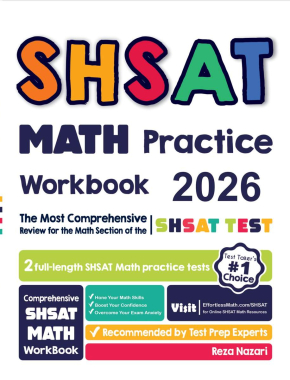
The Best Books to Ace the SHSAT Math Test
A Word About SHSAT Math Strategy
The SHSAT does not give you a formula sheet. That sounds tough, but here’s the upside: the formulas you need are the standard ones from 7th- and 8th-grade math. There’s no calculus, no trigonometry, nothing exotic. If your child has done well in school math, the SHSAT’s formula list will already feel familiar.
One thing I always tell students: the SHSAT Math is less about new content and more about how fast you can use what you already know. The Math section gives you 57 questions, and you share a 180-minute window with the ELA section — so the formulas above need to be instant-recall, not “let me think for a moment.”
Word problems are where most students lose points. The SHSAT loves to dress up basic algebra in a paragraph of text. The skill to practice isn’t a new formula — it’s translating a sentence into an equation quickly. Read, underline the numbers, write the equation, solve. That sequence, over and over.
Books That Go With This Cheat Sheet
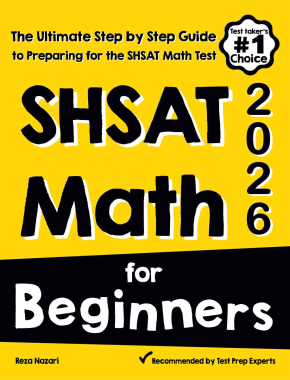
For students who want a slow, careful walk through every concept on this cheat sheet, SHSAT Math for Beginners is my first recommendation. It’s written for the student who needs the formulas explained before they’re applied — not the student who already knows everything.
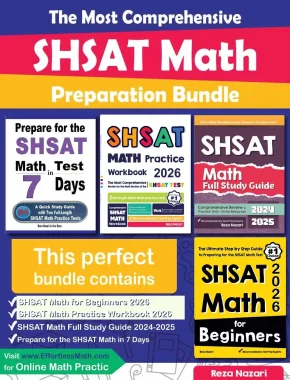
If you want a complete prep package — textbook, workbook, and full-length practice tests bundled together — the Comprehensive SHSAT Math Preparation Bundle covers the whole arc, from first formula to last practice test.
Frequently Asked Questions About SHSAT Math Formulas
Does the SHSAT give you a formula sheet?
No. The SHSAT does not provide a formula reference. That’s why working through (and memorizing) the list above is so important — every formula on the test, you bring with you.
What math topics are on the SHSAT?
The SHSAT Math section pulls from middle school content: arithmetic and number sense, fractions, decimals, percents, ratios and proportions, basic algebra (solving equations, inequalities, simple systems), exponents, geometry (area, perimeter, volume, the Pythagorean theorem, angles), and data analysis. It does not cover calculus, trigonometry, or matrices.
Can I use a calculator on the SHSAT?
No — the SHSAT is calculator-free. Every calculation has to happen in your head or on the scratch paper they give you. That’s why the cheat sheet above includes a few mental-math shortcuts (like the percent-of-change formula written out so you can do it without a calculator).
How hard is the SHSAT Math?
The content is middle-school level, but the questions are harder than what students see in school. The SHSAT loves to combine two or three concepts into a single problem — for example, a word problem that involves percentages and ratios and a system of equations. The formulas are easy; using three of them in the same minute is the challenge.
How much time should we spend on SHSAT Math prep?
Most students need 8 to 12 weeks of focused prep, with about 30 to 45 minutes a day on Math (and an equal amount on ELA). The first three or four weeks should be content review — exactly the formulas above. The remaining weeks should shift toward timed practice problems and full-length tests under realistic conditions.
Which SHSAT Math formulas are most important?
The top five, by how often they appear: the slope formula, the Pythagorean theorem, percent of change, area and perimeter formulas for triangles and rectangles, and the formula for the area of a circle. If you only had time to memorize five formulas, those would be the ones.
What is the slope formula?
Given two points \((x_1, y_1)\) and \((x_2, y_2)\), the slope is \(m = \frac{y_2 – y_1}{x_2 – x_1}\). On the SHSAT, slope shows up in coordinate geometry questions and is one of the highest-frequency formulas on the entire test.
What is the formula for area of a triangle on the SHSAT?
Area of a triangle: \(A = \frac{1}{2}bh\), where \(b\) is the base and \(h\) is the height (the perpendicular distance from the base to the opposite vertex). When you only have the three side lengths, use Heron’s formula — but Heron’s isn’t usually needed on the SHSAT.
How do I quickly translate a word problem on the SHSAT?
Three steps: (1) underline the unknown — “how many,” “what was,” “find,” (2) write a variable for the unknown, (3) translate each sentence one phrase at a time into algebra. Example: “Three more than twice a number is 17” becomes \(2x + 3 = 17\). Practice this until it feels automatic — translation is what wins SHSAT word-problem points.
Related EffortlessMath Lessons
- How to find the slope of a line
- How to use the Pythagorean theorem
- Order of operations (PEMDAS)
- Area of a triangle
- Percent of change in word problems
A Quick Word-Problem Walkthrough
Here’s a translation in action. The SHSAT loves problems like this: “Tomas is twice as old as Anna. In six years, the sum of their ages will be 45. How old is each one today?”
Let \(A\) = Anna’s age today, so Tomas’s age is \(2A\). In six years, Anna will be \(A + 6\) and Tomas will be \(2A + 6\). The sum: \((A + 6) + (2A + 6) = 45\). Combine: \(3A + 12 = 45\). Solve: \(3A = 33\), \(A = 11\). So Anna is 11, Tomas is 22. Notice how every sentence in the problem turned into one piece of algebra. That’s the whole skill.

Related to This Article
More math articles
- Louisiana LEAP Grade 7 Math Worksheets: 95 Free Printable Skill PDFs with Keys
- Comparative Advantage, Specialization, and Trade
- Geometry Puzzle – Challenge 60
- Maryland MCAP Grade 6 Math Free Worksheets: 72 Free Printable Worksheets with Worked Answers
- Low-Temperature Sterilization Methods
- The Best Grade 5 Math Book for Ohio Students
- 10 Most Common 7th Grade FSA Math Questions
- Aviator Crash Game Math: The Multiplier Distribution Explained
- How to Solve Word Problems of Budgeting a Weekly Allowance
- How to Simplify Polynomials? (+FREE Worksheet!)






What people say about "The Ultimate SHSAT Math Formula Cheat Sheet - Effortless Math"?
No one replied yet.