Grade 6 Math: Area of Composite Figures
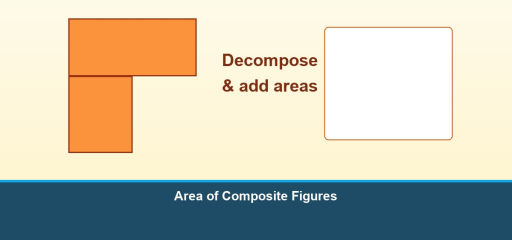
Grade 6 focus: A composite figure (or compound shape) is made from simpler figures—often rectangles and triangles. You find total area by adding areas of non-overlapping parts, or by subtracting a “cut-out” from a larger rectangle.
Video lesson: Watch this Math with Mr. J example of area for composite figures made from rectangles.
Strategy: Decompose
- Draw dashed lines to split the shape into rectangles/triangles you recognize.
- Label unknown lengths using properties of rectangles (opposite sides equal).
- Compute each area, then add (or subtract for holes).
Example (add regions)
An L-shape can split into two rectangles. Add their areas.
Example (subtract)
A rectangle with a rectangular hole: area = big rectangle − hole.
Explain your reasoning
Grade-level tasks often ask you to justify decompositions. Sketch, label, and show each area calculation.
Common mistakes
- Double-counting overlapping regions.
- Missing a hidden segment length needed for a sub-figure.
- Using perimeter where area is required.

Related to This Article
More math articles
- A Step into The World of Calculus: Rules of Differentiation
- How to Add and Subtract Functions? (+FREE Worksheet!)
- How to Multiply Three or More Mixed Numbers, Fractions & Whole Numbers?
- 10 Most Common 6th Grade FSA Math Questions
- 10 Most Common 6th Grade ACT Aspire Math Questions
- 8th Grade OST Math FREE Sample Practice Questions
- PERT Math Formulas
- Top 10 SSAT Middle Level Prep Books (Our 2023 Favorite Picks)
- The Math Expedition: How to Use Theoretical Probability to Predict the Unpredictable
- 7th Grade AZMerit Math Worksheets: FREE & Printable
What people say about "Grade 6 Math: Area of Composite Figures - Effortless Math: We Help Students Learn to LOVE Mathematics"?
No one replied yet.