Unlocking the Mystery: How to Add Fractions with Different Denominators Using Visual Models
Unlocking the Mystery: How to Add Fractions with Different Denominators Using Visual Models: this Effortless Math guide explains the topic in plain language, shows how it works through solved examples, and gives you free practice to try immediately, so the idea sticks instead of staying abstract.
Adding fractions with unlike denominators might seem like a daunting task at first, but with the right approach and understanding, it becomes a breeze.

One of the most effective ways to grasp this concept is by using visual models. In this blog post, we’ll explore a step-by-step guide on how to add fractions with different denominators using models, ensuring you have a solid foundation in this essential grade 5 math topic.
Step-by-step Guide:
1. Understanding the Basics:
Before adding fractions with unlike denominators, it’s fundamental to understand what a fraction represents. A fraction consists of a numerator (the top number) and a denominator (the bottom number). The denominator tells us into how many equal parts a whole is divided, while the numerator indicates how many of those parts we have.
2. Identifying Unlike Denominators:
If two fractions have different denominators, they have unlike denominators. For example, in the fractions (frac{1}{3}) and (frac{2}{5}), the denominators 3 and 5 are different.
3. Using Models for Visualization:
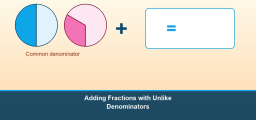
Draw two separate models (like circles or rectangles) and divide them based on the denominators of the fractions you’re adding. For our example, one model will be divided into 3 equal parts and the other into 5 equal parts.
4. Finding a Common Denominator:
To add fractions with unlike denominators, we need a common denominator. This is a number that both denominators can divide into. In our example, the least common denominator for 3 and 5 is 15.
5. Adjusting the Fractions:
Using the models, adjust the fractions to have a common denominator. For our example, (frac{1}{3}) becomes (frac{5}{15}) and (frac{2}{5}) becomes (frac{6}{15}).
6. Adding the Adjusted Fractions:
Now, simply add the numerators of the adjusted fractions. Using our example, (5 + 6 = 11). So, (frac{1}{3} + frac{2}{5} = frac{11}{15}).

Pre-Algebra for Beginners 2026 The Ultimate Step by Step Guide to Preparing for the Pre-Algebra Test
Examples 1:
Add (frac{2}{4}) and (frac{3}{8}) using models.
Solution:
The least common denominator is 8. Adjusting the fractions, (frac{2}{4}) becomes (frac{4}{8}). So, (frac{2}{4} + frac{3}{8} = frac{7}{8}).
The Absolute Best Book for 5th Grade Students
Example 2:
Add (frac{3}{6}) and (frac{1}{3}) using models.
Solution:
The least common denominator is 6. The fraction (frac{3}{6}) remains the same, while (frac{1}{3}) becomes (frac{2}{6}). So, (frac{3}{6} + frac{1}{3} = frac{5}{6}).
Practice Questions:
1. Add (frac{1}{5}) and (frac{2}{10}) using models.
2. Add (frac{3}{7}) and (frac{2}{14}) using models.
3. Add (frac{4}{9}) and (frac{2}{3}) using models.
A Perfect Book for Grade 5 Math Word Problems!

Answers:
1. (frac{3}{10})
2. (frac{4}{7})
3. (frac{10}{9}) or (1 frac{1}{9})
The Best Math Books for Elementary Students

Related to This Article
More math articles
- CLEP College Algebra FREE Sample Practice Questions
- Free Grade 3 English Worksheets for Utah Students
- Due Process Clause
- Roosevelt’s Square Deal, Consumer Protection, and Conservation
- Party organization
- Race and ethnicity
- Top 10 8th Grade Georgia Milestones Assessment System Math Practice Questions
- Florida FAST Grade 6 Math Free Worksheets: Printable B.E.S.T.-Aligned Practice with Answer Keys
- The Best Grade 4 Math Book for Arizona Students
- Sterilization Safety and Exposure Control







What people say about "Add Unlike Fractions with Visual Models"?
No one replied yet.