Geometry Puzzle – Challenge 62
In a triangle whose three angles are in the ratio 1:2:3, what is the smallest angle? The angles must sum to 180 degrees, so if the angles are X, 2X, and 3X, then X + 2X + 3X = 6X = 180, giving X = 30 degrees. The triangle is the classic 30-60-90 right triangle.
Key takeaways:
- The interior angles of any triangle sum to 180 degrees.
- When angles are in the ratio 1:2:3, the angle pieces are X, 2X, 3X.
- Summing: X + 2X + 3X = 6X = 180, so X = 30. The angles are 30, 60, and 90 degrees.
- This is the famous 30-60-90 right triangle — the side ratios are 1 : sqrt(3) : 2.
- Don’t confuse the angle ratio (1:2:3, possible) with the side ratio (1:2:3, impossible by triangle inequality).
This is a great mathematics puzzle to measure your basic math knowledge. Let’s challenge your brain!
Challenge:
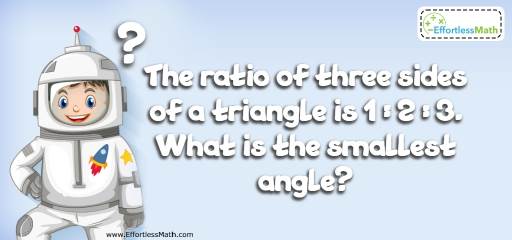
The ratio of three sides of a triangle is 1:2:3. What is the smallest angle?
The Absolute Best Book to Challenge Your Smart Student!

The correct answer is 30 degree.
Original price was: $27.99.$17.99Current price is: $17.99.
There is the same ratio for the angels. Therefore, the ratio of three angles of the triangle is also 1:2:3.
Let X be the smallest angle. Then, the next two angels are 2X and 3X.
X + 2X + 3X = 180 → 6X = 180 → X = 30
The smallest angel is 30 degree.The Best Books to Ace Algebra
Frequently Asked Questions
How do I set up an angle-ratio problem?
Let the smallest angle be \( X \). Multiply by each part of the ratio to express the other angles. For ratio 1:2:3, the three angles are \( X, 2X, 3X \). Then use the triangle angle-sum rule (180 degrees) to solve.
Why is the smallest angle 30 degrees, exactly?
Because \( X + 2X + 3X = 6X = 180 \) forces \( X = 30 \). Always set up the angle-sum equation and solve — never just guess the smallest angle.
What kind of triangle has angles 30, 60, 90?
A 30-60-90 right triangle. It is one of the two special right triangles in trigonometry (the other being 45-45-90). Its side ratios are exactly \( 1 : \sqrt{3} : 2 \), shortest to longest.
If the sides were in ratio 1:2:3, would the triangle exist?
No. The triangle inequality requires each side to be less than the sum of the other two. With sides 1, 2, 3: the longest (3) equals the sum of the other two (1 + 2 = 3), so the \”triangle\” degenerates to a line segment. A real triangle needs a strict inequality.
Is the angle 1:2:3 ratio always 30-60-90?
Yes. Whenever the angles are in the exact ratio 1:2:3, the smallest is 30, the middle is 60, and the largest is 90 — the same triangle, just possibly scaled to different overall sizes (which only changes side lengths, not angles).
What are the side ratios of a 30-60-90 triangle?
Shortest leg : longer leg : hypotenuse = \( 1 : \sqrt{3} : 2 \). The shortest leg is opposite the 30-degree angle, the longer leg is opposite the 60-degree angle, and the hypotenuse is opposite the 90-degree angle.
How would I solve a sides-in-ratio problem instead?
You need the Law of Cosines or trigonometric ratios since the angle-sum rule does not apply directly. For a 5-12-13 triangle, you can verify the right angle directly, then use sin and cos to find the other two angles.
What grade do students learn about the angle sum of a triangle?
Most state standards introduce it explicitly in Grade 8 (Common Core 8.G.5), with informal exposure in earlier grades. The formal proof shows up in high school Geometry.
Where do 30-60-90 triangles show up in real life?
Carpentry (cutting common roof rafters), architecture, drafting, engineering tolerances, and trigonometry. The clean side ratios make calculations exact, not just approximate.
How can I practice angle-ratio problems?
Try ratios like 2:3:4 (giving 40, 60, 80 degrees), 1:1:2 (45, 45, 90 — isoceles right triangle), or 1:4:7 (15, 60, 105). The same setup works every time: assign letters, add them, set equal to 180, solve.
Related Lessons You May Like
- How to classify triangles
- How to find the area of triangles
- How to use the Pythagorean Theorem
- How to find complementary, supplementary, vertical, adjacent angles
- How to find similar figures
If your student enjoys puzzles like this, Pre-Algebra for Beginners covers the algebraic reasoning they tap. For deeper geometry exploration, Geometry for Beginners takes you further.

Related to This Article
More math articles
- Work, Energy, and Power
- Free Grade 4 English Worksheets for Iowa Students
- The Ultimate PSAT 8/9 Math Course (+FREE Worksheets)
- Electioneering
- Chapter 11: The Presidency
- Free Grade 3 English Worksheets for New York Students
- Integer Operations Practice — Add, Subtract, Multiply & Divide
- A 4-Week Grade 6 ELA Study Plan: Reading, Writing, Vocabulary, and Review That Actually Fits Real Life
- The Best Laptops for Kids for School
- Grade 6 Math: Subtracting Fractions with Unlike Denominators






What people say about "Geometry Puzzle – Challenge 62 - Effortless Math"?
No one replied yet.