


Will AI Make Math Easier or Harder to Learn?
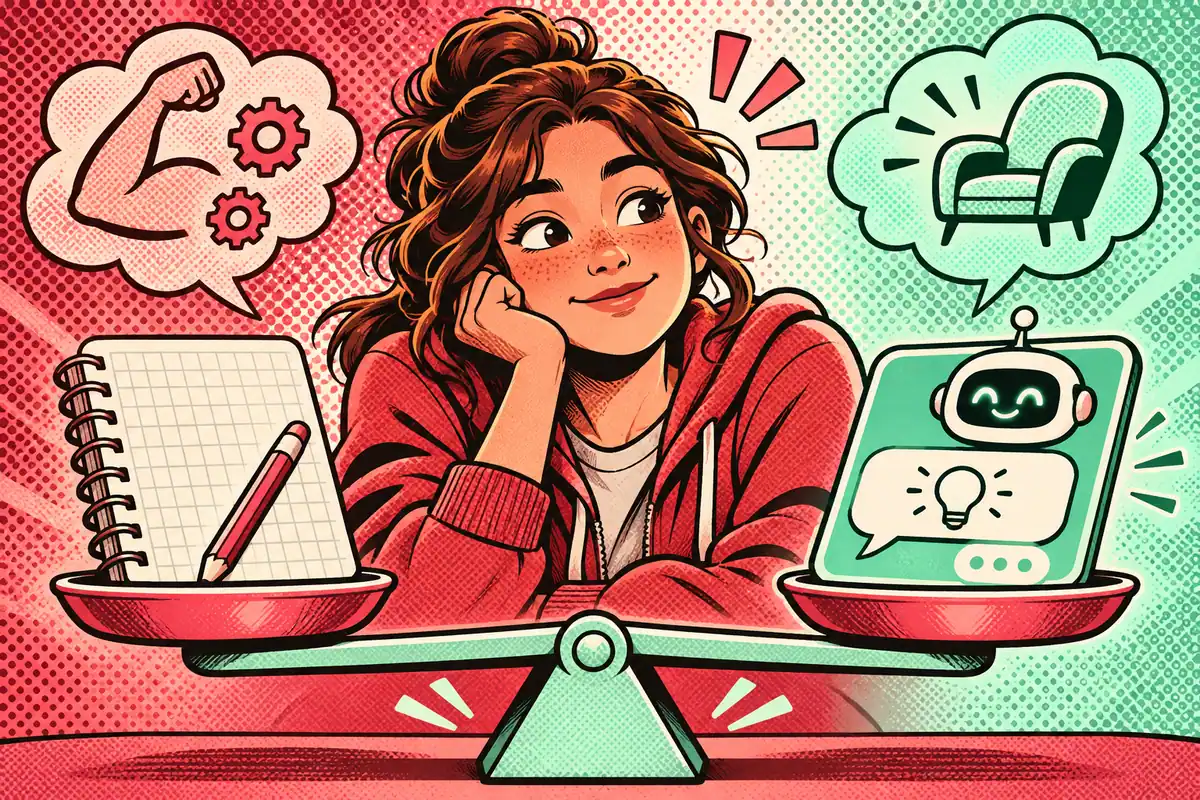
Quick answer: AI is much more likely to make math easier to learn when it acts like a coach rather than an answer machine. In a randomized study of nearly 1,000 high school students, plain ChatGPT raised practice scores 48% but lowered exam scores 17% once it was removed. A tutor version that gave hints instead of answers avoided that harm. Try first, ask for hints, and test yourself without AI.
Will AI Make Math Easier or Harder to Learn? The Short Answer
A chatbot can make tonight’s math homework easier in about ten seconds. Whether it makes math easier to learn is a different question, and the research so far points in a clear direction: it depends heavily on how the AI is set up and how students use it, though results are still mixed.
Here is the pattern that shows up again and again in recent studies:
- AI that hands out answers makes practice feel easier but tends to leave students worse off when the AI is taken away.
- AI that coaches with hints and makes students do the thinking can protect learning, and in some studies it adds a small boost.
- AI that nobody uses does nothing at all, which turns out to be one of the biggest real-world problems.
So AI can make the work easier, the learning harder, or both at once. The good news for students, parents and teachers is that the difference comes down to habits you can control. Below, we walk through what the strongest studies found, why the answer-machine approach backfires, and how to use AI so it actually makes you better at math.
The Turkey High School Study: AI as a Math Crutch
One of the most discussed studies on this question comes from a team led by researchers at the University of Pennsylvania’s Wharton School. Hamsa Bastani, Osbert Bastani, Alp Sungu, Haosen Ge, Özge Kabakcı and Rei Mariman ran a randomized controlled trial with nearly 1,000 students in grades 9 to 11 at a large high school in Turkey during the fall 2023 semester. According to PsyPost, the final paper appeared in the Proceedings of the National Academy of Sciences under the title “Generative AI without guardrails can harm learning: Evidence from high school mathematics.”
Students were split into three groups for four 90-minute math sessions, about 15% of the semester’s material:
| Group | What students had | Practice score vs. control | Exam without AI vs. control |
|---|---|---|---|
| Control | Textbook and class notes | Baseline | Baseline |
| GPT Base | A standard ChatGPT-style tutor | 48% higher | 17% lower |
| GPT Tutor | Same tool with teacher-written instructions to give step-by-step hints, not answers | 127% higher | No significant difference |
Read that table twice. The students with plain ChatGPT did much better while they had it, then did noticeably worse than students who never touched AI once it was gone. As the Wharton write-up puts it, these students “depended on the software to solve the problems” instead of learning the concepts.
Why the crutch happened
The chat logs told the story. According to PsyPost, most GPT Base students simply asked for the answer. The tool was right only 51% of the time, and students often copied flawed answers without understanding them. Lead researcher Alp Sungu summed it up: “That shortcut can hurt their actual learning.”
There was a second, sneakier finding. Students who used AI felt they had learned as much as, or more than, their classmates. Their confidence went up while their exam scores did not. That gap between feeling and reality is exactly what makes answer-giving AI risky for learners.
Watch: Two Videos Worth Your Time
Prefer to watch? These videos add another angle on the topic.
Why Easier Practice Can Mean Harder Learning
The Turkey results make sense once you think about what learning math actually requires. A worked answer on a screen is information. Being able to produce that answer yourself, on a test, a week later, is a skill. Skills are built by doing the hard part: choosing a method, getting stuck, spotting a mistake and fixing it.
When a chatbot does the hard part, the practice looks great but the skill never forms. Think of it like a gym. If a friend lifts the weights for you, your workout log looks impressive, but your muscles have not changed.
That is why the researchers’ tutor version mattered. By forcing students to work through hints rather than copy answers, it kept the struggle in the student’s hands. It did not make students outperform the control group on the exam, but it removed the harm. Sungu was careful about what this means: “We tested one tool with fairly simple prompt engineering.” In other words, a well-designed AI tutor might do better, and the study does not prove AI cannot help.
The study also has limits worth knowing. It covered one school, one subject and short-term results, and it took place when chatbots were still new to students. It is strong evidence about a risk, not the final word on AI and math.
Crutch or Coach? Pick the Best Move
Choose what you would do in each situation, then read the feedback.
You are stuck on a quadratic equation at 10 p.m. and the homework is due tomorrow.
Your homework scores are near perfect since you started using AI, but your last quiz grade dropped.
A chatbot gives you an answer of x = 7, but your own work gave x = 5.
You are a teacher choosing an AI tool for in-class practice.
What Newer AI Math Tutor Studies Found
Since the Turkey trial, several more studies have tested AI tutors built on purpose for learning, some of them much larger. The results are more encouraging, but also more modest than the hype.
- Khanmigo in Tennessee. In a two-year randomized trial in 18 Tennessee middle schools, Philip Oreopoulos and Nina Low found that Khan Academy with its AI tutor, set to coach rather than give answers, raised math achievement by about 1.3 national percentile ranks per term. According to the NBER working paper, the gains were similar to those from Khan Academy practice without AI. The catch: students messaged the tutor in only 17% of practice sessions where they made a mistake. The authors concluded that AI tutoring will require “getting students to use it, not just giving them access.”
- AI plus mastery practice. A second NBER study by Oreopoulos, Michael Liut, Alp Sungu and Nina Low followed more than 6,000 middle schoolers in Hamilton County, Tennessee. According to the paper, AI-supported students moved more slowly and attempted fewer questions but were more accurate, and AI help made them more likely to get the next attempt right after a mistake. The best results on a delayed test came when AI was combined with a rule requiring students to show mastery before moving on, though those gains were only marginally significant.
- Human tutors with an AI helper. A Stanford study of Tutor CoPilot, summarized by the Stanford SCALE Initiative, found that about 1,000 elementary students whose human tutors used AI-suggested replies were 4 percentage points more likely to master a topic, with gains of up to 9 points for students of lower-rated and less experienced tutors. Tutors using the tool were more likely to ask students to explain their thinking.
- A warning from college. The Hechinger Report described a University of Maryland randomized trial in fall 2025 in which courses given an always-on AI assistant saw grades fall slightly, by about 0.11 points on a four-point scale. Only 15% of students used the assistant, mostly to get answers.
Put together, the message is consistent. AI that makes students explain, retry and master skills helps a little. AI that makes answers effortless tends to hurt a little. Neither one is magic.
Who Benefits Most and Who Is Most at Risk From AI in Math
AI does not affect every learner the same way. Based on the studies above, a few patterns stand out.
Likely to benefit
- Students who already try first. A learner who works a problem, then asks for a hint on the exact step that went wrong, gets the most out of an AI tutor.
- Students whose tutors or teachers are newer. In the Tutor CoPilot study, the biggest gains came from students working with less experienced tutors.
- Students who practice regularly. In an Arizona study of the Goblins AI math tool described by the Hechinger Report, middle schoolers who solved at least two problems a week scored higher on year-end tests than similar students who used it less. The study could not prove the tool caused the gain, since more motivated students may simply practice more.
Most at risk
- Students who use AI to finish, not to learn. The answer-copying habit is the clearest risk in the research.
- Students who feel confident but have not tested themselves. The Turkey study showed AI users overestimated how much they had learned.
- First-generation college students. In the Maryland study, the negative effects were stronger for this group. Provost Jennifer King Rice warned that “AI tools could exacerbate inequities in learning outcomes.”
For a deeper look at the risks for younger learners, see our guide on whether AI makes kids worse at math.
How to Use AI So Math Gets Easier to Learn, Not Just to Finish
The research points to a simple rule: let AI help you think, never let it think for you. Here is what that looks like in practice.
- Try the problem first, every time. Give yourself a real attempt, even five minutes, before opening a chatbot. The struggle is where the learning happens.
- Ask for a hint, not the answer. Type something like “Do not solve this. Give me one hint for the next step.” This pushes a chatbot toward the coaching style of the GPT Tutor version, though a prompt alone cannot copy all of its safeguards.
- Explain your step back to the AI. Ask it to check your reasoning instead of producing its own. Tutors who asked students to explain their thinking got better results in the Stanford study.
- Check every AI answer. Chatbots still make math errors. Plug answers back into the original problem or use a simple answer-checking routine.
- Test yourself without AI. End each session by solving one or two similar problems with no help. If you cannot, you have not learned it yet, no matter how good the practice felt.
- Use step-by-step tools to study, not to submit. A step-by-step math solver is great for studying a worked example after you have tried, then covering it up and redoing the problem yourself.
Our full guide on how to use AI to learn math includes sample prompts you can copy.
Is AI Your Math Coach or Your Crutch?
Tick every habit that describes how you usually use AI for math.
What This Means for Students, Parents and Teachers
AI will not make math effortless to learn, and it does not have to make it harder. It changes where the effort goes. The students who come out ahead will be the ones who keep doing the hard thinking and use AI to get unstuck, catch mistakes and get more practice.
For students
Judge your learning by what you can do alone, not by how smooth the homework felt. If your test scores are slipping while your homework scores are perfect, that is a sign AI is doing too much.
For parents
Ask your child to explain one homework problem out loud each week. If they can walk you through it, AI is probably helping. If they cannot, it may be acting as a crutch. Encourage hint-only prompts rather than banning AI outright.
For teachers
The research favors guardrails over free-for-all use: tools that give hints instead of answers, practice that requires mastery before moving on, and regular checks without AI. The Khanmigo trial is a reminder that access alone is not enough. Students need routines that make them actually use the tutor at the moments they make mistakes.
The bottom line: AI makes math easier to do. Whether it makes math easier to learn is still up to the learner.
Quick Quiz: Does AI Help You Learn Math?
Test what you learned from this article with eight quick questions.
Answer each question and press Submit to see your result right away.
Answer each question and press Submit to see your result right away.
Frequently Asked Questions
Tap a question to see the answer.
Is it bad to use ChatGPT for math homework?
Not automatically. The research shows the problem is using it to get answers rather than to understand. Asking for hints, checking your own steps and then solving similar problems without help is a much safer way to use it. Also check your teacher's rules, since some classes do not allow AI at all.
Can AI replace a math tutor?
Not yet, based on the evidence. Studies of AI tutors show small average gains, and the Stanford Tutor CoPilot results suggest AI works well as a helper for human tutors. A good human tutor still notices confusion, motivation and gaps that students do not mention.
Does AI help struggling math students?
It can, if it is set up to coach. AI that gives hints and requires students to fix mistakes can provide extra practice and quick feedback. But struggling students are also the most tempted to copy answers, so guardrails and adult check-ins matter most for them.
What is the best way to prompt AI for math help?
Tell it what not to do. A prompt such as "Do not give me the answer. Ask me a question that helps me find the next step" keeps you doing the work. You can also paste your own solution and ask the AI to find the first step where you went wrong.
Why do students feel they learn more with AI when they do not?
Reading a clear solution feels like understanding, but recognizing an answer is easier than producing it. In the Turkey study, AI users overestimated their learning. A short test without AI is the best way to see what you really know.
Is AI accurate at solving math problems?
Newer models are often more accurate than early chatbots, but they can still make mistakes, and they can sound confident when wrong. In the 2023 Turkey study, the basic chatbot was right only about half the time. Always verify answers by substitution or estimation.
Should schools ban AI in math class?
Current research leans toward guided use with guardrails, though it cannot yet settle the question for every school. Tools that give hints instead of answers, mastery requirements and regular no-AI assessments have shown better results than open, unrestricted access. Teachers can also reserve some tasks for AI-free work to build core skills.
Will AI make mental math and basic skills unnecessary?
No. Basic number sense lets you notice when an AI answer is wildly off, set up problems correctly and follow explanations. Students who skip fundamentals are the ones most likely to be misled by a wrong AI answer.
How can parents tell if AI is helping or hurting their child's math?
Compare homework results with quiz and test results. If homework is perfect but tests are slipping, AI may be doing too much. Asking your child to explain one problem out loud is another quick, reliable check.
Sources and Further Reading
- PsyPost: Unrestricted generative AI harms high school math learning by acting as a crutch
- Knowledge at Wharton: Without Guardrails, Generative AI Can Harm Education
- NBER: One Click Away: AI Tutoring with Khanmigo in a Two-Year School Experiment
- NBER: Making AI Tutoring Productive: Evidence from a Mastery-Based Math Practice Experiment
- The Hechinger Report: Proof Points on AI tutor results
- Stanford SCALE Initiative: Two Emerging Strategies for Using AI in Tutoring
- Edutopia: How AI Vaporizes Long-Term Learning

Related to This Article
More math articles
- How to Master the Pythagorean Theorem and Right Triangles
- FREE 7th Grade Common Core Math Practice Test
- Grade 3 Math Flashcards (Free Online: Formulas, Terms & Concepts)
- Power Tool Care: Inspect Before You Use It
- How to Compare Decimals? (+FREE Worksheet!)
- How to Find the y-Intercept of a Line?
- Integrals Made Easier Using Tables: A Complete Explanation And Examples
- Chinese Zodiac Calculator
- Early Earth and the Origin of Life
- How to Solve Triangles Problems? (+FREE Worksheet!)












What people say about "Will AI Make Math Easier to Learn? What Studies Show"?
No one replied yet.