Can AI Invent a New Branch of Mathematics?
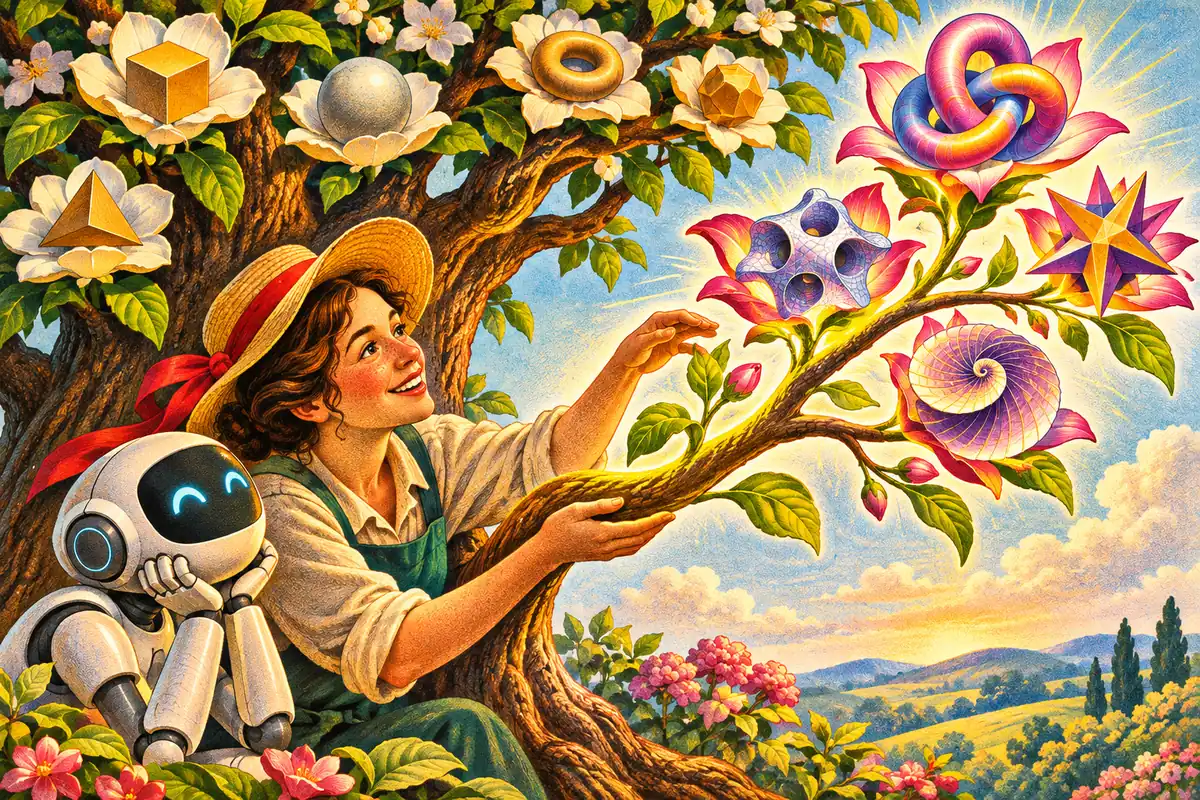
Quick answer: AI has not yet clearly invented a new branch of mathematics. It has solved hard open problems, found counterexamples and spotted new connections, including work behind a claimed Riemann hypothesis proof. But building a lasting field of new definitions, theories and questions that mathematicians adopt is a bigger step, and most experts say AI has not shown it so far.
Can AI Invent New Math? The Short Answer
AI can now prove theorems that stumped people for decades. Inventing a whole new branch of mathematics is a different and much bigger job, and no AI has clearly done it yet.
The honest answer in late 2026 is: not yet, but the gap is shrinking, and experts disagree on how fast. AI systems have found counterexamples, improved old records, spotted patterns people missed and, according to reports this month, helped produce a claimed proof of the Riemann hypothesis. What none of them has done, by the account of most mathematicians quoted in the news, is build a large new framework of definitions and theories that other mathematicians then adopt as a field of their own.
It helps to separate three levels of mathematical novelty:
| Level | What it means | Has AI done it? |
|---|---|---|
| 1. Solve a known problem | Answer a question someone already asked, using known tools | Yes, many times |
| 2. Find a new idea or connection | Spot a pattern, link two areas, or use an old tool in a surprising way | Yes, in several reported cases |
| 3. Invent a new branch | Create new objects, definitions and questions that grow into a lasting field | No clear example so far |
Most of the excitement, and most of the confusion, comes from mixing up these levels. A headline that says AI discovered new math usually means level 1 or level 2. That is impressive. It is not the same as what happened when people created algebra, calculus or group theory.
What It Takes to Invent a Branch of Mathematics
New branches rarely start with a plan to build a branch. They usually start with a stubborn problem that existing tools cannot handle.
Group theory is a classic example. According to the history of group theory, the push came from the search for formulas to solve polynomial equations of degree higher than four. Évariste Galois published his first group theory paper at age 18, in 1829, and was the first to use the word group in its modern sense. His work drew little attention until his collected papers appeared in 1846. Arthur Cayley gave an abstract definition in 1854, and Walther von Dyck is credited with the first fully modern definition in 1882.
That timeline shows what inventing a field really involves:
- A new kind of object. Galois looked at the symmetries of an equation’s solutions instead of only the equation.
- A useful definition. The idea of a group had to be stated in a general, abstract way.
- New questions. Once groups existed, people asked questions about groups for their own sake.
- A community that adopts it. It took decades, and many people, before group theory became a standard part of mathematics.
The last step matters more than it sounds. A branch of mathematics is not just a clever idea. It is an idea that many people find worth learning, teaching and building on. That is a social judgment as much as a logical one, which is one reason the question of whether AI can do it is hard to settle with a single result. If you enjoy this kind of question, our post on whether math is invented or discovered goes further.
Watch: Two Videos Worth Your Time
Prefer to watch? These videos add another angle on the topic.
What AI Has Actually Done in Mathematics So Far
Here is a short tour of real, reported results, ordered roughly by date. Each one pushed a little further toward new ideas.
2021: pointing humans to a new quantity in knot theory
In 2021, Google DeepMind worked with Oxford mathematicians Marc Lackenby and András Juhász. According to DeepMind’s report, machine learning tools hinted that a knot’s algebraic signature is tied to its geometry, and guided Lackenby to a new quantity called the natural slope. The humans then proved the relationship. Oxford’s Marcus du Sautoy said it felt like Galileo picking up a telescope.
2025: AlphaEvolve searching for better constructions
DeepMind’s AlphaEvolve uses Gemini to write and evolve computer programs. As reported by Quanta Magazine, Terence Tao and colleagues tested it on 67 problems. It improved the best known solutions on 23, matched them on 36 and fell short on the rest. In a separate project, Jordan Ellenberg and colleagues reported that AlphaEvolve turned up hypercube structures in certain permutation groups that the team had not asked it to look for. Our AlphaEvolve explainer covers how it works.
2026: a string of number theory results
- August: Anthropic reported that an unreleased research version of Claude, asked to take a real stab at the Riemann hypothesis, did not solve it but raised a long-standing bound on the share of zeta zeros on the critical line from 41.6% to 67.2%, as Scientific American reported. Claude first tried 650 ideas that did not work.
- October: OpenAI released a large batch of AI-written papers, including one on the quasi-Riemann hypothesis, a weaker cousin of the full problem. Quanta reported that experts largely agree the result is correct, although mathematician Peter Sarnak said he would not call it a theorem until humans check the details.
- November: Levent Alpöge, a mathematician at Anthropic, posted a claimed proof of the Riemann hypothesis developed with Claude.
Notice the pattern. Every one of these attacks a question humans had already posed, inside a field humans had already built. That is not a criticism. It is simply where AI sits today.
Solved, Found or Invented?
Tap a card to see which level of math novelty each example reaches.
The Riemann Proof: New Ideas or a Clever Synthesis?
The Riemann hypothesis story is the strongest test case so far, so it is worth reading carefully.
According to Science News, Alpöge worked back and forth with Claude for six weeks, with the work checked in the Lean proof assistant using the Mathlib library. The formal proof runs to about 17 million lines of Lean code, and he also claims the generalized Riemann hypothesis. The day after the release, the Lean Focused Research Organization and the Mathlib Initiative said they had full confidence that the proof is correct, after checking that the 17-million-line Lean library compiles, passes independent proof checkers and proves Mathlib’s own statement of the hypothesis.
Even so, nobody yet claims to understand the proof the way mathematicians normally understand proofs. The Lean FRO and Mathlib Initiative’s statement says the mathematical community still needs to explain the proof’s new ideas. Science News also reported pushback: a group called the Association for Human Mathematics said in a statement that no human can claim responsibility for the proof and that no mathematician can confirm with full certainty that it is correct.
Northwestern’s Bryna Kra called it an historic achievement, but stressed that AI did not work alone: there is someone to stand behind the work. Alpöge himself told Science News that Claude far outpaced him near the finish line.
Earlier results give a useful comparison. For the quasi-Riemann paper, Quanta reported that the proof did not need new concepts but instead unearthed hidden connections between old ones, and mathematician Alexander Dunn called it a surprising synthesis of well-known ideas. For Claude’s August result, Oxford’s James Maynard told Scientific American that the problem needed a new real idea, which this new result seems to provide.
So the best reading today: AI has produced genuinely new ideas inside existing fields. Whether the Riemann proof contains ideas big enough to seed a new field will only become clear once humans can explain it.
For background on the people involved, see our profile of Levent Alpöge.
Why Inventing a Field Is Harder Than Solving a Problem
Solving a problem has a finish line. You know when you are done because the statement is proved or disproved, and a tool like Lean can confirm it. Inventing a field has no finish line and no checker.
In an essay for The Guardian, reposted by Bruce Schneier, Schneier and co-author Kasra Rafi sorted AI’s math wins into two groups: counterexamples, and new uses of known techniques on existing problems. They called these relatively low-hanging fruit for AI, while stressing that they are not trivial. Their key line: what we have not yet seen is an AI developing a substantial new conceptual framework.
Several things make the jump hard:
- No clear target. A new branch begins with deciding which question is worth asking. Benchmarks reward answers, not good questions.
- Explanation is part of the job. In a Simons Foundation talk (see the video below), Terence Tao argued that it is not enough to generate and verify proofs. Results become valuable once they are understood, taught and written into textbooks.
- Long-range planning. Quanta reported that Tao described current AIs as jumping robots that cannot yet do long-term strategic planning. Building a theory takes years of connected steps.
- Taste and adoption. A field needs people who find its definitions beautiful and useful. That judgment comes from the community, not from a proof checker.
There is also a quieter point. AI learned from centuries of human-made definitions. In the same Simons Foundation talk, Tao said that mature theories and textbooks built by people are what AI uses for its success. Inventing a branch means adding new groundwork, not only standing on the old.
What Experts Expect Next
Few serious voices say AI will never invent new mathematics. The disagreement is about timing and about who gets the credit.
| Who | View (as reported) |
|---|---|
| Bruce Schneier and Kasra Rafi | Confident AI will eventually produce novel mathematics, guessing sooner rather than later, while admitting AI predictions are hard |
| Thomas Bloom, to Quanta | After quasi-RH: at this point nothing would surprise me |
| Bryna Kra (Northwestern), to Science News | The Riemann result is a beginning that opens up more questions than it answers; mathematicians must find the next frontier |
| Terence Tao, Simons Foundation talk | Mathematicians, not outside actors, should set the rules on what is acceptable |
One likely path is collaboration. In the 2021 knot theory work, AI flagged a pattern and humans named and proved the new quantity. Stanford’s Ravi Vakil and his coauthors used Google’s Gemini-based tools on a question about embeddings of spheres, and a clear argument from the model gave them a new idea. As Vakil asked Quanta: who is that idea due to? If a new branch appears soon, it may well come from that kind of partnership, with credit shared and argued over.
Gary Marcus, quoted by Science News, adds a separate caution: AI’s success in math may not carry over to open-ended problems in biology, business or robotics. Math has clear rules and a checker, which most fields lack.
What This Means for Students, Parents and Teachers
If AI can solve more and more problems, the human edge moves toward the work it still struggles with: asking good questions, choosing definitions, explaining ideas and judging what matters. Those skills start in ordinary classrooms.
- Ask why, not only how. When you learn a formula, ask why it is defined that way. Why is a slope rise over run and not run over rise? That habit is the seed of mathematical invention.
- Practice making your own questions. After a homework problem, change one number or one condition and ask what happens. You are doing small-scale research.
- Use AI as a sparring partner, not an answer key. Ask it to check your reasoning or suggest a hint, then explain the result back in your own words.
- Learn to explain. The Riemann story shows that verifying a proof and understanding its ideas are two different achievements. Writing clear steps is a real mathematical skill.
- Stay curious about the news, but read it carefully. Check whether a headline means solved, found or invented.
For a longer list of skills that will matter, read our guide to math skills for the age of AI. The short version: AI is getting very good at answers. People who can ask new questions will stay valuable for a long time.
Use AI Like a Young Mathematician
Pick the best move in each situation, then read the feedback.
You finished a geometry problem about triangles and want to go further.
An AI chatbot gives you a proof you cannot follow.
A headline says AI invented new math.
Quick Quiz: Can AI Invent New Math?
Test what you learned about AI, new ideas and new branches of mathematics.
Answer each question and press Submit to see your result right away.
Answer each question and press Submit to see your result right away.
Frequently Asked Questions
Tap a question to see the answer.
Has AI ever discovered a new math theorem?
Yes. AI systems have helped prove new results, such as Claude raising a bound on zeta zeros to 67.2% in 2026, and AlphaEvolve improving known solutions on 23 test problems. These are new results or improved records, but they answer questions that humans had already asked.
Did AI really prove the Riemann hypothesis?
Levent Alpöge posted a claimed proof developed with Claude on November 20, 2026, and the next day the Lean FRO and the Mathlib Initiative said they have full confidence the formal proof is correct. The proof runs to about 17 million lines of Lean code (Alpöge called a widely quoted 250,000-page figure a joke) and is not yet understood by humans in the usual way. The Association for Human Mathematics disputes that anyone can take responsibility for it, so the community discussion is far from over.
Can AI be creative in mathematics?
In a limited sense, yes. Bruce Schneier and Kasra Rafi sorted AI's wins so far into counterexamples and new uses of known techniques on existing problems, and James Maynard said Claude's zeta result seemed to supply a new real idea. What AI has not clearly shown is the deep, sustained theory building that creates whole new fields.
Who gets credit when AI helps prove a theorem?
There is no settled rule yet. In recent cases the human who guided the work, such as Levent Alpöge, posted the result, while groups like the Association for Human Mathematics argued that no human can claim full responsibility. For now, credit is debated case by case.
Will AI replace mathematicians?
Most mathematicians quoted in recent reporting expect their jobs to change rather than vanish. Humans are increasingly needed to choose problems, explain AI-produced proofs and decide what is worth building on. Our post on whether AI will replace mathematicians covers the debate in more detail.
What is the difference between discovering and inventing in math?
Discovering usually means finding a fact that seems to have been true all along, such as a new pattern among primes. Inventing usually refers to creating a new concept, notation or framework, such as the abstract idea of a group. Philosophers still argue about whether math itself is invented or discovered.
How long does it take for a new branch of math to be accepted?
Often decades. Galois published his first group theory paper in 1829, his collected papers appeared in 1846, Cayley gave an abstract definition in 1854, and the fully modern definition is credited to von Dyck in 1882. A new AI-made idea would likely need years of human study before anyone called it a field.
How is an AI proof checked if no human can read it?
Proofs written in a proof assistant like Lean are checked by a small trusted program called a kernel, and sometimes by several independent checkers. For the Riemann proof, the Lean groups also confirmed that the theorem proved matches Mathlib's official statement. Checking that a proof is correct is not the same as understanding why it works.
Should students still learn proofs if AI can write them?
Yes. Writing and reading proofs builds logical thinking, and understanding a proof is still a human job even when a machine produced it. Teachers and mathematicians quoted in the news argue that these skills matter more, not less, as AI improves.
Sources and Further Reading
- Science News: The Riemann hypothesis, math's most famous problem, has apparently been solved
- Lean community blog: Statement on the Riemann Hypothesis proof
- Quanta Magazine: AI proved the quasi-Riemann hypothesis. What happens now?
- Quanta Magazine: The AI revolution in math has arrived
- Schneier on Security: No, AI doesn't mean the end of mathematics, at least not yet
- Scientific American: No, AI didn't just solve the thorniest problem in math
- Google DeepMind: Exploring the beauty of pure mathematics in novel ways
- Wikipedia: History of group theory

Related to This Article
More math articles
- 5 Tips for Surviving a Statistics Course
- The Best Calculator for PSAT 8/9 Math Test
- Chapter 27: Development of the Party System
- Angles of Rotation
- The Best Grade 4 Math Book for Idaho Students
- Ratification of the U.S. Constitution: Nine States and Article VII
- Simple Interest Calculator
- Dudeney’s Dissection: Triangle to Square in 4 Pieces
- Limits: What Happens When a Function Approaches Infinity
- Best tools for Online teachers









What people say about "Can AI Invent New Math? What the Evidence Says"?
No one replied yet.