What the AI Riemann Proof Means for Students and Teachers
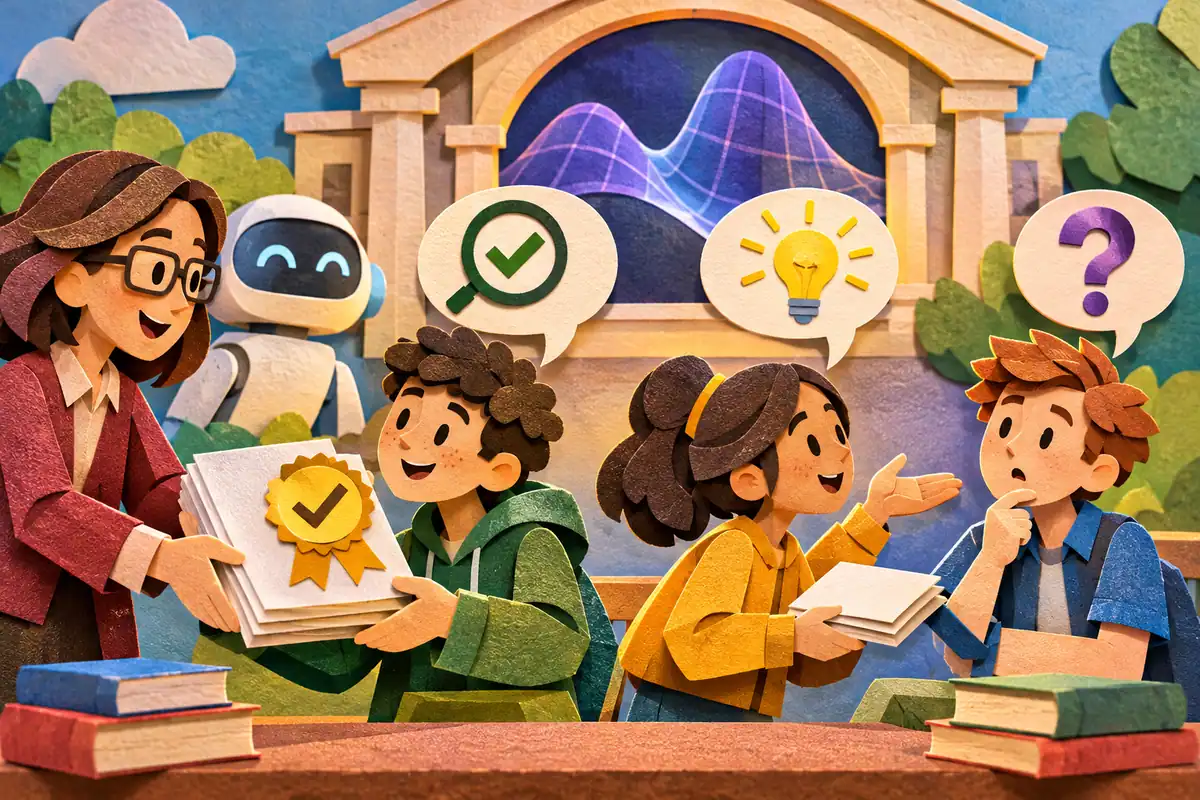
Quick answer: A mathematician working with Claude has produced a machine-checked proof of a 167-year-old problem, certified by Lean experts, though broader acceptance is still pending. For students and teachers, it does not make math pointless. It shows that understanding, checking and explaining matter more than ever, since experts were needed to guide the AI and are still working to understand the proof.
What the AI Riemann Proof Means, in Plain Terms
A problem that stumped the best mathematicians for 167 years appears to have been solved by a mathematician working side by side with an AI. If you are a student or a teacher, the obvious next question is: so what does this mean for me?
Here is the short version. On November 20, 2026, Anthropic mathematician Levent Alpöge posted a proof of the Riemann hypothesis that he developed with the company’s AI model, Claude. Science News reports that he worked back and forth with Claude over six weeks and that Claude checked its work using Lean, software that turns arguments into code so a computer can confirm the logic. The next day, the Lean FRO and the Mathlib Initiative said in a joint statement: We have full confidence that Alpöge’s proof of the Riemann Hypothesis is correct.
The Riemann hypothesis dates to 1859 and is about the zeros of the Riemann zeta function, which are closely tied to how prime numbers are spread out. It is one of the Clay Mathematics Institute’s Millennium Prize Problems, with a $1 million award. Our Riemann hypothesis explainer walks through the idea at a student-friendly level.
For students and teachers, the meaning is not that math is finished. It is that the skills people value in math are shifting, from producing answers toward understanding, checking and explaining them. The rest of this post makes that concrete.
What We Know About the AI Riemann Proof and What Is Still Uncertain
Before drawing lessons, it helps to separate solid facts from open questions.
| Question | What the reporting says |
|---|---|
| Is the proof correct? | The Lean FRO and Mathlib Initiative say they have full confidence it is, after multiple independent computer checks |
| Who did the work? | Alpöge, working with Claude. He wrote that Claude far outpaced him near the finish line |
| Do humans understand it yet? | Not yet. Kevin Buzzard told Al Jazeera nobody yet understands why the theorem is true |
| Has the $1 million prize been awarded? | No. The Next Web reports Clay moved the problem to active status, and its rules require publication, at least two years of scrutiny and broad acceptance |
| Does everyone agree on its meaning? | No. Reactions range from historic landmark to warnings about hype and credit |
Reactions show the range. Ken Ono of the University of Virginia told Science News that it really doesn’t get bigger than this. Bryna Kra of Northwestern University called it an historic achievement but stressed that it was not the work of AI alone, adding that there is someone to stand behind the work. On the skeptical side, Science News notes that a group called the Association for Human Mathematics argued that no human can claim responsibility for the proof.
Credit is also debated. Abhishek Saha of Queen Mary University of London told Al Jazeera that the credit should go to Alpöge rather than Claude. Euronews reports that critics including Gary Marcus and Yann LeCun said the AI did not solve the problem alone, since it relied on months of human guidance and tools built by mathematicians.
Watch: Two Videos Worth Your Time
Prefer to watch? These videos add another angle on the topic.
What the Riemann Proof Means for Math and Everyday Technology
Students often ask whether a famous proof changes anything outside a math department. In this case, the honest answer is: a little, and mostly behind the scenes.
Hundreds of conditional results may become unconditional
For decades, mathematicians proved theorems of the form: if the Riemann hypothesis is true, then this follows. Euronews reports that hundreds of theorems that depended on the hypothesis would become unconditional once the proof is broadly accepted. Ono described the effect to Science News as an earthquake throughout mathematics.
Encryption is not broken
A common worry is that solving a prime number problem breaks online security. Euronews states plainly that the proof does not break internet encryption. Buzzard told Al Jazeera that some algorithms, such as certain fast ways of testing whether a number is prime, have guarantees that depend on the generalized hypothesis, so the claimed proof would confirm those guarantees. Your bank account is not suddenly at risk.
A new way of doing research
The bigger change may be in how research gets done. Science News reports that Alpöge guided the AI, while Claude checked its own work in Lean and drew on Mathlib, Lean’s shared math library. Buzzard compared AI to a telescope and added, the AI doesn’t have taste, not yet anyway. That kind of collaboration is likely to spread, which shapes the skills today’s students will need.
It also arrived sooner than many experts expected. Abhishek Saha told Al Jazeera that his own expectation had been that a proof was several years away. Kit Yates warns in Live Science that AI can create arguments faster than the community can verify, interpret or absorb them, which is why people who can check and interpret results will be in demand.
What the AI Riemann Proof Means for Students
If an AI can help prove the Riemann hypothesis, is there any point in learning fractions or algebra? Yes, and this story actually shows why. Here are five skills that matter more now, not less.
- Understanding, not just answers. Even after computers checked the proof, mathematicians said the job was unfinished because its ideas still had to be understood and explained. Kevin Buzzard told Al Jazeera that, at that point, we don’t even know why the theorem is true, even though the code had checked out. Understanding is the part people still have to supply.
- Checking work. Confidence in the formal proof grew because several independent proof checkers accepted it. Build the same habit: estimate first, then check your answer against it.
- Precise definitions. The verification depended on an exact, expert-vetted statement of the hypothesis. In class, knowing exactly what slope or a function means prevents the same kind of mistakes.
- Explaining your reasoning. Mathematician Kit Yates argues in Live Science that Demonstrating understanding has always been a more important quality in university students. As AI makes written work easier to produce, being able to explain and defend an idea out loud counts for more.
- Your own strong foundation. Math educator Po-Shen Loh responded to the news by writing, You need to have your own independent strong capabilities. You cannot judge an AI’s output in an area you do not understand yourself.
For a practical guide to checking an answer from an app or chatbot, see our post on how to check an AI math answer.
Are You Building AI-Proof Math Skills?
Tick each statement that is true for you most of the time.
What the AI Riemann Proof Means for Teachers
Teachers do not need to rewrite their curriculum overnight. The National Council of Teachers of Mathematics (NCTM), in its 2024 position statement on AI, describes the needed changes as evolutionary, not revolutionary. It also says Teachers must tell students to be very skeptical about AI results. The Riemann story is a perfect hook for that message.
Five classroom ideas
- Discussion starter (all grades): If a computer proves something nobody understands, do we know it is true? Let students argue both sides.
- Number sense activity (middle school): The proof is about 17 million lines of Lean code. Ask students how long reading it would take at one line per second.
- Primes exploration (middle and high school): Have students list primes up to 100 and look for patterns, then explain that the Riemann hypothesis is about the deep pattern in how primes are spread out.
- Verification task (high school): NCTM suggests asking students to generate examples that test whether a solution is correct, since checking a solution takes deeper understanding than producing one. Give them an AI-generated solution with a hidden error.
- Ethics and credit (high school): Who deserves credit, Alpöge or Claude? Use the quotes from Saha, Kra and the critics as evidence.
Assessment that rewards understanding
NCTM warns against shallow assessments that focus only on computation. Yates makes a related point about written work becoming less reliable as a measure of ability, and he recommends discussions and seminars where students explain and defend their thinking. Short oral check-ins, explain-your-step questions and error analysis tasks all fit that advice. Our post on AI in the math classroom has more ideas.
What Would You Do? AI and Math Scenarios
Choose the best response for each situation.
A student says: AI solved the Riemann hypothesis, so I do not need to learn algebra.
A chatbot gives you an answer to a homework problem that differs from yours.
A parent hears the proof will break online banking security.
A teacher wants to assess understanding now that AI can write solutions.
What the AI Riemann Proof Means for Parents
Your child may come home saying AI just solved the hardest math problem ever, so why bother with homework? Here is how to answer that well.
- Agree that it is exciting. It is a genuinely historic moment, and curiosity is a good thing. Watch one of the videos on this page together.
- Point out the human in the story. Alpöge is a trained mathematician who guided the AI for weeks. Without deep knowledge, he could not have steered or judged the work.
- Explain why understanding still matters. Even experts are now working to understand the proof. Understanding is the skill AI has not replaced.
- Set simple AI rules for homework. AI is fine for hints, checking an answer or seeing a second explanation. It should not replace doing the problem first.
NCTM’s statement offers reassurance here too: it says students will continue to need teachers’ mathematical, pedagogical, and relational expertise. AI changes the tools, not the need for good teaching and practice.
Is Math Still Worth Learning After the AI Riemann Proof? What to Do Next
Yes. The people who could use, steer and judge an AI on the hardest problem in mathematics were the people who knew the most math. That is the clearest lesson of the whole story.
A simple plan for this week
- Students: pick one problem you solved recently and write two sentences explaining why your method works.
- Students using AI tools: solve first, then use AI only to check. If the answers differ, find out which one is wrong and why.
- Teachers: run a 10-minute discussion on whether a proof nobody understands counts as knowledge.
- Parents: ask your child to teach you one thing from math class this week. Explaining is the best test of understanding.
- Test takers: exams like the SAT still test your own reasoning, with no AI help allowed. Keep building fundamentals with focused practice such as our SAT math prep.
For a longer look at this question, read Is math worth learning in the age of AI? The AI Riemann proof does not make human math less important. It raises the bar for what human math is for: asking good questions, understanding deeply and explaining clearly.
Quick Quiz: What the AI Riemann Proof Means
Eight quick questions to check what you took away from this post.
Answer each question and press Submit to see your result right away.
Answer each question and press Submit to see your result right away.
Frequently Asked Questions
Tap a question to see the answer.
Did AI solve the Riemann hypothesis by itself?
No. Reports describe mathematician Levent Alpöge working with Claude over several weeks, guiding the work and judging its output. Critics and supporters alike emphasize that human expertise was essential.
Will this change what my child learns in math class?
Not immediately. Core topics like arithmetic, algebra and geometry remain the foundation. What may shift over time is more emphasis on reasoning, checking and explaining, which NCTM already recommends.
Should students use AI for math homework now?
AI can help with hints, second explanations and checking answers, but it works best after a student tries the problem first. Follow your teacher's rules, since some assignments are meant to be done without AI.
Does the proof affect the SAT, ACT or other tests?
No. Standardized tests measure your own reasoning on set topics, and the Riemann hypothesis is not on them. The story is a good reminder that fundamentals still matter, since you cannot use AI on these exams.
Is the AI Riemann proof officially accepted?
The Lean FRO and Mathlib Initiative have certified it as correct based on computer checks. Wider acceptance and the Clay prize process take longer: Clay requires publication in a qualifying outlet, at least two years of scrutiny and general acceptance.
How can teachers explain the Riemann hypothesis to younger students?
Start with prime numbers and ask students to look for patterns in where they appear. Then explain that the Riemann hypothesis predicts a deep, hidden order in how primes are spread out, and that proving it took 167 years and new tools.
Will AI replace mathematicians or math teachers?
The coverage of this proof suggests the opposite for now: experts were needed to guide the AI, check the statement and work to understand the result. NCTM says students will continue to need teachers' expertise.
What is Lean, and can students try it?
Lean is a programming language and proof assistant that checks each step of a proof. It is free and open source, and there are beginner tutorials that start with simple logic and number facts, so curious high school students can try it.
Why do some mathematicians object to the proof?
Most concerns are about understanding and credit rather than correctness. Some argue that a proof no human understands is incomplete, and one group said no human can claim responsibility for it. Others worry about hype around AI.
What is the best way to talk to kids about this news?
Share the excitement, then highlight the human mathematician who guided the AI and the experts now working to understand the proof. Use it to show that deep knowledge is what makes powerful tools useful.
Sources and Further Reading
- Science News: Math's holy grail, the Riemann hypothesis, appears solved with AI's help
- Lean Community Blog: Lean verification of the Riemann Hypothesis
- Euronews: AI just cracked the biggest maths problem of all time: what does it mean?
- Al Jazeera: Riemann hypothesis: Has the world's most famous maths problem been cracked?
- The Next Web: Anthropic's Alpöge says the 250,000-page Riemann proof figure was a joke
- NCTM: Artificial Intelligence and Mathematics Teaching (position statement)
- Live Science: AI is forcing us to rethink what mathematical expertise means (Kit Yates)
- Po-Shen Loh: Riemann Hypothesis solved? Rethink math. Education. And the meaning of life.

Related to This Article
More math articles
- Work and the Economy
- From Equations To Innovation: Math Careers That Quietly Run The World
- The Best Grade 7 Math Book for Washington Students
- The Ultimate 7th Grade PARCC Math Course (+FREE Worksheets)
- VA Loan Calculator With Funding Fee, Taxes & Insurance
- Bureaucratic expertise
- Harnessing Properties: How to Add Three Fractions or Mixed Numbers with Ease
- Top 10 Tips to Overcome CLEP College Math Anxiety
- Top 10 5th Grade MEAP Math Practice Questions
- Reading tables, charts, and graphs







What people say about "AI Riemann Hypothesis Proof: What Students Should Know"?
No one replied yet.