A Proof No Human Can Read: Does It Still Count as Math?
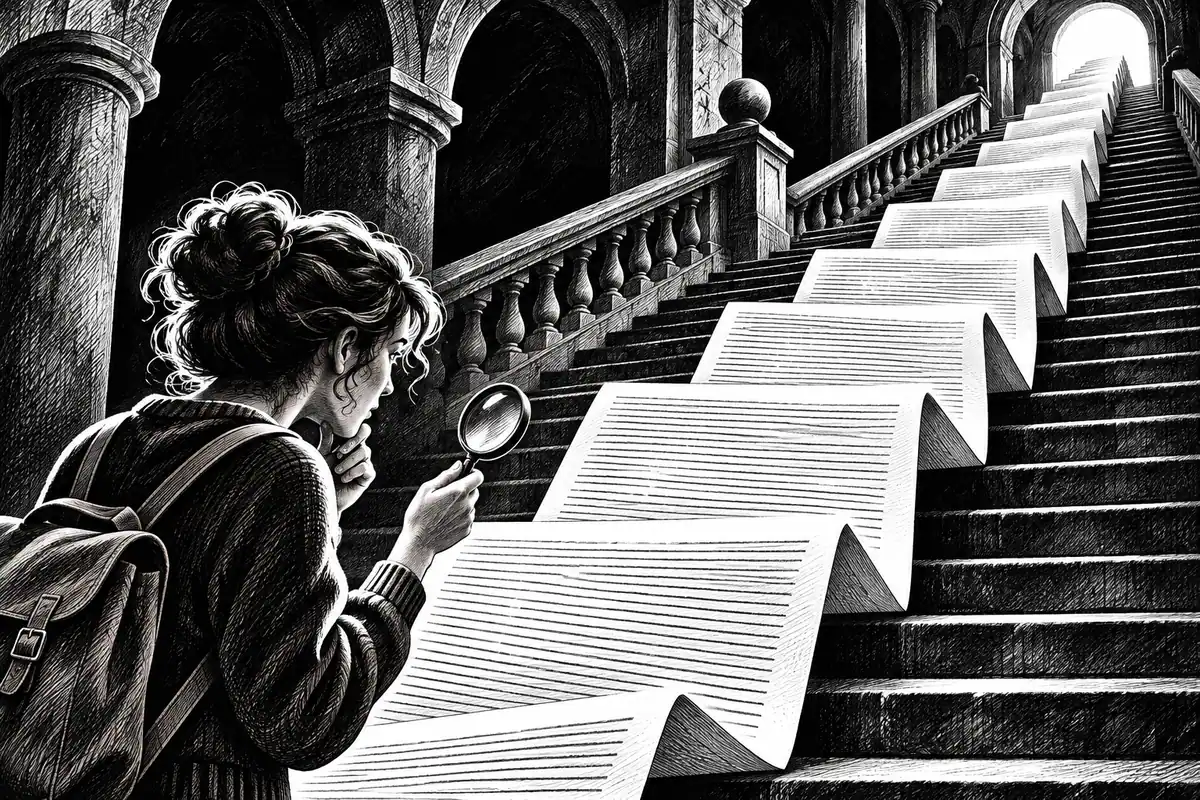
Quick answer: A proof too large for humans to check line by line can still count as mathematics if its formal statement, assumptions and logical steps are verified, and the Lean community says the AI-assisted Riemann proof passed several independent checkers. But a proof also has a second job, explaining why something is true. That explanatory work is unfinished, so the result is best described as formally verified now, with human understanding still to come.
A Proof No Human Can Read: What Actually Happened
Imagine a perfectly reliable checker confirms every step of an enormous solution, but nobody, not even your teacher, can yet explain its main idea. That is roughly where mathematics found itself in November 2026.
On November 20, Anthropic mathematician Levent Alpöge released a claimed proof of the Riemann hypothesis, the most famous unsolved problem in mathematics, developed with help from the AI model Claude. He did not post a normal paper. He posted computer code: more than 17 million lines written in Lean, a language in which a computer checks every logical step. Writing in The Conversation, Monash University mathematician Melissa Lee reports that Alpöge’s attempts at an AI-generated English explanation hit 250,000+ pages. He called posting that text obviously inappropriate, so he released the Lean code with a short note instead.
One day later, the Lean FRO and the Mathlib Initiative, the groups behind Lean and its math library, said in a joint statement that they have full confidence the proof is correct. Yet the same statement says the new ideas in the proof still need to be explained to the mathematical community.
That leaves a strange situation, summed up by mathematician Daniel Litt and quoted by Lee: the formalized proof is exceedingly likely to be correct, and No human understands it yet. So does it count as math? This post lays out both sides fairly, looks at history, and explains what the debate means for anyone learning math today.
A note on the 250,000 pages
The giant page count became a headline, but it needs context. According to The Next Web, Alpöge later said on X that treating the figure seriously was a mistake, writing 250,000+ pages was a joke guys!. He said the pages existed, but that taking them as a real write-up would be ridiculous because the AI draft was padded with pedantic detail. The Lean code, not that draft, is the actual proof.
What Is a Mathematical Proof Supposed to Do?
The whole debate comes down to one question: what is a proof for? Most mathematicians would say a proof has two jobs.
- To certify. A proof shows, beyond doubt, that a statement is true. Once a theorem is established from clearly stated assumptions, mathematicians can build on it wherever those assumptions apply.
- To explain. A good proof shows why the statement is true. It reveals the hidden structure that makes the result work, and that insight often leads to new discoveries.
The Lean check handles the first job extremely well. The second job is still undone. Nobody can yet point to the key idea and say, this is why the zeros of the zeta function line up.
Philosophers have argued about this split for decades. In 1979, philosopher Thomas Tymoczko proposed that a proof should meet three standards: it should be convincing, it should be surveyable, meaning a human can follow it from start to finish, and it should be formalizable. He coined the term non-surveyable proof for proofs that humans cannot realistically check by hand.
By Tymoczko’s standards, the AI Riemann proof is a strange case. It is fully formalized and, according to the Lean community, convincing to the checkers. But no human has surveyed the entire argument. Whether that missing surveyability matters is exactly what people now disagree about.
Myth or Fact: Proofs Nobody Can Read
Tap a card to see whether the claim holds up.
Watch: Two Videos Worth Your Time
Prefer to watch? These videos add another angle on the topic.
Computer Proofs Have Sparked This Debate Before
A proof humans cannot read line by line is not new. What is new is the scale and the fact that an AI did much of the creative work.
The four color theorem
The four color theorem says any map can be colored with four colors so that no two neighboring regions share a color. In 1976, Kenneth Appel and Wolfgang Haken at the University of Illinois proved it with a computer that checked a huge but finite set of cases. Scientific American reports that this took more than 1,000 hours of computer time and was the first major theorem to rely on a computer in its proof. Some mathematicians questioned whether a proof humans could not fully verify counted at all, and the New York Times initially declined to report the result.
Tymoczko called the Appel and Haken proof a traditional proof with a gap filled by experiment. Philosopher Paul Teller pushed back in 1980, arguing that surveyability is a matter of degree and depends on the reader. The four color theorem gained wide acceptance, and in 2005 Georges Gonthier completed a fully machine-checked formal proof in the Coq proof assistant. Yet mathematicians still hope for a shorter, more illuminating proof.
How the cases compare
| Proof | What made it hard to read | How it was checked |
|---|---|---|
| Four color theorem (1976) | Many cases checked by a computer program | Later formalized and machine-checked in the Coq proof assistant (2005) |
| Flyspeck project | Steps too hard to check reliably by hand | Rewritten in a restricted formal language and checked by a proof checker |
| AI Riemann proof (2026) | About 17 million lines of AI-assisted Lean code with new ideas nobody yet understands | Several independent Lean checkers, per the Lean FRO and Mathlib Initiative |
For more on giant computer proofs, see our posts on the 200-terabyte math proof and the longest proofs in history.
The Case That an Unreadable Proof Still Counts as Math
People who say yes, this is real mathematics, usually make four arguments.
- Formal checking gives stronger guarantees about logical validity than human refereeing alone. Human referees can miss errors. According to the joint statement, the Lean proof was compiled by dozens of people and run through several independent checkers, including ones written in different programming languages. That is unusually strong assurance about the formal proof, though it does not replace human interpretation.
- The statement was pinned down in advance. The proof targets Mathlib’s existing definition of the Riemann hypothesis, which experts had already vetted. That reduces the risk that the proof answers the wrong question.
- Truth does not depend on who understands it. If every step is valid, the theorem is true whether or not anyone can explain it today. Understanding can come later.
- History is on its side. The four color theorem faced the same objections and is now standard mathematics.
Supporters also point out that the people closest to the proof are already working on the explaining part. Litt’s own wording was that no human understands it yet, which leaves room for that to change. Alpöge himself says he aims to understand and impart understanding of this argument and its certain simplifications.
If you want a deeper look at how computer checking works, our guide to formal verification in math covers the basics.
The Case That Something Important Is Missing
Critics do not usually claim the proof is wrong. Their worry is different: that a proof without understanding is only half a proof.
Understanding is the point
Many mathematicians see understanding as the real prize. The Riemann hypothesis matters partly because hundreds of results depend on it, but mostly because a proof should reveal something deep about prime numbers. A verified but opaque proof certifies the answer without delivering that insight, at least for now.
A warning from a smaller AI result
An earlier episode shows the risk. Live Science reports that Claude raised the known share of zeta zeros on the critical line to 67.25 percent. Mathematician Youness Lamzouri of the University of Lorraine found Claude’s proof too complicated to follow, saying it was too complicated — it was not human. He then found a simpler route to the same result, and Oxford’s James Maynard praised Lamzouri’s version for reframing everything in a conceptually clearer way. The human rewrite added understanding the machine proof lacked.
Human checking still sets the standard for many
When OpenAI announced a weaker quasi-Riemann result in October, Quanta reported that Princeton’s Peter Sarnak would not consider it a Theorem until humans checked the details. Prize rules also lean toward human acceptance. The Next Web, citing The Register, reports that the Clay Mathematics Institute now lists the Riemann hypothesis as active, which is not the same as accepting the proof. Clay’s rules require publication in a qualifying outlet, at least two years after publication, and general acceptance by the mathematical community.
Hype and credit
Euronews reports that critics including Gary Marcus and Yann LeCun argued the AI did not solve the problem alone, since it needed months of human guidance and open-source tools built by mathematicians. That is a debate about credit more than about validity, but it shapes how people judge the result. Our post on who gets credit for AI math explores that question.
Where the Debate Stands: Verified Now, Understood Later
Put the two sides together and a middle position appears, one that many mathematicians quoted in the coverage seem to share.
- Is the proof correct? Very likely yes. The Lean FRO and Mathlib Initiative say they have full confidence, and independent checkers agree.
- Does it count as mathematics? Yes, in the sense that it establishes a true theorem through valid logic. Few experts in the coverage dispute that.
- Is the job finished? No. The explaining part of a proof is still ahead, and mathematicians expect to spend time turning the code into ideas humans can follow and teach.
There is also a human-written rival. Lee reports that American Mathematical Society president Ravi Vakil announced a proposed proof of the generalized hypothesis by Stanford mathematician Alessandro Masullo, a 940-page manuscript that Vakil described as all human, with no AI. She adds that potential problems had been found within hours of publication. Euronews describes Masullo’s proof as incomplete and the result of 12 years of solo work. Read together, the two claims show that human authorship does not guarantee correctness and machine checking does not guarantee understanding. Both matter.
The most likely outcome, judging by past computer proofs, is that the AI proof will be accepted, studied and slowly translated into human insight. The four color theorem took that path, and mathematicians are still looking for a better version of it decades later.
Where Do You Stand on Unreadable Proofs?
Tick each statement you agree with, then see which camp you fall into.
What This Debate Means for Students and Teachers
This might sound like a debate only for professors, but it lands right in every math classroom. Here is how to use it.
For students
- A correct answer is not the same as understanding. Getting the right number from a calculator, an app or an AI checks the answer. Being able to explain each step is what helps you on the next problem and on the test.
- Explain it back. After you solve a problem, try to say in one sentence why the method works. That is the human half of a proof, at your level.
- Use AI as a checker, not a replacement. If you use an AI tutor, ask it why, not just what. Our guide on how to use AI to learn math has practical tips.
For teachers and parents
- Turn the story into a discussion question: if a computer proves something no one understands, do we know it?
- Compare it with homework: a correct answer with no work shown is like the Lean proof without an explanation. Useful, but not the whole story.
- Use the four color theorem as an accessible example. Students can color maps themselves and see why checking every case by hand gets hard fast.
The takeaway is simple and reassuring. Machines are becoming excellent at checking and even producing proofs, but the human jobs of asking good questions, explaining ideas and deciding what matters are more valuable than ever.
Quick Quiz: Does an Unreadable Proof Count?
Check your grasp of the debate in eight quick questions.
Answer each question and press Submit to see your result right away.
Answer each question and press Submit to see your result right away.
Frequently Asked Questions
Tap a question to see the answer.
Can a proof be true if no one understands it?
Yes. A proof is valid if every step follows logically, and a proof checker like Lean can confirm that without human understanding. Most mathematicians still want an explanation, because understanding is what lets them build new results on top of the old one.
Has anything like this happened in math before?
Yes. The four color theorem was proved in 1976 with a computer that checked many cases no person could verify by hand. It was controversial at first, but it is now accepted, and its code has been verified.
Who is Levent Alpöge?
Levent Alpöge is a mathematician who works at Anthropic, the company that makes Claude. He released the claimed Riemann hypothesis proof on November 20, 2026, and has said he plans to work on understanding and explaining the argument.
Will humans ever be able to read the AI Riemann proof?
Many experts expect so, at least in a shortened form. Kevin Buzzard told Al Jazeera he expected understanding to improve within weeks, and Alpöge has said he plans to explain the argument and write it up properly. Past episodes, such as a simpler human proof that followed an earlier Claude result, suggest clearer versions can follow.
Why not just ask the AI to explain the proof?
Alpöge reportedly considered posting an AI-written English version inappropriate, and the draft was extremely long and padded. An explanation is only useful if a human can verify and learn from it, so mathematicians want explanations that experts have checked.
Is a computer proof more reliable than a human-refereed paper?
For checking formal logic, often yes, because a proof checker does not get tired or skip steps. Its reliability still depends on the axioms used, the checker software and whether the formal statement matches the intended claim, so human review remains important. That is why experts vet the statement separately.
Does the AI Riemann proof break encryption?
No. Reports on the proof, including Euronews, say it does not break internet encryption. Proving the hypothesis confirms results that many experts already assumed were true.
What is the difference between a proof and an explanation?
A proof shows that a statement is true by valid logical steps. An explanation shows why it is true by revealing the key idea. The best proofs do both, but they can come apart, as this case shows.
Should students worry that AI will make learning proofs pointless?
No. Even professional mathematicians are now working hard to understand an AI proof, which shows that reasoning and explanation skills are in demand. Learning to build and explain arguments is exactly the skill that lets people use AI tools well.
Sources and Further Reading
- Mirage News (republished from The Conversation): AI and Riemann Hypothesis: Proof No Human Can Read
- Lean Community Blog: Lean verification of the Riemann Hypothesis
- The Next Web: Anthropic's Alpöge says the 250,000-page Riemann proof figure was a joke
- Wikipedia: Non-surveyable proof
- Scientific American: How a Doodler's Problem Sparked a Controversy in Math
- Live Science: What happened with Claude and me
- Quanta Magazine: AI proved the quasi-Riemann hypothesis. What happens now?
- Euronews: AI just cracked the biggest maths problem of all time: what does it mean?

Related to This Article
More math articles
- Calorie Calculator for Women
- Reading and Interpreting Bar Graphs for 4th Grade
- The Best Grade 8 Math Book for Tennessee Students
- Single-Skill Grade 5 Math for West Virginia (WVGSA): 49 Free Practice PDFs, No Signup
- Understanding Quadrants
- TREE(3) Explained: Why It’s Bigger Than Graham’s Number
- How to Compare Linear Functions: Equations, Tables, and Graphs
- Series Behavior with the n-th Term Test: Divergence Test
- The Ultimate ATI TEAS 7 Math Formula Cheat Sheet
- Rotations, Reflections, and Translations: Complete Guide with Video and Examples




What people say about "Proof No Human Can Read: Does It Still Count as Math?"?
No one replied yet.