Claude vs ChatGPT vs Gemini for Math: Which AI Is Most Accurate?
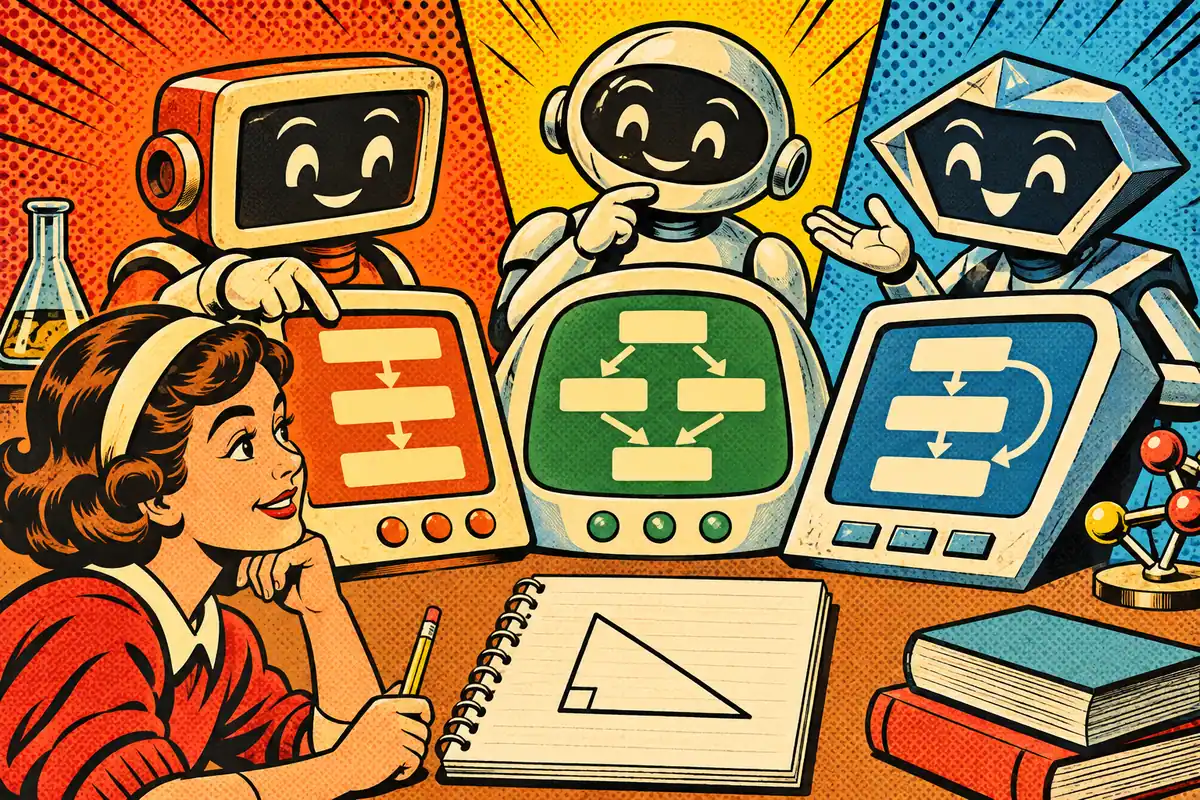
Quick answer: No single AI is most accurate at every kind of math in 2026. Claude Fable 5 led FrontierMath's hardest tier in June, GPT-5.4 topped the 2026 USA Math Olympiad proofs and GPT-6 later led FrontierMath, while Gemini led an everyday calculation test. For homework, all three can help explain math, but accuracy varies by problem and model version, so ask for steps and check the reasoning and the final answer.
Which AI Is Best for Math in 2026? The Short Answer
Ask ten people which chatbot is best at math and you will get ten answers, partly because the answer keeps changing every few months. In 2026 the top models from Anthropic (Claude), OpenAI (ChatGPT) and Google (Gemini) have each led at least one serious math test, and each has a math headline to its name.
Here is the honest summary: there is no single winner for every kind of math. The leader depends on what you measure. Research-level problems, olympiad proofs and everyday calculations have produced different leaders across the cited evaluations and dates, and the free version you use on your phone is usually not the model that set the record.
| Type of math test | Reported leader | Source |
|---|---|---|
| FrontierMath Tier 4, research-level problems (June 2026) | Claude Fable 5 (88%), ahead of GPT-5.5 (about 75%) | The Decoder, citing Epoch AI |
| FrontierMath, after GPT-6 launched (September 2026) | GPT-6 (97.56% on Tier 4; 93.68% on Tiers 1 to 3, with Claude Fable 5.1 second at 90.18%) | The Aggregate benchmark digest |
| 2026 USA Math Olympiad proofs (March 2026) | GPT-5.4 (95.24%), then Gemini 3.1 Pro (74.4%), Claude Opus 4.6 (47%) | OfficeChai, citing MathArena |
| Everyday calculation questions (tested October 2025) | Gemini 2.5 Flash (63%), with ChatGPT-5 at 49.4% and Claude 4.5 Sonnet at 45.2% | Euronews, citing the ORCA benchmark |
Notice that the dates matter as much as the names. A model that trailed in March can lead in June, and the next release can flip the order again. So instead of crowning a champion, this guide shows you what each test measures, what each company has actually achieved in math, and how to choose and use an AI for your own math work without getting burned.
What the AI Math Benchmarks Actually Measure
A benchmark is a fixed set of problems used to compare models. The trouble is that math benchmarks test very different skills, so a high score on one says little about another.
FrontierMath: research-level problems
Epoch AI describes FrontierMath as hundreds of original, exceptionally challenging problems written and vetted by expert mathematicians. Models submit an answer that can be checked automatically, and they may reason and run Python code along the way. Epoch released a major benchmark update in June 2026 that addressed errors affecting 42% of the problems, and the full set now has 338 problems: 295 in Tiers 1 to 3 and 43 in the hardest Tier 4. Our FrontierMath explainer goes deeper into how the tiers work.
The jump on this test has been dramatic. According to The Decoder, Anthropic’s earlier Claude Opus 4.5 scored below 10% on Tier 4 as late as early 2026, while Claude Fable 5 reached 88% by June.
Olympiad proofs: can the model explain, not just answer?
Final answers are easy to grade, but real math is about proofs. For the 2026 USA Math Olympiad, MathArena graded full written proofs using a panel of three AI judges plus human review. OfficeChai reported that the judging panel noticed Gemini 3.1 Pro and Claude Opus 4.6 inflated the scores of their own answers, while GPT-5.4 was the most reliable judge. That detail is a good reminder that grading AI math is itself hard.
Everyday calculations: the test most students care about
The ORCA benchmark, reported by Euronews, gave five chatbots the same 500 practical questions in October 2025, from unit conversions to finance and physics. Even the leader got only 63% right. The most common problem was what the researchers called sloppy math: 68% of mistakes came from rounding or calculation slips, even when the model understood the question. Co-author Dawid Siuda summed it up: numerical reliability remains a weak spot across current AI models.
Put simply, an AI can be brilliant on a research problem and still round a decimal the wrong way on your chemistry homework.
Myth or Fact: AI and Math
Tap a card to see whether the claim holds up.
Watch: Two Videos Worth Your Time
Prefer to watch? These videos add another angle on the topic.
Claude and Math: From Zeta Zeros to a Riemann Hypothesis Claim
Claude’s math reputation jumped twice in 2026, and it is worth separating the two stories carefully.
August 2026: a better bound on the zeta zeros
In August, Anthropic reported that an unreleased research version of Claude raised the proven lower bound for the fraction of Riemann zeta zeros on the critical line from 41.6% to 67.2%. Claude coordinated about 60 subagents over a day and a half, produced a Lean formalization with Anthropic staff member Eric Easley, and the paper was examined by experts Brian Conrey and Dan Goldston. Anthropic was clear about the limits, writing that it did not expect these techniques to lead to a proof of the Riemann hypothesis itself.
November 2026: a claimed proof of the Riemann hypothesis
Then, on November 20, 2026, Anthropic mathematician Levent Alpöge released a proof of the Riemann hypothesis as a Lean library of about 17 million lines. According to Startup Fortune, Alpöge believes he found the proof working with Claude, and Anthropic had not issued a separate statement of its own. The next day, the Lean FRO and the Mathlib Initiative posted a joint statement that certified both the statement and the proof as correct, based on the code compiling for dozens of people, two tools confirming the theorem matches Mathlib’s official statement, and several independent proof checkers accepting the exported proof.
Important caveats remain. Early reports cited an AI-generated explanation of more than 250,000 pages, but Alpöge later said the figure was a joke rather than a measure of a finished manuscript, and that he has promised a human-readable account later. Until then, there is no conventional human-readable explanation of the argument, even though independent formal checks give strong evidence that it is correct. The Clay Mathematics Institute’s prize rules require publication, a two-year wait and general acceptance, none of which has happened yet. The joint statement from the Lean FRO and Mathlib Initiative also looks forward to mathematicians explaining the new ideas in the proof.
What this means for choosing an AI: these results came from an unreleased model, huge amounts of computing time and expert humans steering and checking the work. They show what Claude-based systems can do at the frontier, not what the free chat app will do with your algebra worksheet.
ChatGPT and Math: Olympiad Proofs and Benchmark Records
OpenAI’s models have had an equally strong year on tests.
- Olympiad proofs. On the 2026 USA Math Olympiad, GPT-5.4 at its highest reasoning setting scored 95.24% on fully graded proofs, about 21 points ahead of the next model, according to OfficeChai’s report on MathArena’s results.
- Hard contest problems. MathArena wrote in May 2026 that GPT-5.5 had solved the last unsolved problem on its Apex benchmark, a problem from the International Mathematical Olympiad, and that the companion Apex Shortlist was above 90% accuracy.
- FrontierMath. After GPT-6 launched in September 2026, The Aggregate benchmark digest listed it first on both FrontierMath Tier 4 (97.56%) and Tiers 1 to 3 (93.68%), just ahead of Claude Fable 5.1 on the easier tiers.
One caution applies here. Epoch AI notes that OpenAI funded FrontierMath and has exclusive access to a subset of its problems. Epoch keeps a held-out set to limit that advantage, but it is a fair thing to keep in mind when comparing scores.
For everyday questions, the picture is less rosy. In the ORCA test from late 2025, ChatGPT-5 answered 49.4% correctly. One example from Euronews: asked for the odds of matching 5 of 6 lottery balls drawn from 76, the correct answer is 1 in 520,521, but ChatGPT-5 answered 1 in 401,397. Language models generate answers from learned patterns rather than guaranteed exact computation, which is why long arithmetic and probability are common trouble spots unless the model uses a calculator or code tool.
Gemini and Math: Deep Think, Aletheia and Everyday Numbers
Google’s Gemini has a different kind of math record: strong research tools and the best score on the everyday calculation test.
In February 2026, Google DeepMind described Aletheia, a math research agent powered by Gemini Deep Think. It uses a generator to propose solutions, a verifier to check them and a reviser to fix flawed ones, and it can admit when it fails to solve a problem. DeepMind reported that Aletheia reached just above 90% on IMO-ProofBench Advanced and about 46% on a set of PhD-level exercises, and that a semi-autonomous run over 700 open Erdős problems produced autonomous solutions to four open questions.
DeepMind was also careful about its claims, writing that it does not claim any major advance or landmark breakthrough results so far. That kind of honest labeling is helpful when you are trying to sort real progress from hype.
On simpler math, Gemini 2.5 Flash led the ORCA everyday calculation test with 63%, including 83% in the math and conversions category. On the 2026 USAMO proofs, Gemini 3.1 Pro placed second at 74.4%. So Gemini looks like a solid all-rounder, but not the top scorer on the hardest research tests reported this year.
Why Benchmark Scores Will Not Pick Your Homework Helper
Leaderboards are useful, but they answer a different question from the one most students and parents are asking. Here is why a headline score should not decide which app you open tonight.
- The record-setting model is often not the one you get. Many top results use the most expensive tier, the highest reasoning setting, or, in Claude’s Riemann work, a model that was not released at all.
- Test conditions are generous. FrontierMath models can run code. Research agents run for hours with dozens of helpers. A quick chat with no tools is a different situation.
- Old tests fill up. MathArena concluded in May 2026 that recent public contest problems are no longer a reliable source of hard benchmark tasks because frontier models solve nearly all of them.
- Grading is tricky. As the USAMO panel showed, AI judges can favor their own answers, which is why human review still matters.
- Everyday accuracy lags behind. The ORCA results show that even strong chatbots slip on rounding and arithmetic in ordinary questions.
The better question is not which AI is smartest, but how to use any good AI in a way that catches its mistakes. Our step-by-step guide to checking an AI math answer is a good place to start.
How to Choose and Use an AI for Math: A Practical Checklist
Whichever chatbot you pick, these habits matter more than the logo on the app.
- Turn on the reasoning or thinking mode if your app has one. The big benchmark scores come from these settings.
- Ask for steps, not just an answer. A worked solution lets you spot where a sign or decimal went wrong.
- Check numbers with a tool built for numbers. Plug the final answer back into the equation, or confirm it with a calculator such as our free math calculators.
- Ask a second model when it matters. If Claude, ChatGPT and Gemini agree, you can be somewhat more confident, but they can share the same mistake, so verify important results yourself. If they disagree, slow down and work it by hand.
- Be careful with word problems and units. The ORCA study found misread units, rounding and wrong formulas behind most errors.
- Do not use AI as a shortcut on graded work. Use it to understand a method, then solve a similar problem on your own.
For students: any of the three is fine for explaining algebra or geometry steps, as long as you verify. For parents and teachers: focus on whether a child can redo the problem without the AI. For curious adults following the Riemann news: treat the frontier results as signs of where things are heading, and expect the human explanation of the claimed proof to take time.
If you are preparing for a test such as the SAT, remember that AI is not allowed on exam day. Practice with real questions on our SAT math prep pages so the skills are yours, not the chatbot’s.
What Would You Do?
Pick the best move in each math situation.
ChatGPT gives you an answer of 12.47 for a chemistry conversion, but the answer key says 12.5.
Claude and Gemini give different answers to a hard probability problem.
Your child uses AI to finish a worksheet in five minutes.
You read a headline that an AI solved a famous unsolved problem.
Quick Quiz: AI and Math Accuracy in 2026
Test what you learned about how Claude, ChatGPT and Gemini compare on math.
Answer each question and press Submit to see your result right away.
Answer each question and press Submit to see your result right away.
Frequently Asked Questions
Tap a question to see the answer.
Is ChatGPT or Claude better for math?
It depends on the test. In June 2026 Claude Fable 5 led FrontierMath Tier 4, while GPT-5.4 led the 2026 USAMO proof grading and GPT-6 later topped FrontierMath. For homework, both are capable, and checking the answer matters more than the brand.
Is Gemini good at math?
Yes. Gemini led the ORCA everyday calculation test with 63% and placed second on the 2026 USAMO proofs. Google's Aletheia research agent, built on Gemini Deep Think, also produced autonomous solutions to four open Erdős problems out of 700 it examined.
Which free AI is best for math homework?
Free versions change often and are usually not the models that set benchmark records, so no single free app is best for everyone. Try the free tiers of Claude, ChatGPT and Gemini on a problem you already know the answer to, and keep the one that explains steps most clearly for you.
Can AI solve math problems correctly every time?
No. In the October 2025 ORCA test, even the best chatbot answered only 63% of everyday calculation questions correctly, and newer models may do better. Always check important answers with a calculator or by substituting the result back into the problem.
Did Claude really prove the Riemann hypothesis?
Mathematician Levent Alpöge released a proof made with Claude on November 20, 2026, and the Lean FRO and Mathlib Initiative certified the formal statement and proof the next day. Human mathematicians still need to understand and explain its ideas, and the Clay prize process has not started.
What is the hardest math benchmark for AI?
FrontierMath Tier 4, run by Epoch AI, is one of the hardest, with research-level problems written by expert mathematicians. Newer tests focus on proofs, open problems and formal Lean proofs because older contest-style tests are close to solved.
Why do AI chatbots make simple math mistakes?
Language models predict text rather than compute exactly, so they can slip on rounding, long arithmetic or units. Reasoning modes and built-in code tools reduce these errors but do not remove them.
Should students use AI for math?
AI can be a helpful tutor for explaining steps and generating practice problems. It becomes a problem when it replaces practice, so students should solve similar problems on their own and use AI to check understanding, not to skip it.
Do AI math benchmark scores apply to the free chatbot apps?
Usually not directly. Record scores often use paid tiers, maximum reasoning settings, code tools or unreleased models, so the app you use day to day may score noticeably lower.
Sources and Further Reading
- Anthropic: Claude and the Riemann zeta zeros
- The Decoder: Claude Fable 5 outpaces GPT-5.5 by 13 points on FrontierMath's toughest problems
- The Aggregate: GPT-6 arrived today and is now the best available
- OfficeChai: GPT 5.4 (xhigh) scores 95% on 2026 US Math Olympiad
- MathArena: Farewell to final-answer competition problems as frontier benchmarks
- Euronews: Which AI chatbot is the best at simple math?
- Google DeepMind: Accelerating mathematical and scientific discovery with Gemini Deep Think
- Lean community blog: Lean verification of the Riemann Hypothesis

Related to This Article
More math articles
- Full-Length CLEP College Mathematics Practice Test
- Comparative Advantage, Specialization, and Trade
- The Best Grade 7 ELA Practice Tests for West Virginia Students
- Inverse Laplace Transform Calculator
- Number Recognition and Mathematical Fluency: Practice Ideas
- South Carolina Grade 2 English Worksheets — Free Printable PDFs
- Geometry Vocabulary Flashcards
- Shays’ Rebellion: Economic Crisis, Court Closures and Reform
- How to Write Decimals in Standard and Expanded Form
- Case File: How to Solve Multi-step Problems Involving Percent










What people say about "Best AI for Math in 2026: ChatGPT vs Claude vs Gemini"?
No one replied yet.