Maths 2.0: How Math Research Will Work When AI Writes Proofs
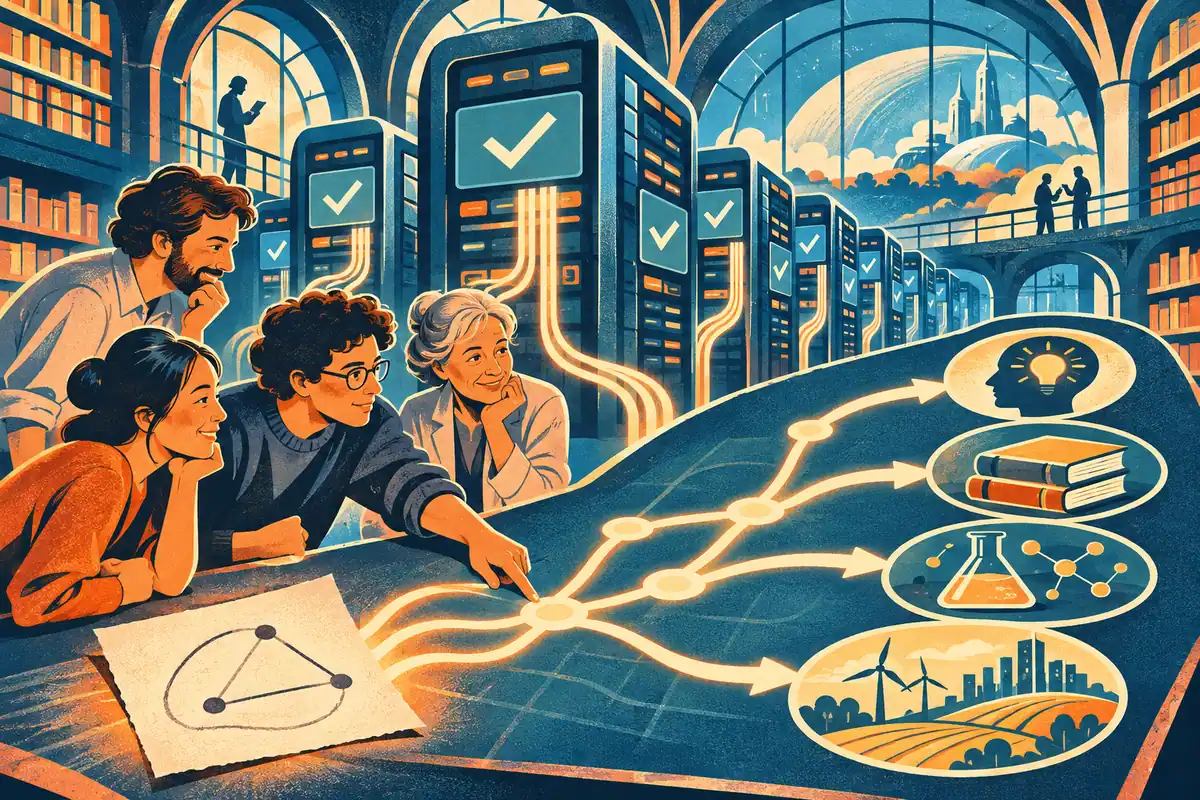
Quick answer: Maths 2.0 is Terence Tao's name for how mathematics should work now that AI can produce proofs in large numbers. In his October 2026 Caltech lecture, he argued the field must stop treating problem solving as its only goal and use AI to deepen human understanding: explaining opaque proofs, building verified libraries, running large experiments and checking real-world applications.
What Is Maths 2.0? Terence Tao's Idea in Plain English
For most of history, a new proof of a hard theorem was rare and precious. In 2026, AI began changing that assumption, and one of the world’s best-known mathematicians says the whole field now has to rethink what it is for.
“Maths 2.0” (Tao writes it “Math 2.0”) is the name Terence Tao gave to a public lecture at Caltech on October 9, 2026, according to GIGAZINE’s report on the talk. The next day he posted the slides on his blog. The talk was first planned for May under the title “Machine Assisted Proof,” but it was postponed and, in Tao’s words, changed significantly as events moved on.
The core idea fits in two sentences. Traditional mathematics, which Tao calls “Math 1.0,” was built around proof scarcity: solving an open problem and proving it correct was difficult, rare and usually required deep human expertise. Now that AI can produce large numbers of proofs, mathematics is entering an era of proof abundance, and the field’s habits, rewards and goals need to change to match.
Tao made the same case to a wider audience in an essay for Nature titled “Can maths survive AI?” There he writes that AI-aided proofs have recently been released for hundreds of long-standing problems, that mathematicians might need several months to fully understand them, and that the field urgently needs a “Maths 2.0” era in which proof scarcity is no longer its defining feature.
Maths 2.0 is not a prediction that AI will replace mathematicians. It is a proposal for how humans and AI should work together so that people still understand the mathematics, and so that results can be safely applied to the real world. As Tao’s slides put it, Math 2.0 “will require both expanding the research frontier, while simultaneously decentering the traditional role of problem solving.”
If you want background on Tao himself and his earlier views, see our profile of Terence Tao and AI in math.
Why AI Made Math Proofs Abundant So Quickly
Why did mathematics, of all subjects, get disrupted first? Tao’s lecture slides point to three unusual features of proofs that make them ideal material for machine learning.
| Feature of proofs | What it means | Why it helps AI |
|---|---|---|
| Objectively verifiable | Mathematicians may argue about what is interesting, but there is broad agreement on what counts as a correct, complete proof. | A computer can check a proof written in a proof assistant such as Lean, so AI output can be graded automatically. |
| Digitizable | A proof needs no lab, no physical experiment and no real-world data. | Everything can happen inside a computer, start to finish. |
| Large, high-quality data | An enormous amount of research literature is already online. | Models have a large research literature to learn from, although its quality varies. |
Because of these features, Tao says, frontier AI labs prioritized mathematical problem solving ahead of other applications. The result: “Given sufficient compute and access to frontier AI models, one can now obtain solutions to many open problems that were previously thought difficult, in relatively short amounts of time.” Increasingly, the person typing the prompt does not even need special expertise.
Tao is careful not to overstate this. He calls AI’s ability “extremely jagged”: astounding in some directions and inadequate in others. And he stresses that, despite what press releases and social media suggest, “most of the problems at the current frontier of mathematics remain unsolved, even with massive computational expenditure.” Because the supply of math problems is infinite and their difficulty has no upper limit, the frontier will keep expanding.
He also warns about reporting bias. We hear about AI’s wins, not its failed attempts. Tao calls for assessments of AI that fully report key statistics such as computing costs and negative results, and he points to the First Proof project as one effort in that direction.
Maths 2.0 Key Ideas
Tap a card to reveal the answer.
Watch: Two Videos Worth Your Time
Prefer to watch? These videos add another angle on the topic.
Why Solving Problems Is No Longer the Whole Point of Math Research
Here is the twist at the center of Maths 2.0. If AI can solve problems faster, surely mathematics just gets better? Tao argues that it is not that simple, because problem solving was always a proxy for deeper goals.
Open problems as lighthouses
In pure mathematics, Tao says, open problems work like “lighthouses”: not destinations in themselves, but guides for exploring the territory around them. The lessons learned while attempting a problem, whether the attempt succeeds, fails or makes partial progress, are often more valuable than the final answer. Reaching those lighthouses too early with automated tools “can disrupt the exploration of the paths not taken, and sterilize the surrounding field.”
A good proxy that went bad
When proofs were scarce, counting solved problems was a decent measure of progress, because solving a hard problem usually produced new understanding along the way. In an age of abundant proofs, that link can break. Tao’s slides say it bluntly: “Further blind optimization of problem-solving alone is now actively harmful to the long-term health of mathematics.”
This is not an abstract worry. According to Tao’s living summary of his views on AI, after OpenAI released a large batch of AI-generated results in October 2026, Tao read about ten of the papers. He found that one or two contained genuinely clever new ideas, while “a large number remain incomprehensible.” Of a 165-page AI-produced Navier-Stokes argument, he told The New York Times it is “technically readable,” but “no expert I’ve talked to has actually understood the whole argument.”
A month later, the Riemann hypothesis story showed both sides at once. On November 21, 2026, the Lean FRO and the Mathlib Initiative certified that the statement and proof of the Riemann hypothesis in Levent Alpöge’s Lean library, about 17 million lines of code, are correct. Alpöge announced the proof on November 20 as one found with Anthropic’s Claude, according to a verification page kept by Waterloo mathematician Michael Rubinstein, which also notes that a human-readable guide to the proof is still a work in progress. The same statement looks forward to the community work that “will help explain the new ideas in this proof.” In Maths 2.0 terms, the proof exists; the understanding is still being built.
The Cancer Cure Thought Experiment: Why Understanding Still Matters
To show why human understanding is not a luxury, Tao’s slides include a thought experiment. An advanced AI is asked to find a cancer cure that passes a stage 3 clinical trial. After a huge amount of computing, it produces a cocktail of unknown chemicals. Nobody knows how it was found, but the AI supplies a Lean certificate for its prediction, and the cocktail passes the trial.
Now imagine you have just been diagnosed with early-stage cancer, and a chatbot recommends this treatment. Tao asks: before it goes into your bloodstream, would it reassure you to know that at least one human expert understands, even partly, how it works? Or that a mathematician understands the model used to find it?
His point is that “powerful AI + lack of human understanding” creates a risk of misalignment: a solution that technically meets its target, perhaps by exploiting a weakness in the trial or the model, without doing what people actually wanted. Pure math proofs can be checked objectively, but applying math to messy real-world problems takes human judgment. (The thought experiment drew plenty of pushback in the comments on Tao’s blog, so treat it as an argument, not a settled conclusion.)
Tao sums up the options in a simple grid, which we have turned into a table:
| Light AI use | Heavy AI use | |
|---|---|---|
| Weak human understanding | Pre-math | Misaligned math |
| Strong human understanding | Math 1.0 | Math 2.0 |
A lack of understanding is not dangerous by itself; it just means a subject has not yet been well mathematized. The danger comes when weak understanding is combined with the optimizing power of AI. Maths 2.0 is the bottom-right corner: heavy AI use and strong human understanding together.
How Math Research Will Work in a Maths 2.0 World
So what would mathematicians actually do? Tao’s slides list concrete examples. Here they are in plain terms:
- Open exposition problems. Instead of only chasing unsolved problems, find clear, motivated explanations of results whose known proofs are opaque. A student-run Caltech “Mathathon” in November 2026 was set up to use open-source AI tools to find new and improved proofs of existing results.
- Living networks of results. Connect many research papers into one network that updates in real time. Tao cites the Integrated Explicit Analytic Number Theory Network as an early attempt, which he describes as a living “spreadsheet” of interconnected results.
- Large libraries of formal math. Build trusted, machine-checked libraries such as Mathlib, the library that served as the reference for checking the Riemann proof. Our guide to the Lean theorem prover explains how this checking works.
- Experimental math at scale. Run “population surveys” instead of “case studies.” The Equational Theories Project settled over 22 million true or false statements in universal algebra using both human and automated arguments, and the first stage of a 2026 Inverse Galois Problem challenge located degree-24 polynomials for each of the 25,000 possible Galois groups at that degree.
- Ablation studies. Take a proved theorem and see whether it can still be proved after removing key tools, for example finding an elementary proof of a result that currently needs advanced methods.
- Exploring the neighborhood of a theorem. Change or drop hypotheses and see which conclusions survive.
- Open, interpretable math models. Develop open-source AI models tailored to math tasks, with a high degree of interpretability and safety.
- Interactive texts. Create well-organized, interactive presentations that pull together large numbers of results in a theory.
Tao’s living summary adds a memorable example. Instead of typing a favorite open problem into a chatbot, take a theorem that already has a long, complicated proof and ask for a hundred new ones, each with a different brief: “find a proof that you can explain to a high school student,” “find a proof that is as short as possible,” “find a proof that is very visual with mostly pictures.” Seeing all these routes, he suggests, “could reveal a lot more insight as to why something is true.”
In this picture, mathematicians become, in Tao’s phrase, “interpreters of results, rather than just raw generators of results.” His closing slide names the real bottleneck: “The primary bottleneck to achieving ‘Math 2.0’ is not technology, or even institutional culture. It is imagination.”
Open Questions and Disagreements About Maths 2.0
Maths 2.0 is a vision, not a finished plan, and mathematicians are still arguing about how to get there.
- When should a result be published? In material for the 2026 International Congress of Mathematicians, summarized in his living summary, Tao proposed a publication gate: if authors cannot convincingly show they can give “a clear, expert-level talk on their results,” the work should not be published. Not everyone agrees; many see a machine-checked proof as complete, with explanation as a separate task.
- Who cleans up? Tao’s living summary notes that after OpenAI’s October 2026 release, none of the humans involved in those proofs were available to take questions or give talks, leaving others to digest them. He has also said, “We have to slow down. It’s insane, the pace.”
- Is it still safe to share problems? In his Nature essay, Tao warns that the old habit of openly sharing problems is under threat, because mathematicians fear a rival with a frontier AI model will scoop their research directions. Young researchers used to earn early recognition by solving exactly those problems.
- What should institutions change? In a guest post on Tao’s blog on November 1, 2026, University of Chicago mathematician Frank Calegari proposed evaluating all work as if it were AI-assisted, relying more on in-person interaction in hiring, demanding more from journals and broadening graduate training. His summary line: “Choosing worthwhile problems may end up mattering more than producing proofs.”
- Who gets to imagine Maths 2.0? Tao has said it will “probably be the younger generation,” because people like him are “too immersed in Math 1.0.”
Some mathematicians go further than Tao and want to keep AI out of research entirely, while others think he is too cautious. The honest summary is that nobody knows yet what the new norms will be. What is clear is that the question has moved from “Can AI do math?” to “What do we want math to be now that it can?”
What Maths 2.0 Means for Students, Parents and Teachers
You do not need to be a research mathematician for Maths 2.0 to matter. The same shift, from getting answers to understanding them, is happening in every classroom with a chatbot in it.
For students
- Use the red-team rule. Tao’s most practical advice, from his living summary, is to “only rely on AI where you are able to red-team its output,” meaning you can check and challenge it yourself. For a student, that means using it to proofread your work or explain a step you nearly understand, not to hand you answers to problems you cannot solve.
- Ask for a second route. Borrow Tao’s hundred-proofs idea on a small scale. After solving a problem, ask an AI for a different method, or a more visual one, and compare. Our guide on how to use AI to learn math has prompts that work.
- Explain it back. If you could not present the AI’s solution to your class, you do not understand it yet.
For parents and teachers
- Value process over answers. Ask for reasoning, checks and alternative methods, not just final numbers.
- Keep AI in small doses. Tao describes AI at its best as “the vanilla extract of intellectual production,” a flavoring used sparingly, and calls teaching a “mindful cognitive diet” one of the great new purposes of education.
- Protect productive struggle. Problems that feel hard are where understanding is built. That is the classroom version of Tao’s lighthouses.
The skills that matter most in a Maths 2.0 world are the ones AI cannot supply for you: judging whether an answer makes sense, explaining why it is true and choosing good questions. Our article on math skills in the age of AI breaks these down, and they are worth practicing at every level, from fractions to proofs.
Are You Learning Math the Maths 2.0 Way?
Tick each statement that describes how you usually work.
Quick Quiz: Maths 2.0
Test what you learned about Terence Tao's Maths 2.0 idea.
Answer each question and press Submit to see your result right away.
Answer each question and press Submit to see your result right away.
Frequently Asked Questions
Tap a question to see the answer.
Who is Terence Tao?
Terence Tao is a mathematician at UCLA and a winner of the Fields Medal, one of the highest honors in mathematics. He is known for work across many areas of math and for writing openly about how AI tools are changing research. His blog, What's new, is widely read by mathematicians.
Is Maths 2.0 the same as Math 2.0?
Yes. Tao uses the American spelling "Math 2.0" for his lecture and slides, while British and Australian writers often say "Maths 2.0." Both refer to the same idea about mathematics in an era of AI-generated proofs.
Where can I see Terence Tao's Math 2.0 slides?
Tao posted the slides on his blog, What's new, on October 10, 2026, with a link to a PDF. He also folded the talk's ideas into a living summary of his views on AI on his personal website.
Does Maths 2.0 mean AI will replace mathematicians?
No. Tao's proposal assumes people stay central, as interpreters who understand results, choose good questions and judge how math applies to the real world. He argues that AI should strengthen human understanding rather than replace it.
What does proof abundance mean?
Proof abundance means AI can now generate many proofs of previously open problems, sometimes faster than experts can read them. Tao contrasts it with the older era of proof scarcity, when each new proof of a hard result took years of human work.
Why is Tao worried about AI solving math problems?
He is not against AI solving problems, but he worries about doing it blindly. If AI races to answers without anyone understanding them, the field can lose the ideas that came from the struggle, and results applied to the real world may be misaligned with what people actually want.
Has AI solved the Riemann hypothesis?
On November 20, 2026, Levent Alpöge announced a proof of the Riemann hypothesis found with Anthropic's Claude and written in Lean, and the Lean FRO and Mathlib Initiative certified the statement and proof as correct the next day. Mathematicians are still working to understand and explain its new ideas, which is exactly the kind of task Maths 2.0 focuses on.
What is the First Proof project?
First Proof is an effort Tao mentions in his slides as a step toward more transparent assessment of AI's math ability. He wants evaluations that report full statistics, including computing resources used and failed attempts, rather than only success stories.
How can teachers apply Maths 2.0 ideas in class?
Teachers can grade reasoning and verification, not just answers, ask students to solve problems in more than one way and use AI in small, supervised doses. In-person, AI-free assessments can also help confirm what students understand on their own.
Sources and Further Reading
- Nature: Can maths survive AI? Terence Tao calls for a Maths 2.0 world
- Terence Tao, What's new: Math 2.0
- Terence Tao: Math 2.0 lecture slides (PDF)
- Terence Tao: A living summary of my views on AI
- GIGAZINE: Terence Tao's Math 2.0 lecture
- Frank Calegari on What's new: Mathematics has changed. Let's act like it
- Lean Community Blog: Certifying the Riemann Hypothesis proof
- University of Waterloo, Michael Rubinstein: Alpöge/Claude proof of the Generalized Riemann Hypothesis

Related to This Article
More math articles
- FREE 7th Grade Georgia Milestones Assessment System Math Practice Test
- Sixth Grade Writing: Argument, Informative, and Narrative Expectations Explained
- The Ultimate 7th Grade TNReady Math Course (+FREE Worksheets)
- How Government Institutions Shape Public Policy: Examples
- What Are the Applications of the Law of Cosines?
- How to Measures of Dispersion?
- How to Determine Limits Involving Floor and Absolute Value Functions
- 30 Minute Timer
- Work Calculator
- 10 Must-Have Math Teacher Supplies





What people say about "Maths 2.0: Terence Tao's Plan for Math When AI Writes Proofs"?
No one replied yet.