What Is Vibe Math? Solving Open Problems by Chatting With AI
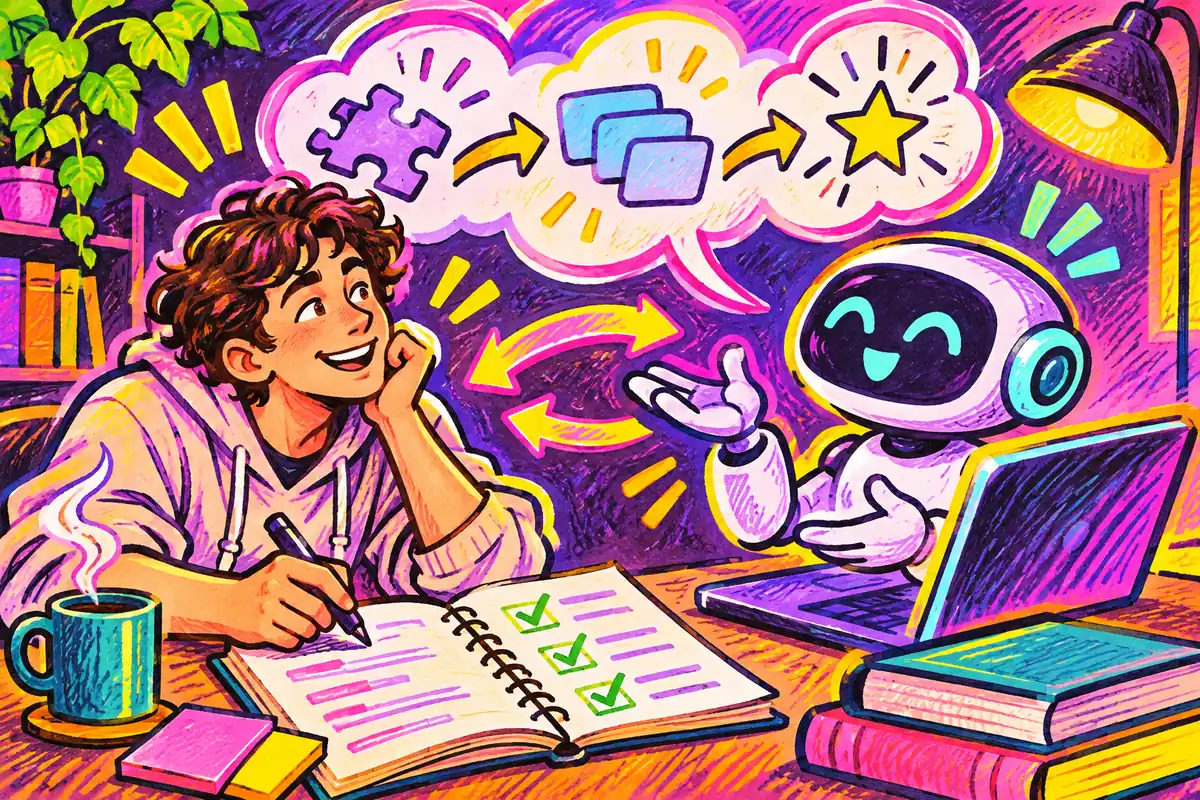
Quick answer: Vibe math is informal, experimental problem-solving in which a person chats with an AI model about a math problem and lets it do much of the reasoning, then checks the result. The term borrows from vibe coding and spread after a 23-year-old amateur used GPT-5.4 Pro to help resolve Erdős Problem 1196, later cleaned up by experts and verified in Lean.
What Is Vibe Math? A Simple Definition
A 23-year-old with no advanced math training typed a single prompt into ChatGPT on an idle Monday afternoon and helped settle a question that had been open for about 60 years. Scientific American described his approach as vibe mathing, and the phrase caught on.
Vibe math is informal, experimental problem-solving in which a person chats with an AI model about a math problem, often one they do not fully understand, and lets the AI do most of the heavy reasoning. The person steers, prompts, checks and shares the result, then experts and proof checkers decide whether it holds up.
The phrase borrows from vibe coding. Merriam-Webster describes vibe coding as making code, web pages or apps by describing what you want to an AI program and letting it generate the result, often without understanding how the code works. It says the term is believed to have been coined by OpenAI co-founder Andrej Karpathy in a post on X on February 2, 2025, where he described fully giving in to the vibes. Vibe math applies the same spirit to mathematics: describe what you want, let the model try, and see what comes back.
There is no official definition yet. Scientific American used the term without defining it, and from its reporting the meaning is clear enough: amateurs and students using chatbots to attack real open problems, with professionals stepping in to check the results. It is a new word for a new habit, so expect its meaning to shift as more people try it.
The Vibe Math Story Behind the Name: Liam Price and Erdős Problem 1196
The case that made vibe math famous involves Liam Price, a 23-year-old amateur with a ChatGPT Pro subscription, and an old question about primitive sets.
What is a primitive set?
A primitive set is a set of whole numbers, each at least 2, in which no number divides evenly into a different number in the set. For example, {4, 6, 9} is primitive, because none of those numbers divides another. The set {2, 4, 7} is not, because 2 divides 4. Any set of prime numbers is automatically primitive, and Scientific American notes that Paul Erdős chose the name because of this link to the primes.
Erdős attached a score to every primitive set, now called the Erdős sum: add up 1 divided by (a times log a), using the natural logarithm, for every number a in the set. According to Scientific American, Jared Duker Lichtman proved in his 2022 doctoral thesis that the set of all primes gives the largest possible score. A related question remained: what happens when every number in the set has to be very large?
The 60-year-old question
Erdős problem 1196, conjectured by Erdős, Sárközy and Szemerédi, asks whether the Erdős sum of a primitive set made only of numbers at least x must be less than 1 plus a quantity that shrinks to zero as x grows. In 2023 Lichtman proved an asymptotic upper bound of about 1.399, but the conjectured limit of 1 stayed out of reach until 2026.
What happened
- Price entered the problem into GPT-5.4 Pro in a single prompt. He told Scientific American he was giving problems to the AI and seeing what it could come up with, and, according to heise, said: I don’t even know what this problem is.
- The AI’s argument used a formula well known in related areas of mathematics but not previously applied to this kind of question.
- Kevin Barreto, a second-year mathematics undergraduate at Cambridge and Price’s occasional collaborator, saw that the result mattered and alerted experts.
- Lichtman, now at Stanford, and Terence Tao of UCLA worked through it. Lichtman said the raw output of ChatGPT’s proof was actually quite poor, so the two shortened it to bring out the key idea.
- The proof was verified in the Lean proof assistant. erdosproblems.com now marks the problem as proved and Lean-checked, credits GPT-5.4 Pro prompted by Price, and cites a 2026 write-up by Alexeev, Barreto, Li, Lichtman, Price, Shah, Tang and Tao.
Tao told Scientific American that human researchers had collectively made a slight wrong turn at move one, and that we have discovered a new way to think about large numbers and their anatomy. He also said the jury is still out on the long-term significance.
Vibe Math Vocabulary
Tap a card to reveal the meaning.
Watch: Two Videos Worth Your Time
Prefer to watch? These videos add another angle on the topic.
How Vibe Math Works in Practice
Vibe math looks casual, but the people who have made it work follow a fairly consistent loop. Quanta Magazine’s August 2026 report on AI and the Erdős problems describes how Barreto and Price actually worked.
- Start small and free. According to Scientific American, Price and Barreto first used a free version of ChatGPT, feeding it open problems picked at random from erdosproblems.com. Price only got a Pro subscription later, as a gift from an AI researcher who noticed their work.
- Pick a well-stated problem. The Erdős problems are popular because Thomas Bloom catalogs them at erdosproblems.com with precise statements. Our guide to the Erdős problems explains who Erdős was and why his questions are so tempting.
- Prompt the model, sometimes with a little misdirection. Quanta reports that Barreto and Price realized early on that if they told GPT-5.2 a problem’s answer was not known, it would not make much headway. Barreto said they learned to prompt it in a very particular way, gaslighting it into thinking the problem is easier than it actually is.
- Check with a fresh copy of the AI. Price would generate a solution in one chatbot session, then paste it into a new session to check it, repeating until the result looked workable. Companies now automate this loop with software they call harnesses or scaffolds.
- Use a formal checker. For Problem 728, which they solved with GPT-5.2 Pro by January 4, 2026, Barreto used Aristotle, a tool from the startup Harmonic, to check the proof’s logic. Formal systems like the Lean theorem prover accept a proof only if every step follows from the stated axioms and earlier results, which checks logical correctness but not whether a result is new or important.
- Search the literature. A proof is only new if nobody found it first, so this step matters more than it sounds.
- Hand it to experts. In the Problem 1196 case, professionals turned a messy AI argument into a clean paper.
Notice how much of this loop is checking rather than solving. The vibe part is the first draft. Everything after it is ordinary, careful mathematics.
Vibe Math Compared With Traditional Research and Vibe Reasoning
Vibe math sits next to two other ways of doing hard math, and the differences are easy to blur.
| Traditional research | Vibe math | Vibe reasoning (research method) | |
|---|---|---|---|
| Who drives it | Trained mathematicians | Often amateurs or students | Researchers designing prompts and workflows |
| Role of AI | Optional helper | Produces most of the first proof | Several models orchestrated with tools |
| Understanding needed | Deep | Can be very little at first | Enough to write good general prompts |
| Main risk | Slow progress | Errors, rediscoveries, unreadable output | Results may not generalize yet |
The term vibe reasoning comes from a December 2025 arXiv paper by Jiaao Wu and colleagues. They used GPT-5 to explore and Gemini 3 Pro to write proofs, with Python tools and file-based memory, and produced the correct answer, 2112, and a rigorous proof for Problem 6 of the 2025 International Mathematical Olympiad, which autonomous AI systems had publicly failed to solve. The authors found that their human prompts evolved from problem-specific hints into general meta-prompts, and they describe the work as ongoing, with its generality not yet fully validated.
The common thread is that a human with modest guidance can unlock far more math from today’s models than a single plain question would. The difference is how much the human understands and checks along the way.
The Risks of Vibe Math: Rediscoveries, Unreadable Papers and Survivor Bias
Vibe math has produced real results, but it also has real problems, and the people closest to it are the first to say so.
Old results dressed up as new
On Christmas morning 2025, Barreto posted an AI-generated proof of Erdős Problem 333 and wrote that it was the first case of an LLM fully autonomously resolving an Erdős problem not previously resolved by humans. Within hours, as Quanta reports, another user pointed out that Erdős had already solved it in a 1977 paper. Barreto asked the community to put greater focus on literature search and admitted, as someone who has fallen for this twice now, that it was quite gut-wrenching. heise also notes that in fall 2025 several claimed GPT-5 solutions to Erdős problems turned out to be already published results.
Papers nobody reads
Thomas Bloom, who runs the Erdős problems database, told Quanta that the site is seeing a lot more 100- to 200-page papers, adding that no human has read them and no human is going to read them. A wall of AI text is not a proof until someone, or something like Lean, has checked it.
Survivor bias
We hear about the prompt that worked, not the many that went nowhere, because failed chats are rarely posted. Scientific American reports that experts call the Erdős problems an imperfect benchmark for AI, since they vary widely in difficulty and many AI solutions proved less original than they first appeared. Tao even suggested Problem 1196 may have been easier than expected once the right first move was found.
The understanding gap
Vibe coding, by definition, means you may not understand how the code works. In math that is a bigger issue, because understanding is the point. The good news is that in the 1196 case, the AI’s idea led experts to new understanding. Lichtman said he had long had the intuition that these problems were clustered together and had some unifying feel, and the AI’s argument supported that.
What Vibe Math Means for Students, Parents and Teachers
You do not need to chase a 60-year-old problem to learn something from this story. Here is how to take the good parts of vibe math into everyday learning.
- Use AI to explore, then prove it to yourself. Let a chatbot suggest a method, then redo the problem without it. If you cannot, you have found exactly what to study next. Our guide on how to use AI to learn math shows practical ways to do this.
- Copy the checking habit. Price asked fresh AI sessions to review earlier outputs, but a second chatbot can repeat the same mistake. Students can use that as a first check, then confirm numbers with a calculator or by plugging answers back in.
- Never present AI work as your own understanding. The Problem 1196 page on erdosproblems.com credits GPT-5.4 Pro and Price for the idea and lists every human who helped write it up. Clear credit like that is a good model for homework too.
- Remember that amateurs can still contribute. Quanta notes that Wouter van Doorn, a non-professional mathematician, made progress on Problem 1102 without AI. Tao first challenged the argument, then replied: I see how your argument works now. Nice! Curiosity and persistence matter as much as tools. See more examples in our roundup of amateur math discoveries.
For teachers: vibe math is a great discussion starter about what a proof is, why checking matters and who deserves credit. For parents: if your child is excited by stories like this, encourage it, and pair the excitement with solid basics, because the people who made sense of the AI’s proof were the ones who knew the math well.
Are You Using AI Like a Careful Vibe Mathematician?
Tick each habit you already follow when you use AI for math.
Quick Quiz: Vibe Math
See how much you remember about vibe math and the Erdős Problem 1196 story.
Answer each question and press Submit to see your result right away.
Answer each question and press Submit to see your result right away.
Frequently Asked Questions
Tap a question to see the answer.
Who coined the term vibe math?
No single person is credited with it yet. It grew out of vibe coding, which Merriam-Webster attributes to Andrej Karpathy in February 2025, and it gained wide attention when Scientific American used vibe-maths to describe Liam Price's Erdős result in 2026.
Can you really solve unsolved math problems with ChatGPT?
Sometimes, yes, but rarely and usually with expert help. Several Erdős problems have been resolved with chatbot help, yet many claimed solutions turned out to be known results or needed heavy repair by mathematicians.
Is vibe math the same as cheating?
Not in research, where AI use is disclosed and the results are checked and credited openly. In school it depends on your teacher's rules, and passing off AI work as your own on graded assignments is usually considered cheating.
Do you need to know math to do vibe math?
You can start with very little, as Liam Price did, but you cannot finish without expertise. In the best-known successes so far, trained mathematicians, a proof checker like Lean, or both confirmed the result.
What are the Erdős problems?
They are open questions posed by the Hungarian mathematician Paul Erdős, often with small cash prizes attached. Thomas Bloom catalogs them at erdosproblems.com, and by August 2026 Quanta reported 565 solved and 652 open problems on the site.
What is the difference between vibe math and vibe reasoning?
Vibe math is the informal, often amateur habit of chatting with AI about open problems. Vibe reasoning is the name of a structured research method from a December 2025 arXiv paper that combines general prompts, tools and multiple AI models.
How do mathematicians check an AI-generated proof?
They read it line by line, look up whether the result is already known and often translate it into a proof assistant such as Lean, which checks each logical step by computer. Independent checking establishes whether the argument is valid, and a literature search shows whether the result is really new.
Which AI is best for vibe math?
The well-known cases used OpenAI's GPT-5.2 Pro and GPT-5.4 Pro, while research teams have also used Gemini and Claude-based systems. Top models change quickly, so the checking process matters more than which one you pick.
Can students try vibe math safely?
Yes, if they treat it as exploration rather than a shortcut. Pick a problem you can verify, ask the AI to show its steps, check the answer independently and talk it through with a teacher.
Sources and Further Reading
- Scientific American: Amateur armed with ChatGPT vibe-maths a 60-year-old problem
- Erdős Problems: Problem #1196
- Quanta Magazine: Why the legendary Erdős problems are falling to AI
- heise online: Creative solution: AI solves 60-year-old Erdős problem
- Merriam-Webster: Vibe coding
- arXiv: Vibe Reasoning: Eliciting Frontier AI Mathematical Capabilities

Related to This Article
More math articles
- Voter Turnout: Who Votes, Why and How to Measure It
- How to Find the Volume and Surface Area of a Triangular Pyramid?
- The Best Grade 8 Math Book for Tennessee Students
- The Best Grade 4 Math Book for Nevada Students
- PayPal Fee Calculator
- Comte, Martineau, and Spencer
- Maryland Algebra 1 Free Worksheets: 64 Free Printable Algebra 1 Worksheets with Worked Answers
- 7th Grade Math Worksheets for Arizona (AASA): 95 Free Printable PDFs
- Propaganda, Wartime Civil Liberties, and Schenck
- 5 Best SAT Math Books for Students Preparing for the SAT Test











What people say about "What Is Vibe Math? How AI Helped Solve an Erdős Problem"?
No one replied yet.