


Can AI Be Creative in Mathematics?
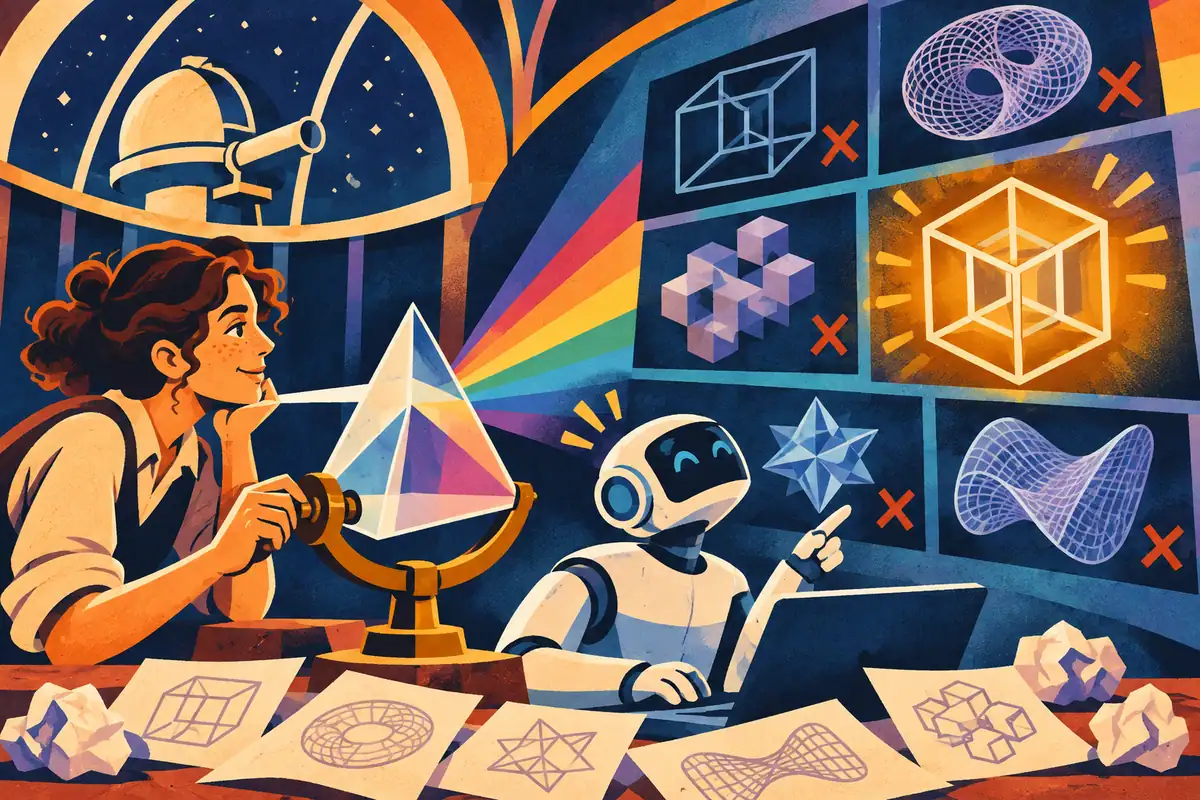
Quick answer: AI can be creative in mathematics in a limited sense: it has produced new, surprising and valuable results, such as AlphaEvolve's unexpected hypercubes and a combined-ideas advance on the Riemann zeta function. But mathematicians such as Terence Tao argue it shows cleverness more than full creativity, since humans still choose the problems, guide the search and supply understanding.
Can AI Be Creative in Mathematics? The Short Answer
In one experiment described by Quanta Magazine, Google DeepMind’s AlphaEvolve, talking to itself as it ran calculations, announced it would try “a ‘Crazy Ivan’ maneuver for this problem,” borrowing the name of a sharp submarine turn from a Tom Clancy novel. In another, the same kind of system turned up a structure that professional mathematicians had not been looking for. Is that creativity, or just very fast trial and error?
The honest answer is: it depends on what you mean by creative. By Margaret Boden’s influential definition, AI has already done things in mathematics that count as creative in a limited sense. It has produced results that experts found new, surprising and valuable. But on the parts of creativity that many mathematicians care about most, such as choosing which questions matter, inventing new frameworks and understanding why ideas work, the evidence is much thinner, and leading mathematicians disagree.
This article walks through the definition, the strongest examples of AI surprising mathematicians, the case against calling it creativity and what all this means for students who want to think creatively in math themselves.
What Creativity Means in Math: Boden's Three Types
To answer the question fairly, we need a definition. The cognitive scientist Margaret Boden, whose work is widely used in debates about computer creativity, defined creativity as “the ability to come up with ideas or artefacts that are new, surprising and valuable,” as summarized by The Marginalian. She also split it into three types:
| Type | What it means | What it looks like in math |
|---|---|---|
| Combinational | Joining familiar ideas in unfamiliar ways, through a link nobody had noticed | Using a tool from one branch of math to crack a problem in another |
| Exploratory | Working inside an existing set of rules to find possibilities nobody had reached | Finding a better construction or a surprising example within a known theory |
| Transformational | Changing the rules themselves, so previously impossible ideas become possible | Inventing a new kind of number, structure or framework |
Boden also separated P-creativity (an idea new to the person who had it) from H-creativity (an idea new in all of human history). A student who discovers a shortcut on their own is P-creative even if mathematicians knew it centuries ago.
With this framework, the question becomes more precise. Most of the AI successes so far look combinational or exploratory. Whether AI has shown transformational creativity in mathematics is much less clear, and that is where the real debate lies.
Creativity Key Terms
Tap a card to reveal the answer.
Watch: Two Videos Worth Your Time
Prefer to watch? These videos add another angle on the topic.
Evidence That AI Can Surprise Mathematicians
Several 2026 examples, reported by Quanta Magazine, show AI producing results that experts did not expect.
The hypercubes nobody asked for
Jordan Ellenberg, Geordie Williamson and colleagues used Google DeepMind’s AlphaEvolve to study objects called Bruhat intervals in permutation groups. The system found that some of these intervals form hypercubes. “We didn’t ask AlphaEvolve to find big hypercubes,” Ellenberg said. Williamson called it “a structure that’s been sitting there for 50 years in front of our nose.” Nicolás Libedinsky went further: “If it was a human, it would be an extremely creative human.”
An optimization question open since 1983
Ernest Ryu used ChatGPT to help prove that Yurii Nesterov’s optimization method converges, a question open since 1983. But he also noted the model often gave wrong proofs: “I had to play the role of the verifier.”
Who gets credit for the idea?
Ravi Vakil and coauthors used Gemini-based tools in a January 2026 proof. “The clarity of the argument gave us a new idea,” Vakil said, then asked: “Who is that idea due to? Is it due to us? Is it due to the model?”
Results top mathematicians admire
Tim Gowers said that if a human had submitted OpenAI’s paper on the unit distance problem to the Annals of Mathematics, he would have recommended it “without any hesitation.” And Terence Tao called a new AI-found zero-free region for the Riemann zeta function, part of OpenAI’s October 2026 release, “the biggest advance on the problem in fifty years.” It was achieved, according to his living summary of his views on AI, by an unusual arrangement of “three or four existing ideas” that he doubts any single living mathematician would have assembled.
Notice that this last example is almost a textbook case of Boden’s combinational creativity. The ingredients were known; the combination was not. For more on systems like AlphaEvolve, see our explainer on how AlphaEvolve works.
The Case Against: Cleverness Is Not the Same as Creativity
Skeptics, including some mathematicians who use AI every day, argue that these examples show something real but narrower than creativity.
Tao draws a useful line. He doubts current tools have true “artificial general intelligence,” but says a weaker “artificial general cleverness” is becoming real: solving broad classes of problems by “ad hoc, often brute-force or stochastic means” that are fallible and hard to interpret but succeed often enough when paired with strong verification. He describes today’s tools as “stochastic generators of sometimes-clever, often-useful outputs.”
Several arguments follow from this view:
- Volume, not insight. AI can try enormous numbers of possibilities. A surprising hit among millions of attempts may look creative without involving any understanding.
- Sparse-data reasoning is still human. Tao contrasts AI’s skill at turning enormous amounts of data into one good answer with a human strength: “Humans are good at taking 10 observations and making really inspired guesses.”
- Breaking problems apart is hard. Tao notes that splitting a problem into tractable pieces is where much of the value lies, and “AI has not demonstrated any ability to be any better than humans in this regard.”
- Humans steer. Even with the AI-assisted Riemann hypothesis proof announced in November 2026, critics such as Gary Marcus and Yann LeCun pointed out, according to Euronews, that it required months of human guidance and open-source infrastructure built by mathematicians.
- Failures go unreported. Tao has pointed out that AI firms publish their successes but not their failures, and in his Math 2.0 lecture he called for assessments that fully report “resource consumption and negative results.” Without them, AI can look more inventive than it is.
There is also the question of understanding. Boden’s definition does not require the creator to understand its idea, but many mathematicians feel that a discovery nobody can explain is incomplete. On this view, creativity in math includes seeing why, not just finding what.
Creative or Not? You Decide
Pick the best description of each situation.
An AI combines three known techniques in a way no mathematician had tried and gets a big new result about the zeta function.
An AI tries millions of random variations and one happens to beat a known record, but nobody understands why it works.
A student finds her own shortcut for multiplying by 25, not knowing it is already well known.
A mathematician asks an AI for ten different proofs of a theorem, then studies them to see why the theorem is true.
Choosing Problems and Mathematical Taste
Perhaps the most important creative act in mathematics is not solving a problem but deciding which problems are worth solving and how to frame them. This is where human taste comes in.
Fields medalist Akshay Venkatesh told Quanta that “there are infinitely many ways to formulate any piece of math,” and that the choices depend on human values. In IEEE Spectrum, the University of Ottawa’s Maia Fraser said that if AI proves a conjecture, “that the statement can be proved by AI is already useful information,” but “it’s still an open problem to come up with an elegant, beautiful human proof.”
Frank Calegari of the University of Chicago, writing in a guest post on Tao’s blog, put it directly: “Choosing worthwhile problems may end up mattering more than producing proofs.” Tao, in his Math 2.0 lecture, says problem solving was always a proxy for deeper goals, and that the main bottleneck to the future of mathematics “is not technology, or even institutional culture. It is imagination.”
Could AI develop taste too? Nobody knows. Some mathematicians think it is only a matter of time. Daniel Litt, for example, told Quanta he expects AI tools within 20 years to generate mathematics that is “in many measurable ways” better than every human mathematician’s. Others think deciding what matters is bound up with human values and cannot be handed over. For now, the evidence suggests AI is strongest when humans set the direction and weakest when asked to decide what is interesting.
Human and AI Creativity Working Together
Many mathematicians now think the most productive question is not “Is AI creative?” but “How can humans and AI be creative together?”
- AI as an idea partner. Johannes Schmitt told Quanta that language models became “good conversation partners” in 2025, even if, as Quanta put it, the mistakes he sees are “weird ones.”
- AI as a way to explore bold ideas. Calegari describes a speculative link between hyperbolic 3-manifolds and arithmetic that he had never pursued because of the background work involved, and notes that “now, with AI, the barriers to trying such a problem are much lower.” He urges mathematicians “to create bold research plans that weren’t even conceivable a year ago.”
- AI as a source of many viewpoints. Tao suggests taking a theorem that already has a long proof and asking AI for a hundred new ones, such as “a proof that you can explain to a high school student” or “a proof that is very visual with mostly pictures,” to reveal more about why it is true.
Tao’s lecture slides describe the goal as “more imaginative and creative uses of AI,” which he expects to expand the research frontier significantly. In this picture, creativity is shared. The AI explores, combines and generates; the human chooses, interprets and understands.
Not everyone finds this comforting. Yang-Hui He of the London Institute for Mathematical Sciences suggested, as IEEE Spectrum reported, that if superhuman AI systems one day form, prove and verify conjectures on their own, human mathematicians could become “priests to oracles.” Our article on AI vs. human mathematicians looks at where each side currently has the edge.
How Students Can Be Creative in Math in the Age of AI
Here is the good news for learners: Boden’s idea of P-creativity means you can be genuinely creative in math today, even if a computer or a mathematician got there first. Finding your own route to an answer is a creative act.
Try these habits
- Solve it two ways. After solving a problem, look for a second method, such as a picture, a table or working backward. That is exploratory creativity.
- Borrow from another topic. Can a geometry picture explain an algebra fact? Combining ideas across topics is combinational creativity.
- Change a rule. Ask “What if?” What if the triangle were on a sphere? What if we only allowed odd numbers? Changing assumptions is a small taste of transformational creativity.
- Use AI as a sparring partner, not a ghostwriter. Share your idea and ask the AI to find a flaw, or ask it for a hint rather than a solution. Our guide on using AI to learn math has examples.
- Ask your own questions. Notice a pattern and wonder whether it always holds. Choosing questions is the part of creativity AI has mastered least.
For a big-picture look at whether math is something we create or something we find, read our article on whether math is invented or discovered.
So, can AI be creative in mathematics? In a limited, measurable sense, yes: it can produce new, surprising and valuable results. In the fuller sense of choosing what matters and understanding why, humans still lead. The most creative future for math probably belongs to people who know how to use both.
Quick Quiz: Can AI Be Creative in Math?
Test your understanding of creativity, AI and mathematics.
Answer each question and press Submit to see your result right away.
Answer each question and press Submit to see your result right away.
Frequently Asked Questions
Tap a question to see the answer.
Can AI come up with new math ideas?
Yes, in a limited way. Systems such as AlphaEvolve and large language models have found new constructions, counterexamples and proof steps that experts had not found. Humans usually still choose the problem, guide the search and check the results.
Is AI creativity the same as human creativity?
Not exactly. AI often succeeds by trying huge numbers of possibilities and keeping what works, while humans can make inspired guesses from very little data. Whether the results should be called creative depends on whether you judge the output or the process.
What is AlphaEvolve?
AlphaEvolve is a Google DeepMind system that uses a language model to propose and refine candidate solutions, which are then scored by an automatic checker. According to Quanta, a team that included Terence Tao tried it on 67 problems by May 2025; it improved on the best known results for 23 of them and matched them for 36.
Can AI invent a new branch of mathematics?
There is no clear example yet. Most AI successes so far work within existing theories or combine known ideas. Inventing a whole new framework, which Boden calls transformational creativity, remains an open challenge and a subject of debate.
Who gets credit when AI has a creative idea in math?
Norms are still being worked out. Mathematicians like Ravi Vakil have openly asked whether an idea is due to them or to the model. Many mathematicians argue that human authors should take responsibility for the work and clearly describe how AI was used.
Why do mathematicians say math is creative?
Math involves choosing questions, inventing definitions, spotting patterns and finding elegant arguments, not just calculating. Many mathematicians compare it to art or music because the best work combines imagination with strict logic.
Will AI make human creativity in math less important?
Many experts argue the opposite. As AI handles more routine work, choosing worthwhile problems, interpreting results and explaining ideas may become the most valuable human contributions. Terence Tao calls imagination the main bottleneck for the future of math.
How can I be more creative in math?
Look for multiple solution methods, connect ideas from different topics, ask what-if questions that change a rule and notice patterns you can test. Creativity grows with practice and with a solid base of skills to combine.
Does creativity in math require understanding?
Boden's definition focuses on ideas being new, surprising and valuable, not on understanding. Many mathematicians, however, feel a discovery is incomplete until someone understands why it works, which is a major reason they question how creative AI really is.
Sources and Further Reading
- The Marginalian: Margaret Boden on creativity
- Quanta Magazine: The AI revolution in math has arrived
- Quanta Magazine: How AI tore through a mathematical community
- Terence Tao: A living summary of my views on AI
- IEEE Spectrum: What it means to be a mathematician when AI does the math
- Terence Tao: Math 2.0 lecture slides (PDF)
- Frank Calegari on What's new: Mathematics has changed. Let's act like it
- Euronews: AI just cracked the biggest maths problem of all time. What does it mean?

Related to This Article
More math articles
- PHQ-9 Depression Screening Calculator
- Conflict, White-Collar Crime, and Corporate Power
- Convert Rational Numbers to a Fraction
- TExES Core Subjects EC-6 Math Flashcards
- 10 Most Common 7th Grade OST Math Questions
- How to Find Composite Numbers?
- Free Grade 8 English Worksheets for Hawaii Students
- Writing and Evaluating Expressions for 5th Grade: Variables and Rules
- Laptop Buying Guide: Essential Tips to Know Before You Buy
- The Best Grade 2 English Worksheets for Colorado Students





What people say about "AI Creativity in Math: Can AI Really Be Creative?"?
No one replied yet.