Math as a Team Sport: How Humans and AI Now Prove Theorems Together
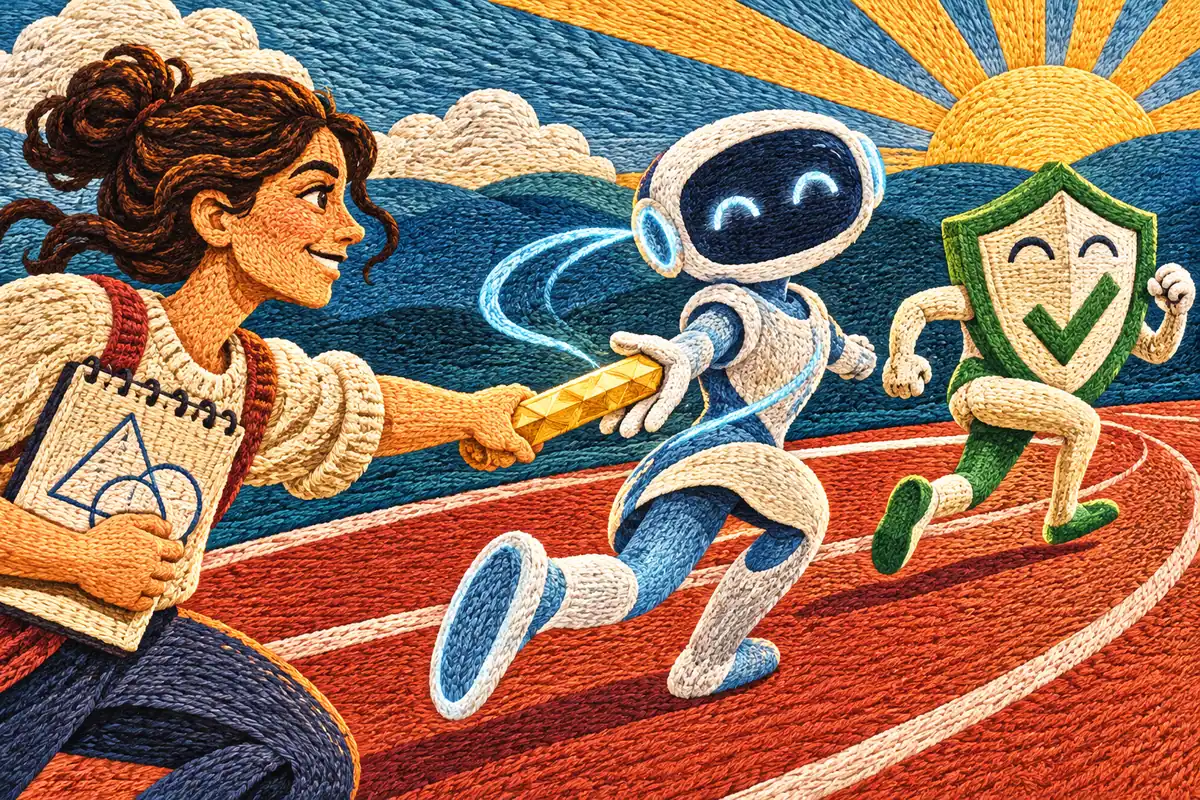
Quick answer: Human-AI collaboration in math means mathematicians, AI models and proof assistants each do the part they are best at. Humans choose problems, guide the work, review results and explain them. AI tries many ideas fast and drafts long arguments. Proof checkers like Lean confirm every step. The Claude-assisted Riemann hypothesis proof by Levent Alpöge is the best-known example.
How Humans and AI Prove Theorems Together Now
The biggest math story of 2026 was not a lone genius or a lone machine. It was a mathematician and an AI model trading ideas for six weeks until a 167-year-old problem appeared to give way.
Mathematics used to be pictured as a solitary pursuit: one person, a chalkboard and years of quiet struggle. That picture is changing fast. Today, many of the most talked-about results come from teams that mix three kinds of players: human mathematicians, AI models that generate and test ideas, and proof assistants such as Lean that check every logical step.
| Team member | Typical strengths | Typical weaknesses |
|---|---|---|
| Human mathematician | Choosing problems, judging what matters, explaining ideas, taking responsibility | Slow at long calculations and huge searches |
| AI model | Trying many ideas quickly, scanning the literature, writing code and long arguments | Can be confidently wrong; output can be hard for people to follow |
| Proof assistant (Lean) | Checking every step with complete rigor | Only checks what it is given; does not explain why a proof works |
None of these players is enough alone. Together, they are producing results that would have sounded like science fiction a few years ago. Below are three real collaborations, what each partner did, and what the new teamwork means for students.
The Riemann Hypothesis Proof as a Human and AI Collaboration
On November 20, 2026, Levent Alpöge, a mathematician at Anthropic, posted a proof of the Riemann hypothesis. According to Science News, he developed it by working back and forth with Anthropic’s Claude for six weeks. Claude used outside tools, its work was checked in Lean, and it had access to Mathlib, Lean’s large library of already formalized mathematics. The formal proof runs about 17 million lines of Lean code (Alpöge called a widely quoted 250,000-page figure a joke), and he also claims the generalized Riemann hypothesis.
The third team member, the proof checker, played a public role. The next day, the Lean Focused Research Organization and the Mathlib Initiative issued a joint statement saying they have full confidence the proof is correct. They reported that the 17-million-line Lean library compiles without errors, that the theorem proved matches Mathlib’s own statement of the Riemann hypothesis, and that several independent checkers accepted it.
Notice what the checker did not do. The same statement says the new ideas in the proof still need to be explained by the mathematical community. Lean can confirm that a proof is valid. It cannot tell humans why it works.
Northwestern mathematician Bryna Kra told Science News the result is an historic achievement but stressed that AI did not do it alone: Claude was trained on human mathematics, and Alpöge is an experienced mathematician who guided the work. In her words, there is someone to stand behind the work. Not everyone agrees. In a November 20 statement, a group called the Association for Human Mathematics said no human can claim responsibility for the proof and no mathematician can confirm with full certainty that it is correct. Alpöge, for his part, told Science News that Claude far outpaced him near the finish line. For more on the mathematician at the center, read our profile of Levent Alpöge.
Watch: Two Videos Worth Your Time
Prefer to watch? These videos add another angle on the topic.
The Zeta Zeros Project: An AI Team With Human Coaches
A few months earlier, a smaller project showed the same teamwork in more detail. In August 2026, Anthropic described how an unreleased research version of Claude improved a long-standing record about the zeros of the Riemann zeta function, raising the proven lower bound for the share of zeros on the critical line from 41.6% to 67.2%. It did not solve the Riemann hypothesis itself.
Who did what
- The prompt: Jarred Sumner, an Anthropic staff member who is not a mathematician, asked Claude to take a real stab at the Riemann hypothesis and left the math choices to the model.
- The search: Claude tried 650 ideas that did not work, then spent a day and a half coordinating about 60 helper agents. Two developed the key ideas, 13 contributed ideas, 30 tried and failed, 13 checked arguments and 2 helped write the first draft of the paper. Along the way they ran 2,400 shell commands, wrote hundreds of Python scripts and downloaded 54 arXiv papers to check whether the result was already known.
- The encouragement: Sumner’s later input was mostly messages like keep going and believe in yourself, which Anthropic says helped Claude get past its initial skepticism.
- The human review: Anthropic mathematicians Levent Alpöge and Ralph Furman examined the work, and outside experts Brian Conrey and Dan Goldston reviewed the paper.
- The formal check: A Lean version, developed with staff member Eric Easley, passes the comparator tool, which checks that the formal theorem matches the intended statement.
Then a human made it simpler
The story did not end there. Mathematician Youness Lamzouri of the University of Lorraine told Live Science that Claude’s proof was too complicated and not human, and he gave up after a couple of hours. He then skipped the dense paper, read the published articles Claude had leaned on and spotted a simplifying constraint Claude had not used. That gave him a shorter proof of the same result plus a new bound: at most 11% of the zeros are neither simple nor on the critical line. He compared AI to bringing big machines to an archaeological site, and said his new way of looking at the problem was, of course, inspired by Claude.
That is collaboration in the fullest sense: the AI found something, and a human turned it into understanding.
Who Did What in the Zeta Zeros Project?
Tap a card to reveal which team member handled each job.
Other Ways Mathematicians Team Up With AI
The Riemann work is the headline, but quieter partnerships are spreading across research math. Quanta Magazine reported several patterns.
The human as verifier
Ernest Ryu used ChatGPT to help prove that an optimization method proposed by Yurii Nesterov in 1983 converges, a question that had stayed open ever since. He checked each partial result the model produced and fed the correct parts back in. In his words, he had to play the role of the verifier.
The AI as idea source
Ravi Vakil, Balázs Elek and Jim Bryan used Gemini-based tools, including Deep Think, on a geometry question about embeddings of spheres in flag varieties. A clear argument from the model gave them a new idea, which raised a question Vakil asked aloud: who is that idea due to?
The AI as search engine for constructions
Terence Tao, Javier Gómez-Serrano, Adam Wagner and Bogdan Georgiev tested Google DeepMind’s AlphaEvolve on 67 problems. It improved the best known answers on 23 and matched 36. Gómez-Serrano said they got comparable results in a day or two.
The crowd plus the checker
Starting in September 2024, Tao helped run the Equational Theories Project, which settled all 22,028,942 implications between 4,694 simple algebraic laws. Contributions came from many people and from automated tools, and every result was validated in Lean. The organizers explain that the older Polymath model, where human moderators review and merge every contribution, would not have scaled to a project this size. The checker made large-scale teamwork possible.
To see how researchers use these tools day to day, read our guide to how mathematicians use AI.
The New Division of Labor in Mathematics
Put these cases side by side and a clear pattern appears. A modern human-AI math project often runs like this:
- A human picks the problem and the goal. Sometimes that person is a top expert; sometimes, as with the zeta project, not even a mathematician.
- AI explores. It proposes approaches, writes code, runs numerical checks and drafts arguments, often failing hundreds of times.
- A proof assistant checks. Lean confirms each logical step, which builds trust in very long proofs. Our Lean explainer shows how that works.
- Humans review and explain. Experts read the work, simplify it and connect it to the rest of mathematics.
- A human stands behind the result. Someone posts the paper and answers questions.
Terence Tao has described this shift as humans increasingly interpreting and understanding AI-produced proofs instead of developing them, according to an SCMP report. Some find that exciting. Others worry about what it means for how students learn. Tao and 24 other Fields Medal winners warned in a joint letter that AI-generated solutions must be developed and integrated into the field by humans, and that shortcuts would undermine how students learn.
Explanation is becoming the human bottleneck. For the quasi-Riemann hypothesis result released by OpenAI in October, Maksym Radziwiłł told Quanta he can now sketch the core argument in half a page, yet said the AI papers fall short of the standard of exposition and clarity in his area by a wide margin.
Open Questions: Credit, Access and Understanding
Teamwork with AI raises questions that math has never had to answer before.
- Credit. When a model suggests the key idea, who gets the credit? Vakil’s question has no settled answer yet. Our post on AI and math authorship looks at the debate.
- Disclosure. Shing-Tung Yau of Tsinghua University leads a new Journal of AI-Assisted Mathematics, due to start publishing in 2027. According to the SCMP report, authors must explain the AI’s contribution and how they verified AI-generated claims.
- Access. Tsinghua mathematician Babak Haghighat warned that AI models are now essential to research, yet mathematicians cannot access the top companies’ models. A field where a few companies control the best tools could become less fair.
- Understanding. A 17-million-line proof certified by independent computer checkers is a new kind of object. Kra told Science News the Riemann result raises more questions than it answers.
These are not reasons to avoid collaboration. They are reasons to build good habits around it, and those habits start long before graduate school.
How Students Can Practice Human and AI Teamwork in Math
Students already work with AI on homework. The research examples above suggest how to make that teamwork productive instead of a shortcut.
- Own the goal. Decide what you are trying to understand before you open a chatbot. You are the team lead.
- Let AI propose, then you verify. Like Ernest Ryu, treat every AI answer as a draft. Check it with a quick example, a sketch or a calculator.
- Simplify like Lamzouri. After you get a solution, try to find a shorter or clearer way to say it. That is where real learning happens.
- Write down who did what. Note which ideas came from you and which came from AI. It is honest, and it is the habit researchers now need.
- Follow your class rules. Teamwork with AI is only legitimate when your teacher allows it. When in doubt, ask.
The future of mathematics looks less like a lonely genius and more like a well-run team. The students who learn to lead those teams, asking good questions, checking claims and explaining results clearly, will be the ones who thrive. For a practical start, see our guide on how to use AI to learn math.
Be a Good Human Teammate
Choose the best move for each situation and read the feedback.
An AI gives you a neat-looking proof for a homework question about even numbers.
You and an AI chatbot disagree about the answer to a word problem.
Your group project used an AI to suggest the key idea for a solution.
An AI solution is correct but 3 pages long and hard to follow.
Quick Quiz: Humans and AI Proving Theorems Together
See how well you understand the new teamwork behind modern math proofs.
Answer each question and press Submit to see your result right away.
Answer each question and press Submit to see your result right away.
Frequently Asked Questions
Tap a question to see the answer.
Can AI prove theorems on its own?
AI systems can now produce proofs with little human help on some problems, such as the 2026 zeta zeros result where a non-mathematician mainly offered encouragement. Even then, humans reviewed the work and a proof checker confirmed it. For major results, human guidance and explanation are still central.
What is a proof assistant?
A proof assistant is software that checks mathematical proofs written in a precise formal language. Lean is the best-known example today, and its Mathlib library holds a large collection of already checked mathematics. If Lean's kernel accepts a proof, every formal step has been checked, assuming the statement is formalized correctly and no extra axioms are used.
Who gets credit when a human and AI prove a theorem together?
There is no settled rule yet. In practice, the human who guided and posted the work usually takes responsibility, while the AI's role is described in the paper. Some groups argue that no human can fully claim very large AI-made proofs.
Do mathematicians trust AI-generated proofs?
Many trust them only after a formal check in a proof assistant or careful human review. AI models can be confidently wrong, so verification is essential. Even trusted proofs are valued more once humans can explain them.
Is the Riemann hypothesis officially solved?
Levent Alpöge's Claude-assisted proof has been certified as correct by the Lean FRO and the Mathlib Initiative, and Bryna Kra called it an historic achievement while Ken Ono called it a mathematical landmark. The Association for Human Mathematics disputes that anyone can fully stand behind it, and the community is still working to understand its ideas. Broader acceptance and formal recognition, such as prize decisions, are separate processes that take longer.
What is the Equational Theories Project?
It was an online collaboration, launched in September 2024, that worked out which of 4,694 simple algebraic laws imply which others. It settled all 22,028,942 implications, combining human-written and automated proofs, with every result verified in Lean. It showed how formal checking makes very large teams possible.
Will collaborating with AI make mathematicians lazy?
Some leading mathematicians worry that shortcuts could weaken how students build skills. Researchers who use AI well still verify, simplify and explain its output, which takes real expertise. The risk depends on how the tools are used.
How can teachers use human-AI collaboration in class?
Teachers can ask students to critique an AI solution, find its errors or rewrite it more clearly. This turns AI from an answer machine into a thinking partner. Clear rules about when AI is allowed help keep the work honest.
Sources and Further Reading
- Science News: The Riemann hypothesis, math's most famous problem, has apparently been solved
- Lean community blog: Statement on the Riemann Hypothesis proof
- Anthropic: Claude and the Riemann zeta zeros
- Live Science: AI's failed attempt to crack the Riemann hypothesis led a mathematician to a breakthrough
- Quanta Magazine: The AI revolution in math has arrived
- arXiv: The Equational Theories Project: Advancing collaborative mathematical research at scale
- The Star (SCMP): As AI solves maths puzzles faster than humans, mathematicians face uncertain future
- Quanta Magazine: AI proved the quasi-Riemann hypothesis. What happens now?

Related to This Article
More math articles
- OAE Mathematics Flashcards
- How to Calculate Limits of Functions
- The Best Grade 5 Math Book for Arkansas Students
- Top 10 Tips to Create the HSPT Math Study Plan
- Using Number Lines to Represent Fractions
- NCLEX Delegation Questions: Right Person vs. Right Direction (2027 Prep)
- Z Table and Calculator
- 49 Printable Maryland MCAP Grade 5 Math Worksheets — Free Download with Step-by-Step Keys
- Contacting officials
- How to Perform Operations of Positive and Negative Decimals











What people say about "Human-AI Collaboration in Math: How Proofs Get Made"?
No one replied yet.