


Why Humans Still Need to Understand Proofs When AI Can Check Them
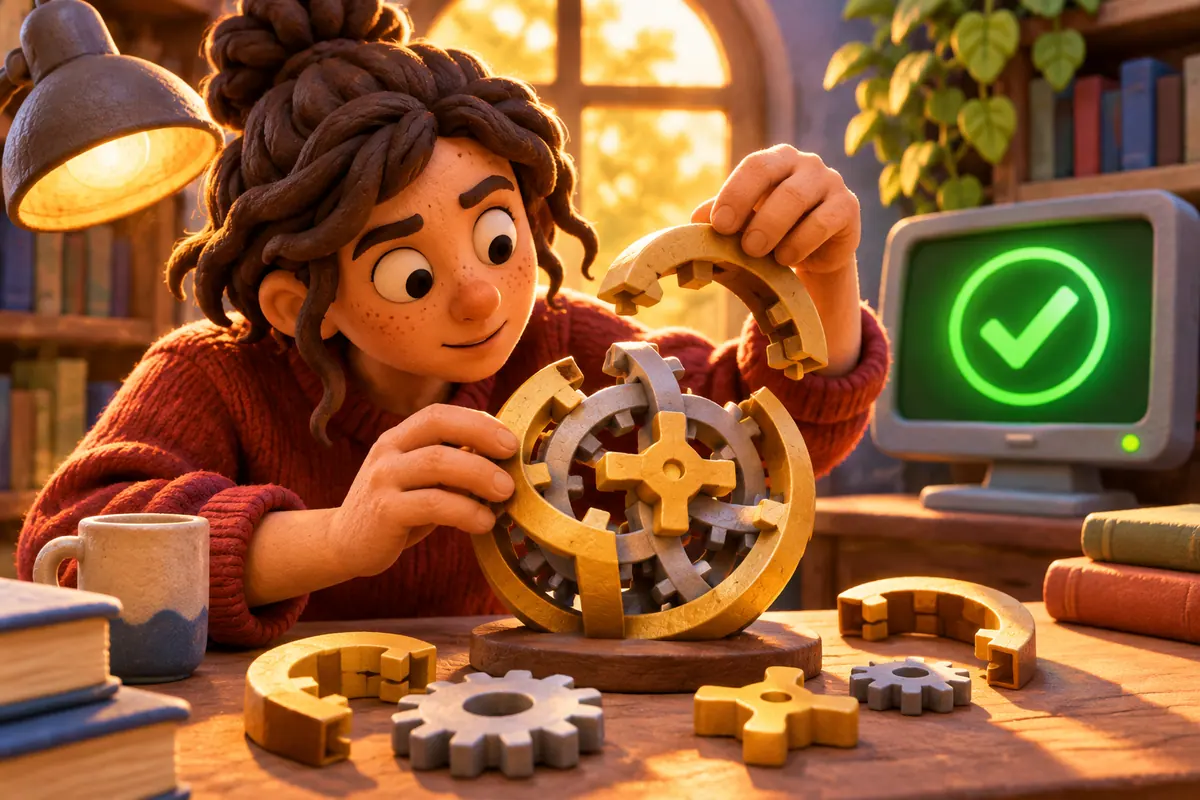
Quick answer: Humans still need to understand proofs because a computer check only confirms that each formal step is valid. It cannot confirm that the statement matches what we meant, explain why the result is true, reveal reusable new ideas or judge whether it is safe to apply. The AI-assisted Riemann proof is certified as correct, but mathematicians are still working to understand it.
Why Understand Proofs When AI Can Check Them?
In November 2026, computers confirmed a proof of the Riemann hypothesis that no person has read from start to finish. So here is a fair question from any student who has ever groaned at a proof: if a machine can check it, why should anyone still have to understand it?
The short answer is that checking and understanding answer two different questions. A computer check tells you that a formal statement follows from the accepted axioms. Understanding tells you why it is true, whether the statement says what you think it says, how to use it and where to go next. Mathematics needs both.
The Riemann story makes the gap concrete. According to the Lean community’s joint statement, the Lean FRO and the Mathlib Initiative certified on November 21, 2026 that both the statement and the proof of the Riemann hypothesis in Levent Alpöge’s Lean library are correct. The library runs to about 17 million lines of code. Alpöge, an Anthropic employee, produced it with the aid of an AI model, which Euronews reports was Anthropic’s Claude. Yet, as Monash University mathematician Melissa Lee noted in an article for The Conversation (republished by Mirage News), mathematician Daniel Litt summed up the situation in five words: “No human understands it yet.”
Alpöge himself does not treat the job as finished. Lee reports that he plans to “understand and impart understanding” of the argument. Below are the main reasons mathematicians give for why that human work still matters, plus the strongest counterargument.
What a Computer Proof Check Does and Does Not Tell You
Proof assistants such as Lean are remarkably strict. Every step must follow from earlier ones by logic the computer accepts, or the proof is rejected. (Our guide to formal verification in math explains the basics.) But a successful check comes with fine print, and reading that fine print takes understanding.
The Lean community’s own checklist for claimed proofs makes several points that surprise newcomers:
- A name is not a statement. It is easy in Lean to define and name the statement “2+2=5,” the page warns, but that is not a proof that 2+2=5. A definition called TheRiemannHypothesis need not match the real conjecture.
- Axioms must be inspected. A proof that quietly adds its own axioms, or admits a step without proof, can look valid without proving the intended theorem. Experts run a command to list every axiom the proof depends on.
- Someone must confirm the statement. For a theorem outside Mathlib, a Lean expert has to confirm that the formal statement matches the mathematics being claimed. Automated checking alone does not settle this.
That is why the Riemann certification did not rest on “it compiled.” The joint statement lists several conditions, including that the theorem matches Mathlib’s expert-vetted statement of the Riemann hypothesis and that several independent proof checkers accepted the exported proof.
Terence Tao, as summarized in his living summary of his views on AI, puts it simply: verification certifies the formal statement, not that it matches what people intended, so human review is reduced, not eliminated. Lee’s article makes the same point about the Riemann proof: “There may be problems with how a proof is formalised, and mathematicians generally agree that a Lean formalisation alone is not enough to confirm a proof.”
In other words, even the act of trusting a machine check requires humans who understand the mathematics well enough to read the statement and judge the setup.
Checked vs. Understood
Tap a card to reveal the answer.
Watch: Two Videos Worth Your Time
Prefer to watch? These videos add another angle on the topic.
Proofs Are Explanations, Not Just Certificates
For many mathematicians, the deepest reason to understand proofs is that understanding is the point of mathematics. In his famous 1994 essay “On proof and progress in mathematics,” William Thurston argued that mathematical progress is about more than formal proofs of theorems. Terence Tao has quoted Thurston’s line that mathematics is not about fulfilling an abstract quota of definitions, theorems and proofs, and adds that we should now append the word “human” to the idea of understanding.
Tao is blunt about what a proof without understanding amounts to. Describing AI results that nobody can explain, he said: “It has all the outward markings of an achievement, but it has none of the substance. People can say, wow, this problem got solved, but I can’t explain it, and you can’t explain it. We can just gawp at it. And that’s no way to do science.”
We have been here before: the four color theorem
This debate is not new. In 1976, Kenneth Appel and Wolfgang Haken announced a proof of the four color theorem, which says any map can be colored with four colors so that neighboring regions differ. Part of the proof was a computer check of a large set of configurations that took more than a thousand hours. Some mathematicians rejected it as a genuine proof, and others found it unsatisfying because it gave no structural explanation of why four colors always suffice.
A simpler computer-assisted proof was announced in 1996, and the theorem was fully formalized in the Coq proof assistant in 2005. Today almost nobody doubts the theorem is true. But the old complaint has not entirely gone away: we know that four colors suffice far better than we know why. The Riemann proof could follow the same path, except at a vastly larger scale, unless people do the work of explaining it.
You Cannot Steer What You Do Not Understand
The second reason is practical. Mathematics is not only admired; it is used, in engineering, medicine, finance and AI itself. Using a result safely means knowing what it actually says and when it applies.
Mathematician and educator Po-Shen Loh made this point in a guest post on Terence Tao’s blog in September 2026 with a driving metaphor: “Driving a car faster than you can run is fine. But not faster than you can steer.” He argued that “in order for a person to know how to steer, they themselves need to have domain mastery,” and called for serious care in keeping a pipeline of humans with the expertise to steer AI agents.
Tao’s Math 2.0 lecture pushes the same idea with a thought experiment. An AI produces a cancer treatment that nobody understands but that comes with a computer certificate and passes a clinical trial. Before taking it, would you want at least one human expert who understands how it works? His argument is that powerful AI combined with a lack of human understanding creates a risk of misalignment: a solution that hits its target in a way nobody intended.
The classroom version is familiar. A student who copies a correct formula without understanding it will happily apply it where it does not work, such as using a formula for a right triangle on a triangle that is not right. Understanding is what tells you when a true statement does not apply.
Understanding Is Where New Mathematics Comes From
The third reason is about the future of math itself. Proofs are not just endpoints; they are toolkits. The methods inside a proof often get reused to solve other problems, sometimes in very different areas. A proof nobody understands is a toolkit nobody can open.
Tao argues that the richest moment to absorb a new idea is when it is first found. As quoted in his living summary, “the best opportunity to do so is at the moment of its discovery, and such moments are increasingly wasted when delegated entirely to AI tools.” He also points out that once you know a problem has been solved, you cannot explore it in the same way, “much as one cannot unhear a movie spoiler or a crossword clue.”
The Lean community’s Riemann statement looks forward to the work that “will help explain the new ideas in this proof,” which is a quiet admission that those ideas are not yet widely understood. Until they are, mathematicians cannot build on them in the usual way, teach them or test how far they reach.
Someone has to read the papers
There is also a community cost. Thomas Bloom, who runs the Erdős problems website, told Quanta Magazine in August 2026 that a big problem is non-mathematicians using AI to produce long papers they cannot verify themselves: “no human has read it, and no human is going to read it.” Each unread paper shifts work onto volunteers who must check it. Po-Shen Loh put the standard in one line: “A proof with even a small hole is not a proof. It is a poof.”
The Other Side: When Is a Verified Proof Enough?
It would be unfair to pretend everyone agrees. There is a strong case that a fully machine-checked proof is already a complete proof, and that explanation is valuable extra work rather than a requirement.
- Machine checking is extremely reliable. The Riemann proof was accepted by several independent checkers from third parties, written in different programming languages. Human referees, by contrast, sometimes miss errors in long papers.
- Checking a proof no longer requires trusting its authors. Tao himself praises proof assistants for this: “you don’t need to trust the people you’re working with, because the program gives you this 100 percent guarantee.”
- History favors acceptance. The four color theorem was controversial in 1976, but it is now a standard result.
Both sides can be right at once, because they are answering different questions:
| Question | Can a computer check answer it? | Who answers it |
|---|---|---|
| Is every step of the formal proof valid? | Yes | Proof checkers |
| Does the formal statement match the intended theorem? | Partly | Human experts, helped by tools |
| Why is the theorem true? | No | Mathematicians who study the proof |
| Which new ideas can be reused elsewhere? | No | Researchers who understand the methods |
| Is it safe to apply in the real world? | No | Experts who understand the math and the application |
So the most accurate way to describe the AI-assisted Riemann proof, as of late November 2026, is something like “certified as correct, not yet understood.” Tao has proposed a stricter standard for publication, according to his living summary of material from the 2026 International Congress of Mathematicians: if authors cannot convincingly show they can give “a clear, expert-level talk on their results,” the work should not be published. Whether the field adopts that standard is an open debate.
Checked or Understood? You Decide
Choose the best response to each situation.
A chatbot gives you the correct answer to a homework problem, and an online calculator confirms it.
A news story says a famous theorem was proved because a Lean file named after it compiled.
An engineer wants to use a new AI-proved formula in a bridge design, but nobody understands when the formula applies.
Your friend says, 'Why learn proofs at all if AI can check them?'
What This Means for Students: Understanding Beats Answer-Getting
If you are a student, this debate has a direct lesson. Calculators, photo-solvers and chatbots can check your answer or produce one. What they cannot do is put the understanding into your head, and that understanding is what lets you handle the next problem, the test question that is phrased differently or the real-world situation where the formula does not quite fit.
Habits that build real understanding
- Ask why, not just what. After any solution, say in one sentence why the method works.
- Check the statement. Like Lean experts reading a formal theorem, reread the question before trusting an answer. Did you solve for the right variable, in the right units?
- Use tools to check, then explain. Use our free guide to checking AI math answers to catch mistakes, then explain the corrected solution in your own words.
- Find a second method. Solving a problem two ways is the student version of looking for a clearer proof.
- Teach someone. If you can explain it to a friend or parent, you understand it.
Parents and teachers can reinforce this by praising explanations, not just right answers, and by asking “How do you know?” as often as “What did you get?” For a deeper look at the Riemann story and whether we can trust AI-made proofs, read our explainer on whether we can trust AI math proofs.
The bottom line: a machine check can tell us a proof is valid. Only people can turn a valid proof into knowledge we can use, teach and build on.
Quick Quiz: Checking vs. Understanding Proofs
See how well you can tell checking a proof apart from understanding it.
Answer each question and press Submit to see your result right away.
Answer each question and press Submit to see your result right away.
Frequently Asked Questions
Tap a question to see the answer.
Can AI check math proofs?
Yes, when a proof is written in a formal language such as Lean, a computer can check every step. Chatbots reading ordinary written proofs are much less reliable, because they can miss errors or invent them. Formal proof checkers give rigorous verification, whether or not AI helped write the proof.
Is a computer-verified proof a real proof?
Most mathematicians accept a carefully verified formal proof as valid, as long as experts confirm the formal statement matches the intended theorem. The live debate is whether such a proof is finished if nobody can explain it. Terence Tao, for example, has suggested that results whose authors cannot give a clear, expert-level talk about them should not be published.
Has anyone read the whole AI Riemann hypothesis proof?
No. The Lean library is about 17 million lines of code, far too long for a person to read line by line. It was checked by computer programs, and mathematicians are now working on human-readable explanations of its key ideas.
What is the difference between proving and understanding?
Proving shows that a statement follows logically from accepted starting points. Understanding means seeing why it is true, how the ideas fit together and when the result applies. A person or machine can produce a valid proof without anyone having that understanding.
Why do mathematicians care about elegant proofs?
Short, clear proofs reveal the reason a result is true and are easier to check, teach and reuse. An elegant proof often exposes a method that solves other problems too. That is why mathematicians keep looking for better proofs of theorems already known to be true.
Do students still need to learn proofs?
Yes. Learning proofs trains you to reason carefully, spot hidden assumptions and explain your thinking, skills that matter in science, coding, law and everyday decisions. These are also the skills you need to check what AI tools tell you.
Can a proof checker make mistakes?
Proof checkers are designed to be small and well tested, and important proofs are often run through several independent checkers to reduce the risk further. The bigger danger is usually human: stating the wrong theorem or adding an unjustified axiom, which is why expert review of the setup matters.
What is formalization in math?
Formalization means rewriting a proof in a precise computer language so a proof assistant can check every step. It removes ambiguity, but it can be a lot of work, and the formal statement still needs human review to make sure it matches the original idea.
Will AI make proof-based math classes obsolete?
Unlikely. As AI produces more results, the ability to read, question and explain proofs becomes more valuable, not less. Classes may shift toward explanation, verification and choosing good questions, but the core reasoning skills remain essential.
Sources and Further Reading
- The Conversation via Mirage News: AI and the Riemann hypothesis, a proof no human can read
- Lean Community Blog: Certifying the Riemann Hypothesis proof
- Lean Community: Did you prove it? Checklist for claimed proofs
- Wikipedia: Four color theorem
- Euronews: AI just cracked the biggest maths problem of all time. What does it mean?
- Terence Tao: A living summary of my views on AI
- Po-Shen Loh on What's new: Why do we need human mathematicians anymore?
- Quanta Magazine: How AI tore through a mathematical community

Related to This Article
More math articles
- How to Pass the FTCE Math Test?
- Unlock Your Potential: “HiSET Math for Beginners” Comprehensive Guide
- Gender Socialization and Social Structure
- How to Balance the Scales: Inequalities in Decimal Addition and Subtraction
- The Best Grade 8 Math Book for Ohio Students
- Prohibition, Organized Crime, and the Twenty-first Amendment
- How to Find Continuity at a Point?
- 1 Times Table
- Baby Weight Percentile Calculator
- CSET Mathematics Flashcards








What people say about "Why Understand Math Proofs If AI Can Check Them?"?
No one replied yet.