North Carolina Algebra 1 Free Worksheets: Printable NC Algebra 1 Practice, Answers Included
If you ask a math teacher what Algebra 1 is really about, the answer almost never starts with the word equations. It starts with the word relationships. The point of the course is to teach a teenager how to describe the way one quantity depends on another, not just numerically, but structurally, in a way that holds across infinitely many specific cases. A line on a graph is a relationship between x and y. A system of two equations is a story about where two relationships meet. A quadratic function is the shape of every problem with a constant rate of change in the rate of change. The numbers are the foreground; the relationships are the whole point.
That is also why ninth grade is a tilt in the floor of a student’s math career. Up through middle school, the work was mostly local, finish this calculation, simplify that fraction, answer this question. In Algebra 1, work starts to depend on the work that came before it in a way it never has, and a missing earlier skill can turn into a wall three weeks later. A student in Charlotte taking the course as an accelerated eighth grader, a Raleigh ninth grader balancing it with band, a Greensboro tenth grader retaking it for a better grade, a Durham student fitting study time around a long commute, every one of them benefits from the same kind of practice: short, specific, finished cleanly.
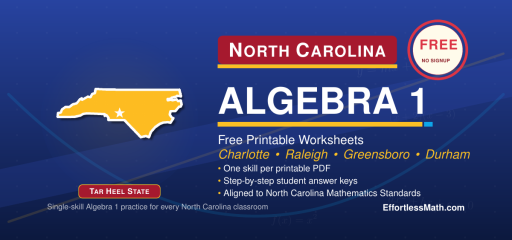
These 52 worksheets are built so that “short, specific, finished cleanly” is the easiest path to take.
What’s on this page
Fifty-two single-skill PDFs, each aligned to the North Carolina Algebra 1 standards. The set follows the actual structure of the course rather than the structure of a textbook chapter: linear equations and inequalities, slope and lines, linear and exponential functions, systems of equations, exponents and radicals, factoring, and quadratic equations and functions. Each PDF stays inside a single skill from first example to last problem, so a sitting on “Graphing Systems of Equations” does not pull in a quadratic and a sitting on factoring does not sneak in a function table.
Every page opens with a one-page Quick Review: the skill stated in ordinary English, with one fully worked example. Then twelve practice problems climbing from gentle warm-ups to genuinely challenging, the last two or three sit at the difficulty an end-of-course assessment tends to use. The final page is a student-facing answer key written in a patient, tutoring tone, short enough to read at a glance but complete enough to actually teach.
Foundations of Algebra
Students meet the language of algebra here: naming unknowns, simplifying expressions, and using the rules that govern how numbers combine. Charlotte families can use these pages to lock the skill in before it’s tested.
- Variables, Expressions, and Properties
- Order of Operations and Evaluating Expressions
- Simplifying Algebraic Expressions
- Introduction to Equations and Solutions
- Personal Financial Literacy
Solving Linear Equations
The chapter drills the discipline of solving, clear, collect, isolate, across increasingly layered linear equations. In Charlotte classrooms it tends to separate confident students from hesitant ones.
- Solving One-Step Equations
- Solving Two-Step Equations
- Solving Multi-Step Equations
- Equations with Variables on Both Sides
Inequalities and Absolute Value
Ranges of solutions take over, graphing inequalities, reasoning through compound cases, and working with absolute value. Steady practice now makes the North Carolina Algebra 1 course feel far more manageable later.
- Solving One-Step Inequalities
- Solving Multi-Step Inequalities
- Compound Inequalities
- Absolute Value Equations
Relations, Functions, and Sequences
The function arrives, one input, one output, alongside domain, range, function notation, and sequences that behave like functions. Master it early and the rest of the North Carolina course leans on it with ease.
- Domain and Range
- Graphing Functions and Transformations
- Arithmetic Sequences as Linear Functions
- Geometric Sequences
- Piecewise Functions
- Combining Functions
Linear Functions and Their Graphs
The chapter is all about lines, finding slope, writing equations in several forms, and relating parallel and perpendicular slopes. It’s a frequent early hurdle for learners in Charlotte and across the state.
- Slope and Rate of Change
- Slope-Intercept Form
- Point-Slope Form
- Standard Form of a Linear Equation
- Writing Linear Equations from Graphs and Tables
- Parallel and Perpendicular Lines
- Inverse Variation
Exponents, Polynomials, and Real Numbers
Powers, polynomials, and number sense combine, exponent rules, polynomial operations, and rational versus irrational numbers. For North Carolina students, fluency here shows up directly on the North Carolina Algebra 1 course.
- Properties of Exponents
- Adding and Subtracting Polynomials
- Multiplying Polynomials
- Special Products of Polynomials
- Rational and Irrational Numbers
Factoring
Here expressions get taken apart, common factors first, then trinomials and the special products that factor cleanly. Getting comfortable here pays off all the way through the North Carolina Algebra 1 course.
- Greatest Common Factor and GCF Factoring
- Factoring Trinomials: \(x^2 + bx + c\)
- Factoring Trinomials: \(ax^2 + bx + c\)
- Factoring Special Products
Quadratic Functions and Equations
Curves replace lines: graphing parabolas and solving quadratics by factoring, square roots, completing the square, and the formula. Time spent here is time saved when the North Carolina Algebra 1 course rolls around.
- Graphing Quadratic Functions
- Solving Quadratics by Factoring
- Solving Quadratics by Completing the Square
- Quadratic Applications and Modeling
Statistics and Probability
Students summarize and display data, read two-way tables and scatter plots, and reason about likelihood. Across North Carolina, this is one of the skills that rewards regular reps.
- Measures of Center and Spread
- Scatter Plots and Correlation
- Lines of Best Fit and Predictions
- Two-Way Frequency Tables
Exponential Functions and Modeling
The final unit covers exponential growth and decay and how to tell exponential models from the others. It is worth the extra reps for North Carolina learners aiming for a strong score on the North Carolina Algebra 1 course.
- Graphing Exponential Functions
- Comparing Linear, Quadratic, and Exponential Models
- Interpreting Functions and Parameters
More Topics
- Absolute Value Inequalities
- Direct Variation
- Displaying Data with Box Plots
- Displaying Data with Histograms
- Graphing Cube Root Functions
- Graphing Square Root Functions
How to use these worksheets at home
The single best thing you can do with this set is print pages in pairs. Algebra 1 is full of skills that are really two-step stories, and when you separate them, the second step costs twice as much effort as it should. Print “Solving Two-Step Equations” on Monday and “Solving Multi-Step Equations” on Wednesday, and the Wednesday page reads as the Monday one with one more move. Schedule “Slope and Rate of Change” right before “Slope-Intercept Form,” and the slope a student just computed becomes the m in y = mx + b without any new mental setup. Put “Factoring Trinomials” the night before “Solving Quadratics by Factoring,” and the second worksheet feels like the next sentence of the first.
Keep the sittings honest. Twenty unbothered minutes on a single page is more useful than an hour of scattered review, and a student who finishes one worksheet completely is much more likely to come back to a second than a student who half-finished three. Print one PDF, set it on the table, and let your North Carolina ninth or tenth grader work it through alone. Fourteen and fifteen are old enough to own that time, and the work being theirs is part of what makes it stick.
End with the answer key. Hand it over, let your student grade their own page, and ask for a one-sentence explanation of any problem that did not go right. That moment, student noticing their own mistake, naming it, and writing the corrected version, is where the skill actually crosses over from “saw it” to “have it.” It is also the habit that pays off on every cumulative test for the rest of high school.
A note about Algebra 1 in North Carolina
North Carolina builds Algebra 1 around the state’s Algebra 1 standards, which align with the Common Core framework for high school mathematics. The course is typically capped in the spring by a cumulative end-of-course assessment, administered as part of the state’s testing program for students taking Algebra 1, and whether your student sits the state EOC, a district final, or a teacher-built cumulative test, the skill list is the same. Solve linear equations and inequalities. Work with linear and exponential functions and their graphs. Solve systems by graphing, substitution, and elimination. Manipulate expressions, including those involving exponents and radicals. Factor and solve quadratics. Reason about real-world data and the key features of functions.
Because each PDF here is mapped to a single standard, the set works neatly as a personal pre-test checklist. Print a sheet near the end of the year, see how the page goes, and let that decide what to do next. A clean answer key is permission to move forward; a stumble points to the prerequisite that needs another twenty minutes. That kind of targeted, evidence-based study is far faster than re-reading a textbook chapter, and it is what students who finish the year confidently almost always do.
A short closing
Algebra 1 in North Carolina becomes manageable the moment a student finishes one page completely and feels the small, clean click of “I have that one.” Bookmark this set, print a single PDF tonight, and let the next sheet you print be chosen by what tonight’s page revealed. By spring, the staircase will have built itself behind you in a way no single weekend of review ever could.
New to Algebra? Start with the basics


Related to This Article
More math articles
- Sandy Savings: A Guide to How to Calculate Sales Tax on Your Beach Vacation
- 4th Grade NSCAS Math Worksheets: FREE & Printable
- ASVAB Math FREE Sample Practice Questions
- How to Identify One-to-One Functions from the Graph
- 8th Grade ACT Aspire Math Practice Test Questions
- The Best Grade 5 Math Book for Indiana Students
- A Comprehensive Collection of Free PERT Math Practice Tests
- NES Elementary Education Math (103) Worksheets: FREE & Printable
- Number Properties Puzzle -Critical Thinking 4
- 4th Grade MEAP Math Worksheets: FREE & Printable










What people say about "North Carolina Algebra 1: Free Worksheets"?
No one replied yet.