Massachusetts MCAS Grade 4 Math Free Worksheets: Printable PDF Practice with Student-Friendly Keys

TL;DR: Free printable Grade 4 math worksheets for Massachusetts families and classrooms, with student-friendly answer keys covering multi-digit multiplication, long division, fractions, decimals, measurement, and the multi-step word problems MCAS leans on.
Key takeaways:
- MCAS Grade 4 math tests operations, place value, fractions, measurement, and geometry.
- All worksheets are free PDFs with student-friendly answer keys.
- Aligned with the 2017 Massachusetts Curriculum Framework for Mathematics (grade 4).
- No signup or email – print at home or for a whole classroom.
- Short, daily sessions (15-20 minutes) work better than weekend marathons.
Fourth grade is where the strands of elementary math start to braid together. Place value feeds multiplication. Multiplication feeds the work with factors. Fractions stop being slices of a circle and become numbers a student can compare, add, and stretch by a whole number. By the end of the year, a fourth grader is not just doing math. They are connecting it, and that connecting is what makes the subject feel less like a list and more like a single, sensible thing.
The list of what the year asks is real and substantial. Students multiply two- and three-digit numbers, divide with remainders, and explore factors and multiples. They build equivalent fractions and compare them, add and subtract fractions with like denominators, work with mixed numbers, and multiply a fraction by a whole number. They meet decimals to the hundredths, measure and classify angles, convert measurement units, read and make line plots, and find both area and perimeter. It is foundational work, fifth grade and middle school quietly count on every bit of it.
Because the strands braid, a weak strand shows up later in a place you might not expect. A child shaky on equivalent fractions will struggle with comparing fractions, then with the fraction word problems that depend on both. The encouraging side of that same fact is that strengthening one skill quietly strengthens the ones downstream of it. That is why patient, single-skill practice is worth the time. It is not busywork, it is reinforcing the threads the rest of the year hangs on.
In Boston or Worcester, Springfield or Cambridge, or in a small town out toward the Berkshires, fourth-grade math runs the same way: one clear skill at a time, practiced until it is firm.
What’s on this page
This page holds 43 single-skill PDFs, each aligned to the Massachusetts Mathematics Standards at Grade 4. Every file is built to do one thing well. A student working on dividing with remainders is not also being tested on line plots; a student on equivalent fractions is not pulled toward angle measurement. That single focus is exactly what makes a short session worthwhile.
Each PDF opens with a one-page Quick Review that explains the skill in plain words and works one example all the way through. Then come 20 practice problems, ordered from easy to challenging, and 4 word problems that drop the skill into a real context. The final page is a student-facing answer key, brief, friendly explanations a student can read on their own and actually learn from.
Place Value & Multi-Digit Numbers
- Understanding Place Value Relationships, [4.NBT.A.1] each place is ten times the one to its right
- Reading and Writing Multi-Digit Numbers, [4.NBT.A.2] standard form, word form, and expanded form
- Comparing and Ordering Multi-Digit Numbers, [4.NBT.A.2] use place value and the symbols >, <, and =
- Rounding Multi-Digit Numbers, [4.NBT.A.3] round to any place from tens to hundred-thousands
Multi-Digit Arithmetic
- Adding Multi-Digit Whole Numbers, [4.NBT.B.4] the standard addition algorithm, with regrouping
- Subtracting Multi-Digit Whole Numbers, [4.NBT.B.4] the standard subtraction algorithm, including across zeros
- Multiplying by a One-Digit Number, [4.NBT.B.5] multiply up to four digits by a single digit
- Multiplying Two Two-Digit Numbers, [4.NBT.B.5] the area model and the standard algorithm side by side
- Dividing with Remainders, [4.NBT.B.6] divide and name the leftover as a remainder
- Finding Factors and Multiples, [4.OA.B.4] list every factor of a number and its first multiples
- Prime and Composite Numbers, [4.OA.B.4] exactly two factors means prime; more means composite
Operations & Problem Solving
- Multiplicative Comparisons, [4.OA.A.1] read ‘4 times as many’ as a multiplication statement
- Multiplicative Comparison Word Problems, [4.OA.A.2] solve ‘times as many’ stories with multiplication or division
- Multi-Step Word Problems, [4.OA.A.3] two or more operations in one real-world problem
- Interpreting Remainders, [4.OA.A.3] decide what the leftover means, round up, drop it, or use it
- Number and Shape Patterns, [4.OA.C.5] follow a rule and find the next terms in a pattern
Fractions
- Equivalent Fractions, [4.NF.A.1] the same amount written with different numbers
- Comparing Fractions, [4.NF.A.2] compare fractions with unlike denominators using benchmarks
- Adding Fractions with Like Denominators, [4.NF.B.3a] add the numerators, keep the denominator
- Subtracting Fractions with Like Denominators, [4.NF.B.3a] subtract the numerators, keep the denominator
- Decomposing Fractions, [4.NF.B.3b] break a fraction into a sum of unit fractions
- Adding and Subtracting Mixed Numbers, [4.NF.B.3c] work with the whole and fraction parts, including regrouping
- Multiplying a Fraction by a Whole Number, [4.NF.B.4b] repeated addition of a fraction, written as multiplication
- Fraction Word Problems, [4.NF.B.3d] real-world stories that call for adding or subtracting fractions
Decimals
- Fractions with Denominators 10 and 100, [4.NF.C.5] rename tenths as hundredths and add the two
- Decimal Notation for Fractions, [4.NF.C.6] write tenths and hundredths as decimals, and back
- Comparing Decimals to Hundredths, [4.NF.C.7] line up the place values and compare with >, <, =
- Adding Decimal Fractions, [4.NF.C.5] add decimals to the hundredths place
Measurement & Data
- Converting Measurement Units, [4.MD.A.1] change from a larger unit to a smaller one
- Measurement Word Problems, [4.MD.A.2] length, weight, volume, and time in real situations
- Area of Rectangles, [4.MD.A.3] length times width, the space inside a rectangle
- Perimeter of Rectangles, [4.MD.A.3] the distance all the way around a rectangle
- Area and Perimeter Word Problems, [4.MD.A.3] decide whether a problem needs area or perimeter
- Line Plots with Fractions, [4.MD.B.4] read and use a line plot of fraction measurements
Angles
- Angles as Fractions of a Circle, [4.MD.C.5] a full turn is 360 degrees, find a fraction of it
- Measuring Angles with a Protractor, [4.MD.C.6] name angles acute, right, or obtuse by their measure
- Drawing Angles with Given Measures, [4.MD.C.6] know what a given degree measure should look like
- Adding and Subtracting Angles, [4.MD.C.7] an angle split into parts, find the missing part
Geometry
- Points, Lines, Rays, and Angles, [4.G.A.1] the building blocks of geometry and how to tell them apart
- Parallel and Perpendicular Lines, [4.G.A.1] lines that never meet, and lines that cross at a square corner
- Classifying Triangles, [4.G.A.2] sort triangles by their angles and their sides
- Classifying Quadrilaterals, [4.G.A.2] name four-sided shapes by their sides and angles
- Lines of Symmetry, [4.G.A.3] find the lines that fold a shape onto itself
How to use these worksheets at home
You do not need an elaborate schedule. You need a small habit that repeats. Choose a couple of afternoons a week, treat one PDF as a single sitting, and keep it near fifteen minutes. A fourth grader will give you fifteen real minutes far more reliably than a vague, open-ended stretch.
Sequence skills so each one props up the next. Start a multiplication run with a place-value page, because reading 2,750 as two thousands, seven hundreds, and five tens is what makes the partial products make sense; then “Multiplying by One-Digit Numbers” before “Multiplying by Two-Digit Numbers” makes the harder version feel like a continuation. Put “Dividing with Remainders” right after that multiplication work, so a child meets division as multiplication reversed and reads the remainder as the part that would not fill a whole group.
Fractions ask for the same ordering. “Equivalent Fractions” before “Comparing Fractions” puts the right tool in a student’s hand before they reach for it, and “Mixed Numbers” follows naturally, a mixed number is just a whole and a fraction side by side. Let “Decimals to the Hundredths” land next to fraction work so a child sees that 0.5 and one-half mark the same point on the number line. In geometry, “Area of Rectangles” then “Perimeter of Rectangles” keeps the two ideas from blurring into one, covering versus surrounding, and “Measuring Angles” before “Classifying Shapes” gives a child the measuring eye that makes naming triangles and quadrilaterals straightforward.
When the work is done, the answer key is the student’s, not the parent’s. At a kitchen table in Cambridge or anywhere after dinner, let your child check their own page and read the explanation for anything they missed. That calm self-check is where a worksheet becomes understanding. It also helps to circle back: every few weeks, pull a worksheet your child finished earlier and have them rework a few problems, since a skill left alone since the fall can fade quietly, and a quick check catches it early.
A note about MCAS at Grade 4
Massachusetts students take the Massachusetts Comprehensive Assessment System (MCAS) Mathematics assessment in the spring. It is built on the Massachusetts Mathematics Standards, so the skills practiced on these worksheets line up directly with what the test asks.
The Grade 4 MCAS looks for thinking, not just correct answers. It asks students to explain place-value reasoning, choose operations for multi-step problems, compare fractions and justify the result, interpret remainders, and work through decimals, angles, area, perimeter, and shape classification. Many items ask a child to solve and then explain, and that explaining grows directly out of practice that was understood rather than rushed. Because each PDF here is tied to one standard, the spring window turns into a checklist you can actually act on, see what is shaky, work just those skills, and leave the solid ones alone.
A short closing
Fourth-grade math comes together gradually, one connection, one short afternoon at a time. No single page braids the whole year together, but each one adds a thread, and by spring the weave holds. Bookmark this page, print a single PDF tonight, and let your student start somewhere small. Massachusetts kids do careful, connected work well when the next step is clear, and a worksheet on the table makes it clear.
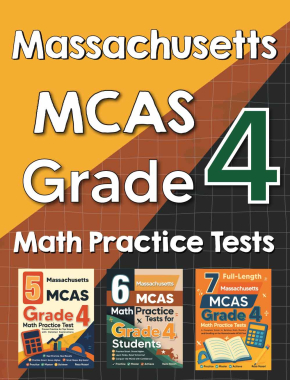
Best Bundle to Ace the Massachusetts MCAS Grade 4 Math Test
Want the fastest path through Massachusetts MCAS Grade 4 math? This bundle pulls it together, four full practice-test books with complete, step-by-step answer keys, instant PDF download.
Recommended EffortlessMath Books
For a workbook that pairs neatly with these printable practice pages, Mastering Grade 4 Math walks your child through every fourth-grade topic with clear examples and lots of try-it-yourself problems. For extra word-problem practice (the part many fourth graders find hardest), see Mastering Grade 4 Math Word Problems.
Frequently Asked Questions
What is mass in grade 4 math?
Mass is how much matter an object has, and fourth graders measure it in grams and kilograms. One kilogram equals 1,000 grams, so a 3 kg bag of apples has a mass of 3,000 grams. Massachusetts students learn to convert larger units to smaller ones and solve word problems with mass, like adding a 250 g box and a 1 kg bag to get 1,250 g. Pounds and ounces come up too.
What are factors in 4th grade math?
Factors are the numbers that multiply to make a given number. The factors of 24 are 1, 2, 3, 4, 6, 8, 12, and 24, found as the pairs 1 × 24, 2 × 12, 3 × 8, and 4 × 6. Massachusetts fourth graders also learn how factors differ from multiples: 6 is a factor of 24, while 24, 48, and 72 are multiples of 6.
What are the Massachusetts 4th grade math standards?
Massachusetts fourth graders follow the 2017 Massachusetts Curriculum Framework for Mathematics. Grade 4 covers Operations and Algebraic Thinking, Number and Operations in Base Ten, Number and Operations–Fractions, Measurement and Data, and Geometry. For example, students should be able to multiply 4,512 × 3 (13,536) and explain why 3/4 equals 6/8. The Department of Elementary and Secondary Education (DESE) posts the full framework for free.
What is on the Massachusetts 4th grade MCAS math test?
The grade 4 MCAS math test checks the skills in the Massachusetts Curriculum Framework: multi-digit operations, fractions and decimals, measurement, data, and geometry. It is taken on a computer and includes both selected-response and constructed-response questions, where students show their reasoning. DESE releases past MCAS test items, so working through a few with your child is a good way to preview the question style.
What does the Massachusetts 4th grade math curriculum include?
The state framework sets what students learn, while each Massachusetts district picks its own curriculum materials. From Boston to Springfield, grade 4 math usually includes place value to one million, multiplication and long division, equivalent fractions, adding fractions and mixed numbers, decimals, measurement conversions, angles, and line plots. Your child’s teacher can share the unit order so home practice lines up with class.
Related EffortlessMath Lessons
If a topic on this page feels rusty, these short lessons go deeper:
- How to multiply multi-digit numbers
- How to divide multi-digit numbers
- How to add and subtract fractions with like denominators
- How to find equivalent fractions
- How to solve multi-step word problems

Related to This Article
More math articles
- Find the Key: “AFOQT Math for Beginners” Complete Answer Book
- Federalists and Anti-Federalists: Power, Representation and Rights
- Top 10 5th Grade MEAP Math Practice Questions
- Platforms, Algorithms, Data, and Surveillance
- Top 10 8th Grade PARCC Math Practice Questions
- RD Exam Attempt Limit: Who Does the New Policy Apply To? (2027 Prep)
- Top 5 Free Websites for TExES Mathematics Preparation
- Rounding to the Nearest 10, 100, and 1,000 for 4th Grade
- 7th Grade PSSA Math Worksheets: 68 Free PDFs by Topic
- Capitalism, Socialism, Mixed Economies, and Postindustrial Change









What people say about "Massachusetts MCAS Grade 4 Math: Free Worksheets"?
No one replied yet.