Iron Triangles and Issue Networks
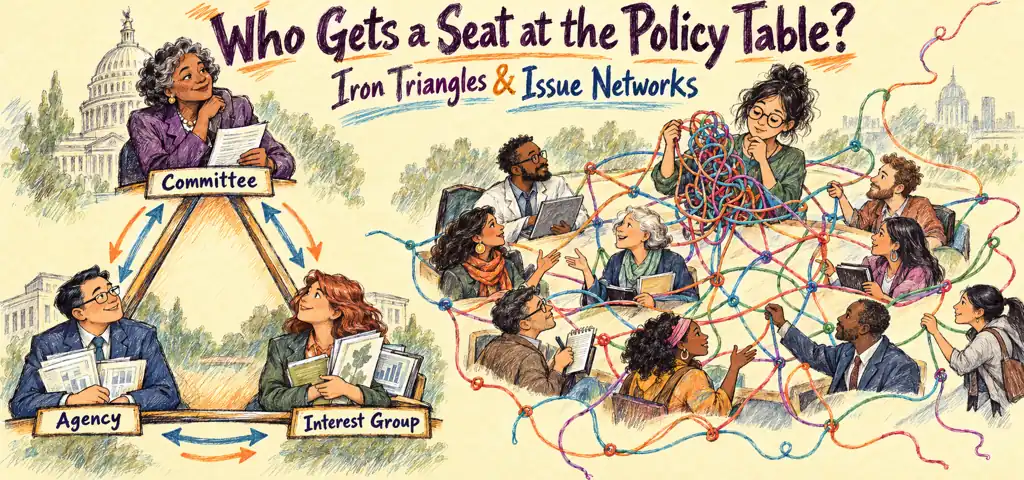
An iron triangle is a stable, three-way alliance among a congressional committee, a federal agency, and an interest group that all benefit from the same policy. An issue network is looser and larger: a shifting web of legislators, staff, agency officials, think tanks, journalists, and advocacy groups who share expertise on an issue but do not control it. The key difference is that iron triangles are closed and durable, while issue networks are open and fluid.
An Iron triangle is a relatively stable, reciprocal relationship among three participants: a congressional committee or subcommittee, an administrative agency, and an organized interest. The committee supplies legislation, budgets, and oversight. The agency supplies implementation and expertise. The group supplies information, political support, and feedback from the affected field. The word Iron signals durability and restricted access, not a formal constitutional body or automatic illegality.
An Issue network is broader, more fluid, and less predictable. Officials, researchers, journalists, firms, professional associations, advocacy groups, and state or local actors enter and leave as particular questions arise. Participants may share an interest in the policy field while disagreeing sharply about solutions. Modern technical problems often attract issue networks because expertise is dispersed and decisions move among committees, agencies, courts, and levels of government.
The governing rule for iron triangles and issue networks
Stability and access distinguish the models. One hearing at which an agency, committee, and trade association agree does not establish an iron triangle. Look for repeated reciprocal support and a comparatively closed set of participants. A changing community with competing experts and organizations fits an issue network. Both arrangements can transmit useful knowledge. Both can also privilege people who possess time, expertise, or established access over diffuse citizens who organize less easily.
Iron Triangles and Issue Networks: the legal or political boundary
Agency capture is a separate conclusion about outcomes. A regulator is captured when it persistently serves the regulated interest rather than the public mission supplied by law. Repeated contact may contribute to capture through information dependence, political pressure, or shared professional culture, but contact alone is insufficient. a committee, bureau, and hospital association cooperate for years, while researchers and patient groups enter only during controversies. The stable core resembles an iron triangle. The changing outer community is an issue network. Capture would require further evidence that the bureau abandoned its statutory purpose.
Reason through an example of iron triangles and issue networks
A classmate claims that iron triangles and issue networks always produces the same result, so correct the claim with one example and a relevant limit.
Video lesson: Iron Triangles and Issue Networks
Khan Academy gives a focused explanation of this topic in Iron triangles and issue networks | US government and civics.
If the player does not load, watch this lesson directly on YouTube.
Connect this lesson to the larger course
For a broader map connecting iron triangles and issue networks to participation, parties, elections, interest groups, and media, use the AP U.S. Government and Politics learning hub.

Related to This Article
More math articles
- Free Grade 3 English Worksheets for Wyoming Students
- ISEE Upper-Level Math FREE Sample Practice Questions
- How to Classify Numbers
- Voisins, Tiers, Orphelins: A Math Tour of Roulette Call Bets
- Cooley’s Looking-Glass Self
- How To Create a Distraction-Free Study Environment: 10 Tips
- How to Divide Exponents? (+FREE Worksheet!)
- Ohio OST Algebra 1 Free Worksheets: Printable OST-Ready Algebra 1 Worksheets with Step-by-Step Keys
- Grants-in-aid
- How to Find Measures of Variability? (+FREE Worksheet!)





















What people say about "Iron Triangles vs. Issue Networks: Definitions and Examples"?
No one replied yet.