Free Grade 6 English Worksheets for Idaho Students
A yellow school bus rolls along a two-lane road outside Boise at seven-fifteen in the morning, and at least three sixth graders on it are reading, one a graphic novel, one a fantasy paperback with a cracked spine, one the back of a cereal-bar wrapper because she forgot her book. By the time the bus reaches the school parking lot, the kid with the fantasy paperback has consumed more text than she will in any class period that day. Most reading growth in sixth grade happens in moments like that, in pockets nobody schedules. The job of a parent or teacher is to make sure the pockets exist.
That is the through-line of sixth-grade English in Idaho. The Idaho Content Standards for English Language Arts ask for steady, cumulative growth, not a sprint toward the spring test, but a slow accumulation of small reading and writing moves that builds across the year. The ISAT ELA assessment, which runs on the Smarter Balanced platform, eventually measures it. But the test is the thermometer, not the weather.
The worksheets here are built to ride in the same backpacks that carry the fantasy paperbacks. Forty-six free PDFs, one skill each, lined up with the Idaho Content Standards. Sized so a sixth grader can finish one over breakfast or in the fifteen minutes before homework officially starts.
What’s on this page
Each worksheet covers one standard from the Grade 6 framework. The format does not change: a short Quick Review on page one, a small set of practice items, and a final-page answer key with explanations that talk to the student rather than over their head. The explanations are why these pages work for self-study; a sixth grader can mark themselves and learn something from the marking.
No accounts. No paywall. Print and work.
Reading: Literature
- Citing Textual Evidence and Drawing Inferences, [RL.6.1] name the inference, then point at the line that earns it
- Theme and Objective Summary, [RL.6.2] what the whole story teaches, in one careful sentence
- Plot, Episodes, and Character Change, [RL.6.3] small scenes that quietly change a character
- Figurative Language, Connotation, and Tone, [RL.6.4] the feel a word carries past its definition
- Structure: How a Scene or Stanza Builds the Whole, [RL.6.5] every chunk doing a job for the larger piece
- Developing the Narrator’s Point of View, [RL.6.6] how an author makes you see through one character’s eyes
- Reading vs. Watching: Comparing Versions, [RL.6.7] what the page does that the screen cannot
- Comparing Stories Across Forms and Genres, [RL.6.9] same idea, different shape
Reading: Informational Text
- Citing Evidence and Drawing Inferences in Nonfiction, [RI.6.1] pull the sentence that clinches the conclusion
- Central Idea and Objective Summary in Nonfiction, [RI.6.2] the article’s main point, no filler
- How Ideas and Events Are Developed, [RI.6.3] how a writer introduces a point and elaborates on it
- Word Meaning in Nonfiction: Figurative, Connotative, Technical, [RI.6.4] three different jobs one word can do
- Text Structure: How Sections Fit Together, [RI.6.5] cause, effect, problem, solution, sequence
- Author’s Point of View and Purpose, [RI.6.6] the angle of the writer and the reason for the piece
- Integrating Information from Text, Visuals, and Data, [RI.6.7] read the words, the chart, and the photo as one
- Evaluating Arguments and Claims, [RI.6.8] separate the claim from the support, then judge the support
- Comparing Two Authors on the Same Topic, [RI.6.9] same subject, different angles
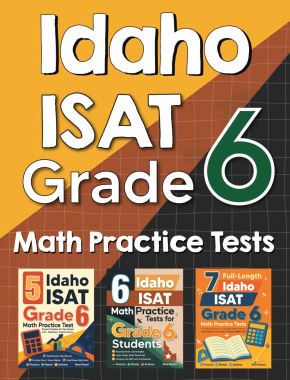
Working on Math Too? Try the Idaho ISAT Grade 6 Math Bundle
Many third graders are getting ready for the ISAT in both subjects. If your child also needs math practice that matches the same standards, this companion bundle is the shortest path, workbook, study guide, and full practice tests in one download.
Writing
- Argument Writing: Claim, Reasons, Evidence, [W.6.1] defend a position with reasons and quoted proof
- Informative and Explanatory Writing, [W.6.2] teach a reader something cleanly
- Narrative Writing, [W.6.3] hook, pacing, dialogue, sensory detail, real ending
- Clear Writing for Task, Purpose, and Audience, [W.6.4] match writing to the actual reader
- Planning, Revising, and Editing, [W.6.5] drafts in passes, not single shots
- Short Research Projects, [W.6.7] focused question, multiple sources, tidy report
- Gathering, Evaluating, and Citing Sources, [W.6.8] which sources to trust and how to credit them
Speaking & Listening
- Collaborative Discussions, [SL.6.1] show up prepared, listen, build on what was said
- Interpreting Diverse Media, [SL.6.2] what each format does well and what it skips
- Analyzing a Speaker’s Argument, [SL.6.3] find the claim, the reasons, the soft spots
- Presenting Claims and Findings, [SL.6.4] open with the point, walk the evidence, land the close
- Adapting Speech to Context, [SL.6.6] friend, classmate, teacher, principal, different talk for each
Grammar
- Pronoun Case: Subjective, Objective, and Possessive, [L.6.1a] I, me, my, and which belongs where
- Intensive Pronouns, [L.6.1b] myself, themselves, and the emphasis they bring
- Avoiding Shifts in Pronoun Number and Person, [L.6.1c] one person, one number, hold it
- Vague Pronouns and Unclear Antecedents, [L.6.1d] every pronoun gets a clear noun the reader can point at
- Recognizing and Improving Non-Standard English, [L.6.1e] when to keep your voice and when to switch into school English
Conventions: Punctuation, Spelling
- Punctuation: Commas, Parentheses, and Dashes, [L.6.2a] three ways to drop in extra information
- Spelling Grade-Appropriate Words, [L.6.2b] the homophones and trouble words sixth graders miss most
Knowledge of Language and Style
- Varying Sentence Patterns for Style, [L.6.3a] combine, expand, rearrange, anything but flat
- Consistency in Style and Tone, [L.6.3b] pick a register and hold it
Vocabulary and Word Study
- Using Context Clues, [L.6.4a] slow down at the strange word, read what is around it
- Greek and Latin Roots and Affixes, [L.6.4b] port, dict, tele, photo, and the doors they open
- Using Dictionaries and Thesauruses Effectively, [L.6.4c] match the tool to the question
- Verifying Word Meaning, [L.6.4d] check the guess instead of trusting it
- Figurative Language: Personification and More, [L.6.5a] the moves that bring writing alive
- Word Relationships: Cause-Effect, Part-Whole, Category, [L.6.5b] patterns that link words together
- Connotation: Shades of Meaning, [L.6.5c] thin, slender, scrawny, same idea, different feel
- Academic and Domain-Specific Vocabulary, [L.6.6] the words that travel across subjects and the words tied to one field
How to use these worksheets at home
The trick with sixth-grade reading practice is small windows that nobody fights. Twelve focused minutes before the dinner table gets cleared. A worksheet on a Sunday afternoon when the weather is wrong for going outside. The thirty minutes before a soccer practice that always starts late.
Pair the worksheet with the book your child is already reading. If they are working on a novel for English class, pull the literature worksheet that matches what the teacher is asking about, theme, character change, point of view. If they are working on a nonfiction article for social studies, pull the central idea or text structure page. The transfer between class reading and worksheet practice is fastest when they are working on the same skill in the same week.
Hand the answer key to your child after they finish, not before. Have them grade themselves. When they miss a question, ask them to read the explanation out loud and then re-read the original passage one more time. The two-pass approach is what makes the correction stick.
A note about ISAT ELA
The Idaho Standards Achievement Test for English Language Arts is administered in the spring, typically March through May. ISAT ELA runs on the Smarter Balanced platform, which means it is computer-adaptive, the difficulty of the items shifts based on how your sixth grader is answering. The test includes both adaptive items and a performance task, where students read a small set of related texts and then produce an extended written response that draws evidence from those texts.
Because the assessment is anchored in the Idaho Content Standards for English Language Arts, the worksheets your child completes during the year are the same skills the test will sample from. There is no separate “test prep” content. The work of doing well on ISAT ELA is the work of doing the standards consistently, week by week, with attention to evidence, organization, and revision.
Want everything in one bundle?
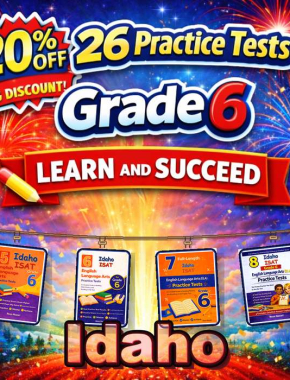
For families who want one consolidated resource instead of a long single-skill page, the Grade 6 ELA Preparation Bundle is the move. It gathers full-length practice tests with thorough answer explanations into a single package, useful in the weeks before ISAT when your sixth grader is ready to rehearse the whole assessment in one sitting.
Idaho Grade 6 ELA Preparation Bundle, four practice-test books, 26 unique full-length tests, complete answer keys with explanations.
A short closing
The pockets of reading that build a sixth grader are quiet ones, a worksheet on the kitchen table, a paperback in a backpack, a question read aloud and answered in pencil. Bookmark this page and pull a worksheet when one of those pockets opens up. The growth is real even when the moment feels small.
Best Bundle to Ace the Idaho ISAT Grade 6 ELA
Looking for the best resource to help your kid ace the Idaho ISAT? Try this bundle, four full practice-test books (5 + 6 + 7 + 8 tests) covering the same Grade 6 reading, writing, and language skills your child is already learning. Instant PDF download, answer keys included.

Related to This Article
More math articles
- Is Arbitrage Betting Legal in Australia?
- Online Baccarat vs. Land Baccarat: Where the Math Actually Diverges
- Fiscal Policy, Deficits, and Public Debt
- What Is the Highest Score for SHSAT Test?
- Understanding and Mastering Perpendicular Lines and How to Draw Them
- How to Distance Teach Math with a Drawing Pad?
- Grade 2 Math Practice for Arkansas Second Graders
- Social movements
- The Ultimate 6th Grade RICAS Math Course (+FREE Worksheets)
- Power Series Integration: Fundamentals, Step-by-Step Methods, and Applications






What people say about "Free Grade 6 English Worksheets for Idaho"?
No one replied yet.