How Long Is the ALEKS Placement Test? Time, Questions and Retakes

Quick answer: Most students finish the ALEKS PPL placement test in about 60 to 120 minutes. It asks up to about 30 adaptive, open-response questions. Your school sets how long the test stays open once you start (for example 2 hours, 2.5 hours, 3 hours or 24 hours), how many retakes you get (up to 5) and how many Prep and Learning Module hours come before each retake.
“How long is the ALEKS placement test?” has two honest answers: how long it usually takes to finish, and how long your school gives you before the session closes. ALEKS PPL (Placement, Preparation and Learning) is run by McGraw Hill, but each college sets its own time window, number of attempts, waiting periods and required study hours. This post puts those numbers side by side, as published in October 2026, and turns them into a plan for your first attempt and any retakes.
ALEKS placement test length at a glance
| Question | Typical answer | Who decides |
|---|---|---|
| How many questions? | Up to about 30, adaptive and open-response | ALEKS (the number varies by student) |
| How long does it usually take? | About 60 to 120 minutes | Your pace |
| How long is the session open? | From about 2 hours to 24 hours, or untimed with resume | Your school |
| How many attempts? | Up to 5 in total; some schools allow fewer | Your school |
| Wait between attempts | Often 24 to 72 hours | Your school |
| Study before a retake | Required hours in the Prep and Learning Module, often 3 to 5 | Your school |
| Calculator | Only the ALEKS on-screen calculator, when a question provides it | ALEKS |
| Score | 0 to 100 | ALEKS; the course cut scores come from your school |
How many questions are on the ALEKS placement test?
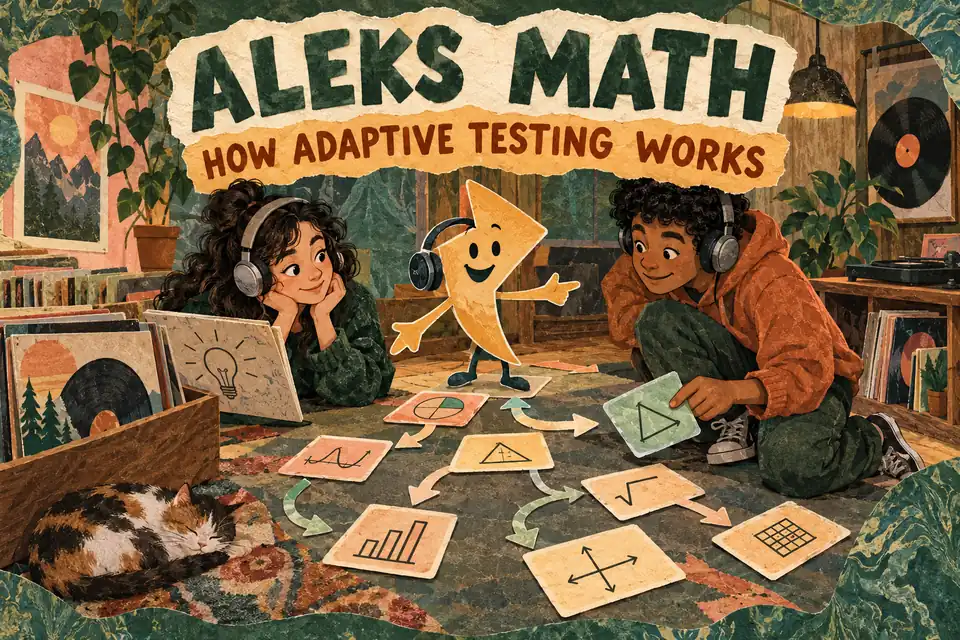
ALEKS does not give everyone the same test. Each answer decides the next question, and the test stops once ALEKS has a clear picture of what you know. McGraw Hill’s ALEKS PPL product page says the open-response Placement Assessment measures knowledge across 314 topics “in 25 questions or less,” while many college pages built from ALEKS’s student guidance (for example Lehigh University’s 2026 ALEKS FAQ) say “up to 30 questions.” Either way, expect roughly two to three dozen problems, and do not worry if your count differs from a friend’s.
Two features change how you should spend your time. First, answers are typed in (no answer choices), so you work each problem on paper. Second, there is an “I don’t know” button. Several school guides note there is no penalty for a wrong answer, and that “I don’t know” is the right choice only for material you have never learned, because ALEKS reads it as not knowing that topic. Before the first question, ALEKS also runs a short tutorial on its answer tools; schools such as Colorado Mesa University note that the tutorial does not affect your result. If you want to know which topics those 314 cover, see what is on the ALEKS math placement test.
Is the ALEKS placement test timed?
Mostly no, in the sense that there is no countdown per question. But almost every school puts a limit on how long a started assessment stays open, and if that window closes before you finish, you usually have to start over. Here is how a few schools describe it on their own pages:
| School (as published) | Window once you start | Attempts | Wait between attempts | Module work before a retake |
|---|---|---|---|---|
| University of Pittsburgh | 24 hours | 3 within 12 months | 24 hours | At least 5 hours |
| Lehigh University | Up to 2.5 hours | 5 | 48 hours | At least 3 hours |
| Colorado Mesa University | 2 hours | 5 | 24 hours | A set amount of time |
| Simpson College | Not timed; you can exit and resume | 5 | 48 hours | 3, 3, 5, then 8 hours |
| University of Illinois Chicago | One sitting, about 1.5 to 2 hours | 5 (1 plus 4 retakes) | 72 hours after module work | 5 hours |
| Santa Fe College | 3 hours total | See school | See school | See school |
The pattern is clear: the same ALEKS test can come with a 2-hour window at one school and a 24-hour window at another. Your school’s math department or testing center page is the only place that tells you your numbers, and those rules can change from one year to the next.
Can you retake the ALEKS placement test?
Yes, at nearly every school. McGraw Hill describes ALEKS PPL as including “up to five assessment attempts” plus access to a personalized learning module, and schools then choose how many of those attempts to allow and what comes between them. The usual sequence looks like this:
- Initial Placement Assessment. Your first attempt sets your starting score.
- Prep and Learning Module. ALEKS builds a module from the topics you missed. Some schools say you cannot switch to a different module later, and that the access clock (often 6 or 12 months) starts when you select start.
- Required module time. Your school sets the hours you must log before the next attempt opens. In the module, periodic Knowledge Checks send topics you have not truly mastered back for more review.
- Waiting period. Typically 24 to 72 hours between attempts.
- Next Placement Assessment. Schools such as Pitt and Lehigh use your highest score for placement.
One rule surprises a lot of students: progress in the module does not change your placement by itself. Pitt and the University of Georgia both say only a new Placement Assessment can change your result. Some schools also set a last date for retakes, such as the first week of the term at UIC.
Calculator, notes and proctoring
ALEKS shows an on-screen calculator only on questions where it decides one is needed. Personal calculators, notes, websites and help from other people are not allowed. Most schools let you test unproctored at home under an honor code, but some add monitoring. ALEKS’s own guide to Respondus tools for PPL explains that schools can require Respondus LockDown Browser, which blocks other apps and websites, and Respondus Monitor, which records you by webcam, for any of the five attempts. Others ask you to test in person at a testing center. Find out which applies before you start, because LockDown Browser has to be installed in advance.
How ALEKS scores turn into placement
Your result is a number from 0 to 100, which school guides describe as the percentage of placement topics ALEKS believes you have mastered. Your school decides which score places you in which course. Pitt, for example, lists 61 for several entry courses and 76 for Math 0220, and Simpson lists 76 or higher for MATH 151. Scores also expire on school-set timelines (12 months at Simpson, three semesters at UGA). Our guide to what a good ALEKS score is explains how to read those ranges, and our ALEKS placement review and FAQs covers practical questions such as devices and what happens if your browser crashes.
What this means for you: a timing plan
Before you start, write down five numbers from your school’s page: the session window, the number of attempts, the wait between attempts, the module hours required before a retake, and the cut score for the course you want. Then plan around them.
Before your first attempt
- Take a short, untimed check of your skills, such as our 10-minute ALEKS math diagnostic, to see which topics need work.
- Spend most of your review on algebra: linear equations and inequalities, lines and slope, exponents, factoring, quadratics and functions. That is where most placement topics sit for students aiming at college algebra or precalculus.
- Practice without a calculator. Fractions, negative numbers and simplifying expressions by hand come up often.
- Block out a quiet two-hour period even if your window is longer, with paper and a pencil ready.
Between attempts: a worked example
Say your target course needs 61, you score 54 on the first attempt, and your school requires 5 module hours and a 24-hour wait. Rather than rushing through the 5 hours in one evening, spread them over five days at about an hour a day, and add 20 minutes of paper practice on the topics the module keeps returning to you. Retake on day 6 or 7, when the material is fresh but not crammed. If your school allows several attempts, treat each one as a checkpoint after real study, not a quick second try. The extra practice tests and topic quizzes in our ALEKS math center work well alongside the module.
Finally, if you are close to a cut score and your school allows a retake, that retake is usually worth it. A few more points can mean starting in the course you actually need instead of a prerequisite.
Practice Quiz: 10 ALEKS Placement Math Questions
Answer each question and press Submit to see your result right away.
Answer each question and press Submit to see your result right away.
Frequently Asked Questions
Can you fail the ALEKS placement test?
No. ALEKS PPL is a placement test, not a pass or fail exam. Your score from 0 to 100 decides which math course you can start in. A lower score places you in an earlier course, and most schools let you study in the Prep and Learning Module and retake the assessment to try for a higher placement.
What happens if I run out of time on the ALEKS placement test?
If your school's session window closes before you finish, schools such as Pitt and Colorado Mesa say you have to restart the assessment. Some schools let you log out and resume within the window. Check your school's rules before starting, and leave more time than you think you need.
Does working in the ALEKS Prep and Learning Module raise my score?
Not directly. Module progress does not change your placement. Only a new Placement Assessment can do that. The module matters because it reviews the topics you missed and because most schools require a set number of module hours before your next attempt opens.
Can I use my own calculator on ALEKS?
No. ALEKS provides an on-screen calculator only on questions where it decides one is needed. Personal calculators, phone apps, notes and websites are not allowed, so practice arithmetic, fractions and algebra by hand before your attempt.
How many times can you take the ALEKS placement test?
ALEKS PPL allows up to five Placement Assessments, but each school decides how many of those students may use. Some allow all five, while others allow three. Schools also set the waiting time between attempts, often 24 to 72 hours, and the module hours required before each retake.
Is the ALEKS placement test hard?
It can feel hard because it is adaptive. ALEKS keeps raising the level until it finds where your knowledge ends, so most students see questions they cannot answer. That is expected and does not mean you did badly. Your score reflects the share of topics you have mastered.
Sources
- McGraw Hill: ALEKS PPL product page
- ALEKS: PPL and Respondus LockDown Browser / Monitor FAQ
- ALEKS Higher Education Math Placement topic list (314 topics)
- Lehigh University ALEKS FAQ 2026
- University of Pittsburgh: ALEKS Math Placement Assessment
- Colorado Mesa University ALEKS FAQ 2024
- Simpson College ALEKS Placement Guidance 2024
- University of Illinois Chicago: ALEKS FAQ
- University of Georgia: ALEKS Placement FAQ
- Santa Fe College: How long does the placement assessment take?

Related to This Article
More math articles
- Conclusions: What the Evidence Allows
- ASVAB Math Formulas
- Rounding Rally: Simplifying Decimals to the Nearest Whole
- Inspectors general
- How to Find Domain and Range of a Function?
- Top 10 CLEP College Mathematics Practice Questions
- Multiplying 2-Digit by 2-Digit Numbers for 4th Grade
- FREE 6th Grade MEAP Math Practice Test
- ATI TEAS 7 Math-Test Day Tips
- Competing interpretations of equality and freedom












What people say about "How Long Is the ALEKS Placement Test? Time & Retakes"?
No one replied yet.