Entry eliminates long-run economic profit
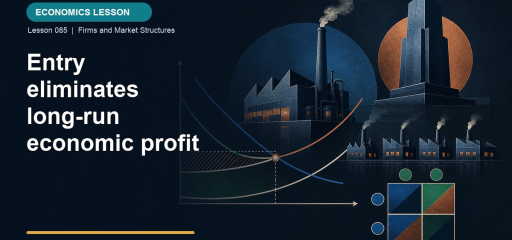
Entry eliminates long-run economic profit: this Effortless Math guide explains the topic in plain language, shows how it works through solved examples, and gives you free practice to try immediately, so the idea sticks instead of staying abstract.
New substitutes shift each incumbent’s demand left.
A differentiated café earns positive economic profit. Similar cafés enter and shift its demand left. Entry stops when
- demand is tangent to ATC at zero economic profit
- price equals marginal cost at the efficient output
- each firm produces at minimum average total cost
- rival products become perfect substitutes
- selling costs and advertising fall to zero
demand is tangent to ATC at zero economic profit Entry shifts each incumbent’s demand left until it is tangent to ATC, leaving zero economic profit.
Positive economic profit in monopolistic competition will normally cause
- entry, reducing each incumbent’s demand
- exit and a rightward shift of incumbent demand
- the government to set price equal to marginal cost
- each incumbent’s marginal cost to become horizontal
- products to become identical
entry, reducing each incumbent’s demand Entry adds substitutes and divides the market, shifting each incumbent’s demand left until economic profit disappears.
In long-run equilibrium, a monopolistically competitive firm typically has
- positive economic profit and minimum ATC
- negative economic profit and excess capacity
- price equal to marginal cost
- a horizontal demand curve
- zero economic profit but price above marginal cost
zero economic profit but price above marginal cost Entry eliminates economic profit, but differentiation leaves the firm on a downward-sloping demand curve where price exceeds marginal cost.
Watch the idea in action
A focused video lesson from Khan Academy.
Profit attracts entrants with differentiated alternatives. Each incumbent loses some customers at every price until its demand curve is tangent to ATC. At tangency, P=ATC, so economic profit is zero. The firm still chooses where MR=MC and still faces downward-sloping demand.
Entry does not copy the product perfectly. It adds close substitutes. An incumbent’s demand shifts left because fewer buyers choose it at each price and often becomes more elastic because alternatives increase. The process stops when no excess return remains after explicit and implicit costs.
Tangency means demand touches ATC at the chosen output without crossing it. If demand lay above ATC, profit would remain and entry continue. If it lay below ATC, loss would induce exit. MR=MC still selects the tangency quantity. P=ATC measures zero economic profit.
Loss causes exit, shifting the remaining firms’ demand right until normal profit returns. Entry and exit affect each firm’s demand, not merely the market supply curve used in perfect competition.
| Initial result | Long-run response | Incumbent demand |
|---|---|---|
| Positive economic profit | Entry of differentiated rivals | Shifts left, usually more elastic |
| Economic loss | Exit of some rivals | Shifts right |
| Zero economic profit | No entry or exit | Tangent to ATC at chosen output |
Long-run tangency
A profitable fitness studio attracts yoga, cycling, and training studios. The original studio’s demand shifts left and becomes more elastic. Long-run equilibrium occurs where its demand is tangent to ATC, covering economic cost but leaving no excess profit.
Zero economic profit still includes normal return, owner labor, and opportunity cost. Studios remain open because resources earn as much as in their next-best use. Entry stops from lack of excess return, not because revenue or accounting profit is zero.
Perfect competition handles entry differently: market supply shifts right while one firm’s horizontal demand line moves down with market price. In monopolistic competition, each firm has its own downward-sloping demand and new substitutes shift it left. Both reach zero economic profit, but the graph route and efficiency endpoint differ.
If barriers prevent entry, the model no longer guarantees zero long-run profit. “Many differentiated firms” must be paired with relatively easy entry. A licensing cap can preserve profit and move the setting toward oligopoly or regulated competition.
The exact number of firms is not determined by the basic graph. Market demand and each firm’s scale influence it. The key endpoint is tangency with no entry or exit incentive.
Long-run tangency occurs on the downward-sloping portion of the firm’s demand curve. It does not mean demand and ATC have equal slopes everywhere or that the firm produces at minimum ATC. The chosen point must also satisfy MR=MC.
If a license or other barrier prevents new differentiated sellers, profit need not disappear. The zero-profit prediction rests on relatively easy entry. Always verify that condition before carrying the standard long-run result into the stem.
Loss and exit form the mirror process: fewer substitutes shift the surviving firm’s demand right until it is tangent to ATC. The incumbent’s cost curve need not move. The adjustment comes through the number of differentiated alternatives available to buyers.

Reza is an experienced Math instructor and a test-prep expert who has been tutoring students since 2008. He has helped many students raise their standardized test scores--and attend the colleges of their dreams. He works with students individually and in group settings, he tutors both live and online Math courses and the Math portion of standardized tests. He provides an individualized custom learning plan and the personalized attention that makes a difference in how students view math.
Related to This Article
More math articles
- 10 Most Common 8th Grade SBAC Math Questions
- Top 10 Tips to Overcome CLEP College Math Anxiety
- FREE OAR Math Practice Test
- Ranking Craps Bets From Lowest House Edge to Worst
- Factor markets and policy compare private with social value
- Grade 3 Math: Understanding Fractions
- Free Grade 7 English Worksheets for Georgia Students
- 3rd Grade OST Math Worksheets: FREE & Printable
- The Best Algebra 1 Book for Mississippi Students
- Grade 3 Math: Word Problems: Addition and Subtraction






















What people say about "Entry Eliminates Long-Run Economic Profit"?
No one replied yet.