Colorado CMAS Grade 8 Math Free Worksheets: Printable Grade 8 Math Practice with Full Solutions

If you have a Colorado eighth grader, you may have noticed the math homework getting quieter and more thoughtful, more pausing, more crossing out, more “wait, let me think.” That is the year doing its job. Eighth grade is when arithmetic becomes algebra. The student who used to land on a single answer now has to handle the structure underneath it: slope as a rate of change, a function as a rule that gives each input exactly one output, an equation that might have one solution, no solution, or infinitely many. It is a real change in how a kid has to think.
Geometry climbs the same slope. This is the year of the Pythagorean theorem, used to find a missing length or the distance between two points on the plane. It is the year of transformations, sliding and flipping and turning figures on the coordinate grid, and the year students take on the volume of cylinders, cones, and spheres. Beneath it all runs a new familiarity with the real number system: irrational numbers, scientific notation, and the laws of exponents.
These worksheets were built for that part of the year. Whether your student is in Denver, Colorado Springs, Aurora, or Boulder, each PDF gives them one clear skill at a time, with enough practice to make it hold.
What’s on this page
Seventy-two single-skill PDFs, each aligned to the Colorado Mathematics Standards for Grade 8. Every file stays on one skill and nothing else, so a student working through systems of equations is not also fighting with scientific notation, and a student on volume is not getting pulled sideways into scatter plots.
Each PDF opens with a one-page Quick Review that explains the skill in plain language, paired with a fully worked example. Twenty practice problems follow, building from straightforward to genuinely challenging, plus four word problems that set the skill in a real context. The final page is a student-facing answer key, not just answers, but short, friendly explanations a student can read alone and actually learn from.
Real Numbers
- Rational and Irrational Numbers, [8.1, 8.NS.A, 8.NS.A.1] tell a fraction-able number from one whose decimal never repeats
- Turning Repeating Decimals into Fractions, [8.NS.A, 8.NS.A.1] the algebra trick that turns 0.272727.. Into a clean fraction
- Estimating Irrational Numbers, [8.NS.A, 8.NS.A.2] pin a root like √20 between two whole numbers, then closer
- Estimating Expressions with Irrational Numbers, [8.2, 8.NS.A, 8.NS.A.2] approximate whole expressions that mix roots and π
- Personal Financial Literacy, [8.PFL.1] real-money math: budgets, balances, and simple percent work
- Prime Factorization with Exponents, [8.NS.1] break a number all the way down and write it with exponents
- Density of Real Numbers, [8.NS.1] there is always another number between any two, find it
Exponents, Roots & Scientific Notation
- Properties of Integer Exponents, [8.EE.A, 8.EE.A.1] product, quotient, power, zero, and negative-exponent rules
- Square Roots and Cube Roots, [8.EE.A, 8.EE.A.2] undo a square or a cube, including the ± on x² equations
- Understanding Scientific Notation, [8.EE.A, 8.EE.A.3] move the decimal the right way for huge and tiny numbers
- Operations with Scientific Notation, [8.EE.A, 8.EE.A.4] multiply, divide, add, and subtract without losing the exponent
- Order of Operations with Radicals, [8.EE.2] where the radical bar fits in PEMDAS. It groups like parentheses
Linear Equations and Inequalities
- Graphing Proportional Relationships, [8.EE.B, 8.EE.B.5] read the unit rate straight off a proportional graph
- Slope as a Rate of Change, [8.EE.B, 8.EE.B.5] slope is just rise over run, a real-world rate
- Slope and the Equations of a Line, [8.EE.B, 8.EE.B.6] build y = mx + b from a slope and a point
- Solving Linear Equations in One Variable, [8.EE.C, 8.EE.C.7] multi-step solving: distribute, combine, isolate
- Solving Systems of Two Equations, [8.EE.C, 8.EE.C.7, 8.EE.C.8] find the point two lines share by substitution or elimination
- Solving Real Problems with Systems, [8.G.C, 8.G.C.9] turn a word problem into two equations and solve it
- Solving Linear Inequalities, [8.EE.7] solve like an equation, but flip the sign when you divide by a negative
- Multiplying Linear Expressions and Factoring, [8.EE.1] distribute to expand, pull out a common factor to undo it
- Graphing Linear Inequalities in Two Variables, [8.EE.8] boundary line, solid or dashed, then shade the right side
- Parallel and Perpendicular Lines, [8.EE.6] equal slopes for parallel, negative reciprocals for perpendicular
- Point-Slope and Standard Form, [8.EE.6] two more ways to write a line, and when each one helps
- Literal Equations, [8.EE.7] solve a formula for a different letter
- Absolute Value Equations and Inequalities, [8.EE.7] split into two cases, and read ‘and’ vs ‘or’ correctly
- Equations with Special Solutions, [8.EE.7] spot ‘no solution’ and ‘all real numbers’ before you waste time
Functions and Sequences
- What Is a Function?, [8.F.A, 8.F.A.1] every input gets exactly one output, and how to check
- Reading Function Values, [8.F.A, 8.F.A.1] evaluate f(x) and read values from tables and graphs
- Comparing Two Functions, [8.F.A, 8.F.A.2] compare functions given as equations, tables, and graphs
- Linear vs. Nonlinear Functions, [8.F.A, 8.F.A.3] constant rate of change means linear, everything else does not
- Building Linear Functions, [8.F.B, 8.F.B.4] write the function from a description, a table, or two points
- Sketching and Describing Function Graphs, [8.F.B, 8.F.B.5] match a graph’s shape to a story: increasing, flat, falling
- Domain and Range of a Function, [8.F.1] the inputs you may use and the outputs you get back
- Arithmetic Sequences, [8.F.4] add the same step each time, and find the nth term
- Geometric Sequences, [8.F.4] multiply by the same ratio each time, and find the nth term
Geometry
- Rotations, Reflections, and Translations, [8.G.A, 8.G.A.1] the three rigid motions and what each does to a figure
- Congruent Figures, [8.G.A, 8.G.A.2] same size and shape, and the moves that prove it
- Transformations on the Coordinate Plane, [8.G.A, 8.G.A.3] apply transformation rules to coordinates
- Similarity and Dilations, [8.G.A, 8.G.A.4] scale a figure up or down and keep its shape
- Angles in Triangles and Parallel Lines, [8.G.A.5] the angle sum and the parallel-line angle pairs
- Pythagorean Theorem, [8.G.B, 8.G.B.6, 8.G.B.7] a² + b² = c² for any right triangle
- Distance with the Pythagorean Theorem, [8.4, 8.G.B, 8.G.B.8] find the distance between two points on the plane
- Volume of Cylinders, Cones, and Spheres, [8.G.C, 8.G.C.9] the three curved-solid volume formulas, side by side
- Angle Relationships, [8.G.B, 8.G.B.7] complementary, supplementary, vertical, and adjacent angles
- Surface Area of Prisms, Cylinders, and Pyramids, [8.G.9] add up every face, nets make it visible
- Volume of Pyramids, [8.G.9] one-third of the matching prism
- Composite Figures: Area and Perimeter, [8.G.9] break an odd shape into shapes you already know
- Interior Angles of Polygons, [8.G.A.5] the (n − 2) × 180° rule for any polygon
- Triangle Inequality Theorem, [8.G.5] which three lengths can actually close into a triangle
- Surface Area of Spheres, [8.G.9] the 4πr² formula and where it shows up
- Arc Length and Area of Sectors, [8.G.9] a slice of a circle. Its curved edge and its area
- Cross Sections of 3D Figures, [8.G.9] the 2D shape you get when you slice a solid
- Parallel Lines and Transversals, [8.G.A.5] name and use every angle pair a transversal creates
- Applying the Pythagorean Theorem, [8.G.7] real-world right-triangle problems: ladders, ramps, diagonals
- Volume of Cones and Spheres, [8.G.C, 8.G.C.9] focused practice on the two trickiest volume formulas
Statistics and Probability
- Scatter Plots, [8.SP.A, 8.SP.A.1] read clustering, outliers, and the direction of a trend
- Fitting a Line to Data, [8.SP.A, 8.SP.A.2] draw a trend line and find its slope and intercept
- Using a Linear Model, [8.SP.A, 8.SP.A.3] use the trend line to predict and to interpret slope
- Two-Way Tables, [8.SP.A, 8.SP.A.4] organize categorical data and read relative frequencies
- Mean Absolute Deviation, [8.SP.4] measure how spread out a data set really is
- Probability: Simple and Compound, [8.SP.4] single-event probability and combining events
- Counting Principle and Permutations, [8.SP.4] count outcomes by multiplying, and when order matters
- Box Plots and IQR, [8.SP.4] the five-number summary, the box, and the spread of the middle
- Random Sampling, [8.SP.4] why a fair sample beats a biased one, and how to scale up
- Effect of Data Changes, [8.3] what adding or scaling values does to mean, median, and range
- Probability of Compound Events, [8.SP.4] and/or events, with and without replacement
Financial Literacy
- Simple Interest, [8.PFL.1] I = Prt, interest that grows on the original amount only
- Compound Interest, [8.PFL.2] interest that earns interest, period after period
- Percents: Tax, Discount, and Markup, [8.PFL.3] the everyday percent problems behind every receipt
- Cost of Credit and Loans, [8.PFL.4] what borrowing really costs once interest is counted
- Payment Methods, [8.PFL.5] cash, debit, credit, and checks, the math and the trade-offs
- Saving for College, [8.PFL.6] set a goal, plan a monthly amount, and let growth help
How to use these worksheets at home
You do not need a plan that runs the length of the school year. A steady weekly rhythm beats a weekend cram every time. Pick two afternoons, maybe one mid-week after school and one on a slow Sunday, and treat each PDF as a single sitting. Most take fifteen to twenty minutes, short enough that a tired eighth grader will actually do it.
A pairing that works well: do a skill, then do the skill that builds on it. Run Solving Linear Equations in One Variable one day and Solving Systems of Two Equations the next, and the second worksheet feels like a step rather than a leap. The same goes for Rotations, Reflections, and Translations before Transformations on the Coordinate Plane, or Pythagorean Theorem before Applying the Pythagorean Theorem. Each pair lets the harder skill rest on something already understood.
Colorado families do homework wherever the day lands them, a kitchen table in Denver, a cabin afternoon in the mountains west of Boulder, the quiet hour before dinner in Colorado Springs. Print what you need the night before, keep the answer key for after the work is done, and let the student check their own thinking. That last step, actually reading the explanations, is where most of the learning happens.
A note about CMAS at Grade 8
Colorado students take the Colorado Measures of Academic Success, Mathematics, known as CMAS, in the spring. It is built on the Colorado Mathematics Standards, so the skills on these worksheets and the skills on the test come from the same source.
The Grade 8 CMAS asks students to do more than compute. It asks them to interpret a graph, set up an equation from a word problem, reason about a geometric figure, and decide which of several approaches actually fits the question in front of them. It leans hard on the algebra-and-functions strand that defines eighth-grade math, so a student who is comfortable with functions, slope, and linear equations is well positioned walking in.
Because every PDF here targets one Colorado standard, you can use the run-up to the spring window as a checklist. If your student is shaky on functions or on the Pythagorean theorem, you can see it clearly and work just those PDFs, rather than re-reviewing things they already have down.
A short closing
Eighth-grade math is a climb, but it is a steady one, a student gets there one skill, one afternoon at a time. Bookmark this page, print a single PDF tonight, and let your student start somewhere small. Colorado kids do hard things well when the next step is clear, and a worksheet on the table is about as clear as it gets.
Best Bundle to Ace the Colorado CMAS Grade 8 Math Test
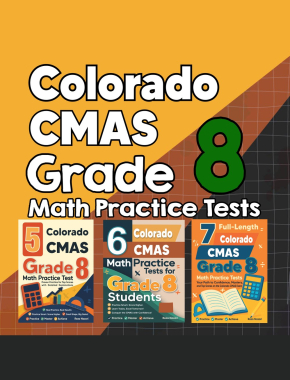
Want the fastest path through Colorado CMAS Grade 8 math? This bundle pulls it together, four full practice-test books with complete, step-by-step answer keys, instant PDF download.

Related to This Article
More math articles
- 5th Grade PEAKS Math Worksheets: FREE & Printable
- Top 10 Tips to Overcome ACT Math Anxiety
- What Kind of Math Is on the Computer Science?
- The Best Grade 4 Math Book for Ohio Students
- How to Apply a Mathematical Approach to Essay Writing
- Idaho ISAT Grade 6 Math Free Worksheets: 72 Free PDF Worksheets, One Skill at a Time
- How Math Skills Give Players a Competitive Edge in Various Online Games
- How to Graph Triangles and Quadrilaterals?
- A Comprehensive Collection of Free Praxis Math Practice Tests
- The Best Grade 8 Math Book for Pennsylvania Students








What people say about "Colorado CMAS Grade 8 Math: Free Worksheets"?
No one replied yet.