Free Grade 6 English Worksheets for California Students
If you have ever opened the California Common Core State Standards for English Language Arts at Grade 6, you know they are not a casual document. The strand codes, the subdivisions, the careful verbs, analyze, integrate, delineate, read like a contract. They are precise on purpose. They describe what a California sixth grader is supposed to be able to do by the end of the year, and they are the foundation for everything from district pacing guides to spring assessments.
The trouble is that the standards do not explain themselves to families. A parent reading RL.6.3 about how a story’s plot unfolds in a series of episodes and how the characters respond is not necessarily going to know what that looks like on a Wednesday-night homework page. That gap, between the standard and the practice, is what these worksheets are for.
Each PDF below targets a single Grade 6 standard from the California Common Core. The Quick Review on page one explains the skill in plain language. The practice items run at grade level. The answer key explains reasoning, not just answers. Everything is free and printable. No login. No email collection.
What’s on this page
Forty-six single-skill worksheets, grouped by what they actually do. The intent is not to replace the curriculum your sixth grader’s teacher is delivering. It is to give California families a clean, predictable place to go when the homework hits a snag and the lesson at school happened a week ago.
Single skills, in small doses, repeated across the year. That is the sentence behind every page on this list.
Reading: Literature
- Citing Textual Evidence and Drawing Inferences, [RL.6.1] RL.6.1: state the inference, then anchor it to the exact line that proves it
- Theme and Objective Summary, [RL.6.2] RL.6.2: the lesson the whole text teaches, written as a real sentence
- Plot, Episodes, and Character Change, [RL.6.3] RL.6.3: track how episodes push characters toward change
- Figurative Language, Connotation, and Tone, [RL.6.4] RL.6.4: word choices that build feeling and tone
- Structure: How a Scene or Stanza Builds the Whole, [RL.6.5] RL.6.5: the job each section does in the larger text
- Developing the Narrator’s Point of View, [RL.6.6] RL.6.6: how an author crafts a perspective
- Reading vs. Watching: Comparing Versions, [RL.6.7] RL.6.7: what each medium delivers that the others cannot
- Comparing Stories Across Forms and Genres, [RL.6.9] RL.6.9: similar themes in different forms
Reading: Informational Text
- Citing Evidence and Drawing Inferences in Nonfiction, [RI.6.1] RI.6.1: careful conclusions, sentence-anchored
- Central Idea and Objective Summary in Nonfiction, [RI.6.2] RI.6.2: the whole article’s main point, not a single detail
- How Ideas and Events Are Developed, [RI.6.3] RI.6.3: introduce, elaborate, illustrate, compare
- Word Meaning in Nonfiction: Figurative, Connotative, Technical, [RI.6.4] RI.6.4: three jobs a word can hold
- Text Structure: How Sections Fit Together, [RI.6.5] RI.6.5: cause, effect, problem, solution, comparison
- Author’s Point of View and Purpose, [RI.6.6] RI.6.6: angle and motive
- Integrating Information from Text, Visuals, and Data, [RI.6.7] RI.6.7: combine the words, the chart, the photo
- Evaluating Arguments and Claims, [RI.6.8] RI.6.8: distinguish claim from support and judge the support
- Comparing Two Authors on the Same Topic, [RI.6.9] RI.6.9: same subject, different choices
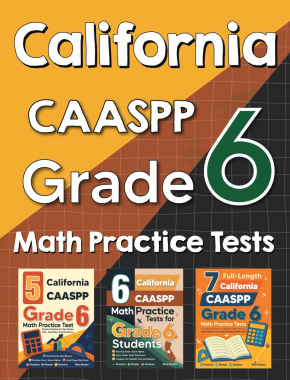
Working on Math Too? Try the California CAASPP Grade 6 Math Bundle
Many third graders are getting ready for the CAASPP in both subjects. If your child also needs math practice that matches the same standards, this companion bundle is the shortest path, workbook, study guide, and full practice tests in one download.
Writing
- Argument Writing: Claim, Reasons, Evidence, [W.6.1] W.6.1: defend a debatable position with reasons and quotes
- Informative and Explanatory Writing, [W.6.2] W.6.2: teach a reader using facts, transitions, and clear order
- Narrative Writing, [W.6.3] W.6.3: hook, develop, resolve
- Clear Writing for Task, Purpose, and Audience, [W.6.4] W.6.4: match the writing to who is reading
- Planning, Revising, and Editing, [W.6.5] W.6.5: drafts get better in passes
- Short Research Projects, [W.6.7] W.6.7: focused question, multiple sources, clean write-up
- Gathering, Evaluating, and Citing Sources, [W.6.8] W.6.8: credible sources, properly credited
Speaking & Listening
- Collaborative Discussions, [SL.6.1] SL.6.1: prepared, attentive, additive
- Interpreting Diverse Media, [SL.6.2] SL.6.2: strengths and limits of each format
- Analyzing a Speaker’s Argument, [SL.6.3] SL.6.3: claim, reasons, gaps
- Presenting Claims and Findings, [SL.6.4] SL.6.4: preview the structure, walk the evidence, close cleanly
- Adapting Speech to Context, [SL.6.6] SL.6.6: formal and informal English on demand
Grammar
- Pronoun Case: Subjective, Objective, and Possessive, [L.6.1a] L.6.1a: I, me, my and the rules behind them
- Intensive Pronouns, [L.6.1b] L.6.1b: myself, themselves, for emphasis
- Avoiding Shifts in Pronoun Number and Person, [L.6.1c] L.6.1c: hold the person and number through the paragraph
- Vague Pronouns and Unclear Antecedents, [L.6.1d] L.6.1d: every pronoun needs a clear noun
- Recognizing and Improving Non-Standard English, [L.6.1e] L.6.1e: switching into school English on demand
Conventions: Punctuation, Spelling
- Punctuation: Commas, Parentheses, and Dashes, [L.6.2a] L.6.2a: three ways to drop in extra information
- Spelling Grade-Appropriate Words, [L.6.2b] L.6.2b: homophones and the words sixth graders miss most
Knowledge of Language and Style
- Varying Sentence Patterns for Style, [L.6.3a] L.6.3a: combine, expand, rearrange
- Consistency in Style and Tone, [L.6.3b] L.6.3b: pick a register, hold it
Vocabulary and Word Study
- Using Context Clues, [L.6.4a] L.6.4a: definitions, examples, contrasts nearby
- Greek and Latin Roots and Affixes, [L.6.4b] L.6.4b: root pieces that unlock hundreds of words
- Using Dictionaries and Thesauruses Effectively, [L.6.4c] L.6.4c: match the reference tool to the actual question
- Verifying Word Meaning, [L.6.4d] L.6.4d: check the guess, don’t trust it
- Figurative Language: Personification and More, [L.6.5a] L.6.5a: language moves writers use on purpose
- Word Relationships: Cause-Effect, Part-Whole, Category, [L.6.5b] L.6.5b: predictable patterns linking words
- Connotation: Shades of Meaning, [L.6.5c] L.6.5c: shades between near-synonyms
- Academic and Domain-Specific Vocabulary, [L.6.6] L.6.6: high-utility academic words plus subject-specific ones
How to use these worksheets at home
California families practice in fragments. A sixth grader has band, soccer, the school musical, a math project that quietly grew into a four-day commitment, and a tutoring session twice a week. The reading-practice window is not an hour. It is fifteen minutes between the end of dinner and the start of whatever else is on the calendar.
Build the routine around that reality. Pick one worksheet. Sit down. Set a timer if it helps. Twelve minutes of focused work on a single skill beats sixty minutes of half-attention on a packet. When the timer ends, you stop, even if the page is not finished. The point is the consistency, not the completion.
Read the answer key explanations together. Out loud. Even with a kid who would rather not. The act of reading the reasoning aloud is where the skill cements. The next night, do not redo the same worksheet, pick a different one from a different section. Spacing is more powerful than drilling.
If a particular standard keeps showing up on a graded assignment as a weak spot, do not just print more of the same worksheet. Print one, work through it slowly, and wait three or four days before printing the next one in that group. The pause is when memory actually consolidates.
A note about CAASPP Smarter Balanced ELA
The California Assessment of Student Performance and Progress, CAASPP, uses the Smarter Balanced ELA test at Grade 6, aligned to the California Common Core State Standards. Students work through reading sections that mix literary and informational passages, a listening section, a research section, and a performance task that includes extended writing. The test is computer-adaptive, which means the questions adjust to the student’s responses as they go.
What CAASPP rewards is the same set of moves these worksheets train: pulling evidence to support an answer, identifying central ideas, working out word meaning in context, judging the strength of an argument, and writing organized responses that cite the texts. Year-round practice on the standards is the most reliable test preparation a family can offer.
Want everything in one bundle?
Some California families want a single consolidated resource rather than a long page of worksheets. The state’s Grade 6 ELA Preparation Bundle is built for that, with full-length practice tests, complete answer keys, and the same standards alignment as the worksheets here.
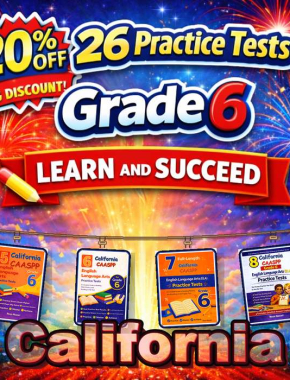
California Grade 6 ELA Preparation Bundle, four practice-test books, 26 unique full-length tests, complete answer keys with explanations.
Common questions from California families
Are these aligned to the California Common Core? Yes. Every PDF targets a specific Grade 6 standard from the California Common Core State Standards for English Language Arts, and the standard codes are listed inline next to each worksheet title above.
My child’s school uses a specific curriculum, do these conflict with it? They should not. The worksheets are skill-based, not curriculum-based, which means they sit alongside whatever the school is using and target the same underlying standards.
My child is an English Learner, are these useful? They can be. The Quick Review section at the start of each PDF is written in plain, level-controlled language, and the vocabulary worksheets in particular tend to be strong support for ELs working through grade-level content.
Do these work for after-school tutoring? Yes. Many California tutors use single-skill worksheets as the diagnostic and practice piece of a session, then use the answer key as the basis for the teaching conversation.
A short closing
Print one worksheet tonight. That is the only ask. Sixth grade is long, the standards are dense, and the only practice that matters is the practice that actually happens. Come back when you need the next one.
Best Bundle to Ace the California CAASPP Grade 6 ELA
Looking for the best resource to help your kid ace the California CAASPP? Try this bundle, four full practice-test books (5 + 6 + 7 + 8 tests) covering the same Grade 6 reading, writing, and language skills your child is already learning. Instant PDF download, answer keys included.

Related to This Article
More math articles
- Free Grade 5 English Worksheets for SBAC Students
- The Ultimate Middle School Math Course (+FREE Worksheets)
- How to Determine Limits Using Algebraic Manipulation?
- Right to petition
- Is a Calculator Allowed on the CBEST Test?
- Macroeconomic Equilibrium, Gaps, and Self-Correction
- Integer Operations Practice — Add, Subtract, Multiply & Divide
- The Best Grade 7 ELA Practice Tests for Alabama Students
- Grade 3 Math: Subtracting 3-Digit Numbers
- How to Evaluate Decimal Distances on the Map







What people say about "Free Grade 6 English Worksheets for California"?
No one replied yet.