How to Graph the Cosine Function?
Cosine is one of the primary mathematical trigonometric ratios. In this guide, you will learn more about the graph of the cosine function.

Graph the Cosine Function: what to notice and how to work it
What to notice first
Common student mistake
Key formulas and cues
A reliable path
- Choose the modelUse a right triangle, the unit circle, or a transformed graph.
- Track unitsConvert degrees and radians when needed.
- Use identitiesReplace complicated trig expressions with equivalent simpler ones.
Worked examples
Read a cosine rule
- Amplitude is |2|.
- Period is 2pi/4 = pi/2.
- Midline is y = 3.
Place parent cosine points
- Start at (0, 1).
- Use quarter-period steps.
- The y-values are 1, 0, -1, 0, 1.
Try one before moving on
Graph the Cosine Function: pop-up practice
A step-by-step guide to graphing the cosine function
Cosine is one of the primary mathematical trigonometric ratios. The cosine can be defined as the ratio of the length of the base to the length of the hypotenuse in a right triangle.
(color{blue}{cos:x:=frac{Adjacent:Side}{Hypotenuse}=frac{Base}{Hypotenuse}:})
where (x) is the acute angle between the base and the hypotenuse.
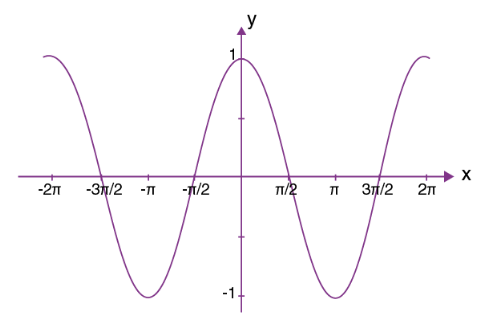
A cosine graph or (cos) graph is a top-down graph just like a (sin) graph. The only difference between a (sin) graph and a (cos) graph is that a sine graph starts at (0) while a cos graph starts at (90) (or (frac{pi }{2})). The (cos) plot given below starts at (1) and decreases to (-1) and then starts increasing again.



Related to This Article
More math articles
- Rational-choice voting
- The Ultimate NDSA Algebra 1 Course (+FREE Worksheets)
- Comparing and Ordering Fractions for 5th Grade: Unlike Denominators
- What’s The Best Laptop for Online Teaching?
- GED Test: Everything You Need to Know
- SHSAT Math Formulas
- Protest rights
- SIFT Math Flashcards (Free Online: Formulas, Terms & Concepts)
- Arizona Grade 2 Math Worksheets — Free Printable PDFs
- Top 10 Tips You MUST Know to Retake the TASC Math
What people say about "Graphing the Cosine Function: Full Guide"?
No one replied yet.